Free vs Paid Ad Promotion: Is Boosting Worth It?
Most classified platforms offer paid ways to make your listing more visible: bumping it to the top, highlighting it, featuring it on a homepage. Sometimes that is money well spent. Frequently it is money spent solving the wrong problem, because visibility was never what was holding the listing back.
What this covers
Key takeaways
- Promotion buys visibility, not desirability.
- If people are seeing your listing and not enquiring, more views will not help.
- It is most defensible on high-value items in crowded categories.
- Free improvements — better title, photographs, price — usually outperform paid promotion.
- List It Global has no paid ranking at all.
What promotion actually buys
| Type | What it does | Effect |
|---|---|---|
| Bump to top | Republishes as if newly listed | Short burst of views, then decays again |
| Highlight or border | Visual emphasis in results | Modest lift in click rate |
| Featured placement | Fixed position above organic results | Sustained visibility while paid for |
| Homepage or category spotlight | Shown outside normal results | Reaches browsers rather than searchers |
| Extended duration | Runs longer before expiry | Useful only for slow categories |
The problem it does not solve
This is the distinction that decides whether promotion is worth buying, and it is visible in your own view count.
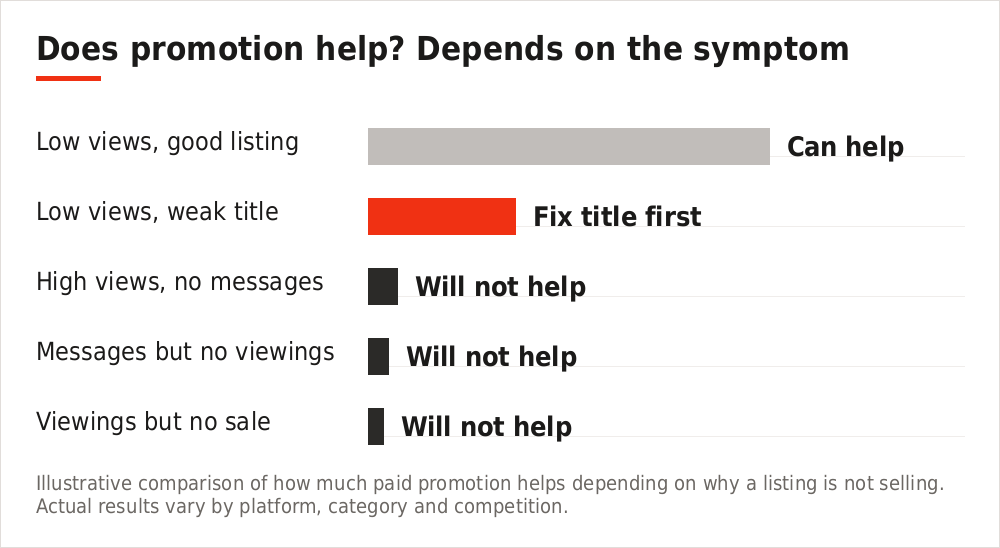
Illustrative comparison of how much paid promotion helps depending on why a listing is not selling. Actual results vary by platform, category and competition.
| Symptom | Real cause | Does promotion help? |
|---|---|---|
| Very few views | Discovery problem | Possibly — but fix the title first |
| Views, no messages | Price or photographs | No — more views changes nothing |
| Messages, no viewings | Description gaps | No |
| Viewings, no sale | Condition overstated | No |
| Only low offers | Priced above market | No |
If a hundred people have viewed your listing and none enquired, showing it to another hundred produces the same result. The information you already have is telling you the price or the photographs are wrong — and promotion cannot fix either.
When it is genuinely worth it
- High-value items where a small fee is trivial against the sale price
- Genuinely crowded categories where listings sink within hours
- Time pressure — you are moving and need it gone this week
- Business sellers with many listings competing for the same buyers
- After you have fixed everything free — good title, photographs and price already in place
- Seasonal peaks where a few days of visibility coincides with maximum demand
No paid ranking here
Results are driven by relevance and recency. No listing can be bought above another.
When it is wasted
- Low-value items — the fee can approach what the item is worth
- Before fixing the free things — title, category, photographs, price
- When views are already high — the problem is elsewhere
- Quiet categories where your listing was visible anyway
- Out of season — visibility to people who are not looking
- Repeatedly, on the same listing — if two bumps did not work, a third will not
Why platforms sell promotion at all
Worth understanding the incentive, because it explains why free listings feel harder to surface on some platforms than they used to.
A classified platform that charges nothing for listings needs revenue from somewhere. Promotion is the obvious answer: sellers pay voluntarily, and the more crowded a category becomes, the more valuable a paid position looks. The consequence is that as a platform grows, unpromoted listings can become progressively harder to see — not through any deliberate suppression, but simply because more paid positions sit above them.
| Platform model | Revenue from | Effect on free listings |
|---|---|---|
| Free with paid promotion | Optional visibility fees | Can be crowded out in busy categories |
| Commission marketplace | A share of each sale | Listing is free but the sale is not |
| Subscription | Recurring seller fees | Cost regardless of results |
| Advertising supported | Third-party advertising | Listings compete with display advertising |
Each is a legitimate way to fund a platform, and sellers should simply understand which one they are using. The practical question is whether your listing can be seen without paying, and that varies enormously between platforms and categories.
Comparing platforms on visibility cost
Before committing effort to any platform, it is worth checking how much of the first page is paid placement.
Search your category as a buyer would
Not as a seller. Use the terms someone looking for your item would type.
Count the promoted results
Look at how many of the top ten are marked as featured, sponsored or highlighted.
Judge how quickly listings sink
Check timestamps on the first page. If everything is from the last two hours, your listing has a very short window.
Factor promotion into your cost comparison
A free platform where you must pay to be seen is not free.
Free ways to improve visibility
Almost all of these outperform paid promotion, and none of them cost anything.
Rewrite the title with specifics
Brand, model, size, year. Buyers search for these, not for adjectives. This is the single biggest free improvement available.
Use the deepest correct category
An item left at the top level only appears in the broadest, most crowded view.
Pin your location accurately
Distance filtering removes you entirely if the location is vague.
Reshoot in daylight
The thumbnail decides whether anyone clicks. A brighter first image outperforms paid highlighting.
Publish at the right time
Sunday evening and weekday evenings see the most browsing, and recency ordering means timing matters.
Refresh rather than pay
New photographs and a revised price reach people who passed before, which a bump alone does not.
Working out whether it pays
Before buying promotion, answer three questions honestly.
- Is the fee small relative to the sale price? On a low-value item it rarely is.
- Is my view count genuinely low? If not, visibility is not the problem.
- Have I already fixed the free things? Title, category, location, photographs, price.
If the answer to any of those is no, spend the effort rather than the money. If all three are yes, promotion is a reasonable decision.
If you sell regularly
For traders the arithmetic is different, because promotion costs recur across every listing and compound quickly.
- Track cost per sale, not cost per listing
- Test on a subset rather than promoting everything
- Compare against listing on more platforms free instead
- Reserve promotion for slow-moving stock that is otherwise sound
- Improve the listings first — a template lift benefits every future listing at no cost
Frequently asked questions
Does bumping a listing actually work?
It produces a short burst of views, which helps only if low visibility was the problem. It changes nothing about price or presentation.
Should I promote a cheap item?
Rarely. The fee can approach the item value. Improve the title and photographs instead, or bundle it with other items.
Is promotion necessary on busy platforms?
In genuinely crowded categories on some platforms it materially affects visibility. There is no paid ranking at all on List It Global.
How do I know if visibility is my problem?
Check the view count. Low views means a discovery problem; high views with no messages means price or photographs.
Is it worth promoting more than once?
Generally no. If two attempts produced nothing, the problem is not visibility.
What is the best free alternative?
Rewriting the title with specific searchable terms, then reshooting the first photograph in daylight.
The short version
Check your view count first. Low views can sometimes justify promotion, but only after you have fixed the title, category, location and photographs. High views with no enquiries means the price or the pictures are wrong, and no amount of paid visibility will change that.
Free listings, no paid ranking
Nobody can buy their way above you. Free to post, free to sell, no commission.
Or start by browsing the marketplace to see comparable items.