

Local Ads, Global Reach: How Location Works Here
There is a false choice at the heart of classified advertising. Local sites reach the people who can collect but stop at a border. International sites reach everyone and are useless for a sofa. You are told to pick one. You should not have to, and on List It Global you do not.
What this covers
- Local is the default, not the option
- How location actually works
- The difference is the ceiling
- The numbers behind cross-border demand
- Who else sees your listing
- The audience nobody else reaches
- A second-hand market growing faster than retail
- When it matters and when it does not
- Thin markets and the small-town problem
- Writing a listing that works both ways
- Frequently asked questions
Key takeaways
- Your listing shows to nearby buyers first, exactly like a local classified site.
- Nothing about posting changes. You do not choose between local and international.
- The difference is that local reach has no upper limit here.
- The UN counted 304 million international migrants in 2024 — a measurable, motivated audience national platforms cannot serve.
- For a sofa, wider reach is irrelevant. For specialist items it is the whole game.
Local is the default, not the option
Open the site or app and it detects where you are. You see what is for sale near you, sorted by distance, filtered to your city or region. Somebody in Manchester sees Manchester listings. Somebody in Karachi sees Karachi listings.
That is the same experience Gumtree, Kijiji, OLX or Marktplaats give you. It is what a classified site should do, because the overwhelming majority of second-hand transactions are somebody driving over with a van and paying cash.
How location actually works
Your location is detected automatically
On first visit the site works out roughly where you are and shows nearby listings by default. No setup, no choosing a region from a list.
You set a search radius
Buyers narrow to their own city, or widen it when they are willing to travel for the right item.
Sellers pin one location
You post once, with your town or district. You never choose between a local listing and an international one, because there is no such distinction.
Anyone can change where they are browsing
Someone can look at another city entirely. Unusual behaviour for a sofa. Completely normal for someone about to relocate, or hunting a specific item they cannot find at home.
The difference is the ceiling
A national platform is a closed room. However good your listing is, the audience is capped at the border, and for most items that cap never matters.
Until it does. A specialist lathe, a vintage camera lens, left-hand-drive parts, a piece of professional equipment, a collectable with a following — these have a handful of plausible buyers in any one country and hundreds worldwide. On a national site the listing simply expires. Here the same listing, posted the same way, is still visible to whoever was actually looking for it.
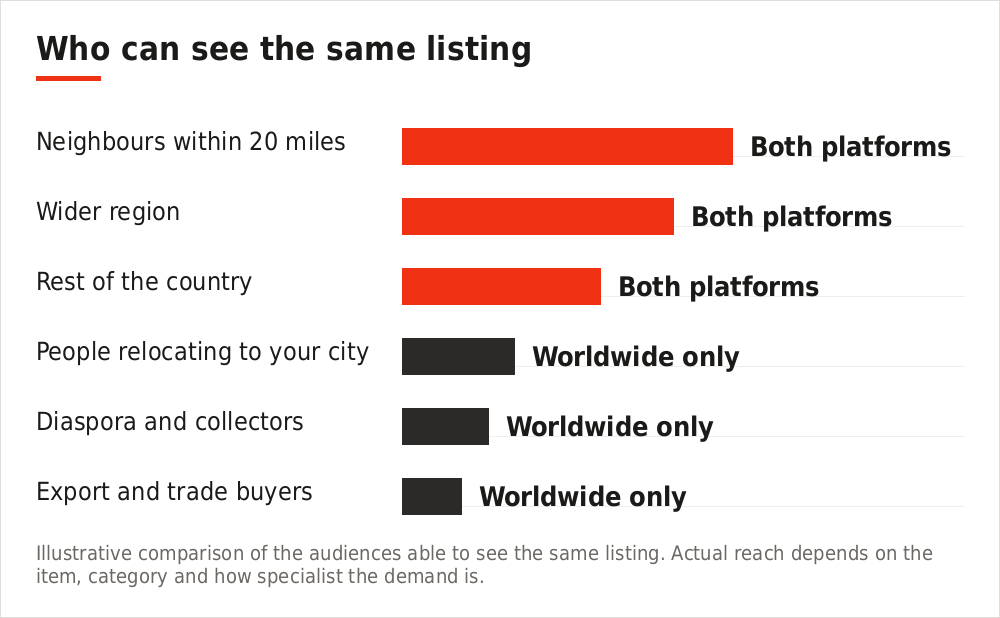
Illustrative comparison of the audiences able to see the same listing. Actual reach depends entirely on the item, its category and how specialist the demand is.
The numbers behind cross-border demand
The argument for reaching beyond your own country is usually made with vague talk about a connected world. It is worth replacing that with actual figures, because the scale is larger than most sellers assume.
According to United Nations DESA estimates, 304 million people were living outside their country of birth in 2024 — roughly 3.7% of the world population. That figure has nearly doubled since 1990, when it stood at about 154 million, and it is close to four times the 1960 level. Between 2020 and 2024 alone the migrant population grew around 10%, roughly three times faster than the world population as a whole.
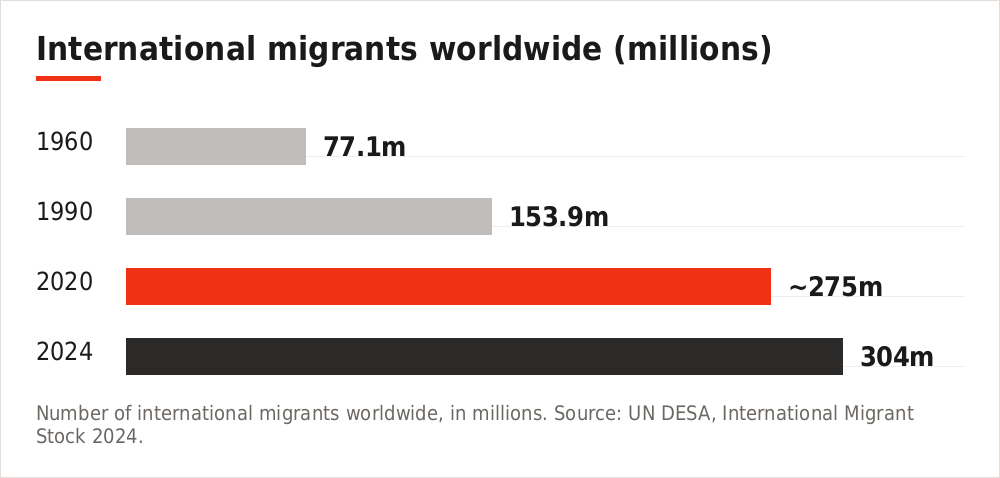
Number of international migrants worldwide, in millions. Source: United Nations Department of Economic and Social Affairs, International Migrant Stock 2024.
Every one of those people arrived somewhere and had to furnish a home. A large share will move again. Some send goods back to family in another country. This is not an abstract audience — it is a third of a billion people whose buying and selling is inherently cross-border, and who are poorly served by platforms that assume everybody is already local and staying put.
The UN figures put the immigrant share of the population at roughly 77% in Qatar and 74% in the United Arab Emirates. In markets like these, the majority of people advertising and buying are people who arrived from somewhere else and will eventually leave. A platform that only thinks in national terms is misreading almost the entire market.
Who else sees your listing
Beyond the neighbours who would have seen it anyway, five groups can find it here that could not find it on a national site.
| Audience | What they are looking for | Typical items |
|---|---|---|
| People relocating to your city | Furnishing a home before they land | Furniture, appliances, vehicles |
| Diaspora buyers | Goods from a particular country | Traditional items, textiles, food equipment |
| Collectors and enthusiasts | A specific model or edition | Cameras, watches, instruments, vinyl |
| Trade and export buyers | Stock they already ship routinely | Vehicles, machinery, plant, job lots |
| Search engine traffic | The item by name, not a marketplace | Anything with a model number |
You do not pay more, tick a box, write a second listing or manage anything extra. The additional audience is a property of the platform, not a product you buy.
Post once. Local buyers first.
Free to list, no commission, and buyers near you see it by default.
The audience nobody else reaches
Of those five groups, the most underrated is people who are about to move to your city.
Someone relocating to Dubai in six weeks, or starting a job in Toronto in the spring, browses that city’s listings long before they arrive. They are furnishing an empty flat and they want a whole home’s worth of things from as few sellers as possible. They are motivated, they have a deadline, and they frequently buy several items at once.
On a national platform they cannot browse a destination until they get there, because the site assumes everyone is already local. Here they can look at any city from anywhere, which means your listing reaches them while they are still planning.
If you are the one moving, you can browse your destination city now and line up furniture before you land. And if you are leaving, the people arriving are precisely the buyers for everything you cannot take with you. See our guide to selling everything before you move abroad.
A second-hand market growing faster than retail
The other reason reach matters is that the pool of people buying used goods is expanding quickly.
Analysis published by Boston Consulting Group with Vestiaire Collective put the second-hand market at roughly 210 to 220 billion dollars, growing at about 10% a year — roughly three times the pace of the equivalent first-hand market. Separate research from GlobalData for ThredUp projects the global second-hand apparel market alone reaching around 393 billion dollars by 2030, with younger buyers driving the majority of that growth.
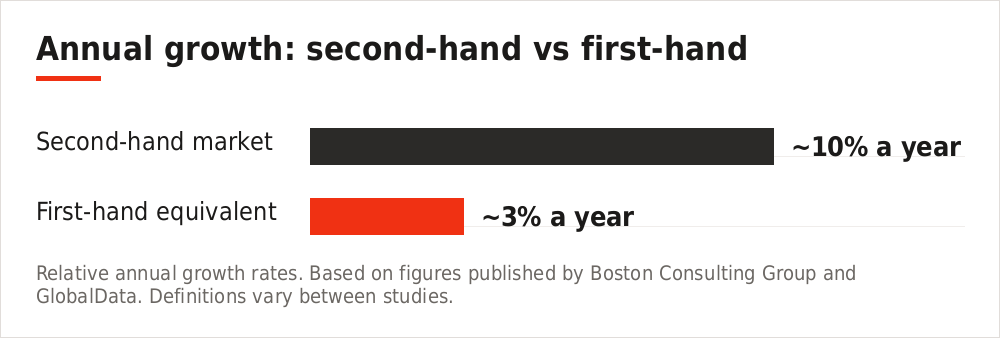
Relative annual growth rates, second-hand versus first-hand markets. Based on figures published by Boston Consulting Group and GlobalData. Category definitions vary between studies, so treat these as directional rather than precise.
For a seller this matters in a practical way. More buyers are willing to consider used goods than five years ago, they are increasingly comfortable buying at a distance, and they research specific models before they buy. That is exactly the buyer a detailed listing with a searchable title reaches — wherever they happen to live.
When it matters and when it does not
Being honest about this is more useful than overselling it.
| Item | Does wider reach help? |
|---|---|
| Sofa, wardrobe, washing machine | No — collection only, local is everything |
| Everyday phone or laptop | Marginally — plenty of local buyers already |
| Bicycle, garden tools | Rarely — transport cost decides it |
| Specialist or professional equipment | Substantially — few buyers anywhere |
| Collectables, watches, instruments | Substantially — buyers are wherever collectors are |
| Vehicles, machinery, job lots | Substantially — an established export trade |
| Anything in a small town | Substantially — the local pool is simply too thin |
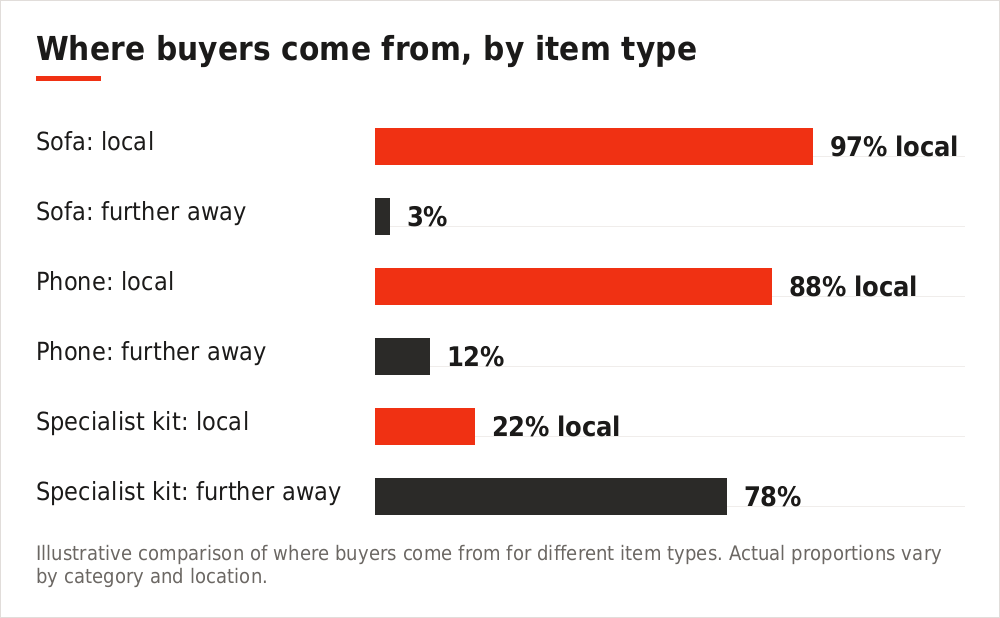
Illustrative comparison of where buyers come from for different item types. Actual proportions vary by category, location and how niche the demand is.
For most household items the honest answer is that local buyers will sell it, and the wider audience changes nothing. The point is not that every listing needs the world. It is that you never have to work out in advance which of your listings does.
Thin markets and the small-town problem
There is one group for whom this is not a marginal benefit but the entire difference between selling and not: people who do not live in a major city.
If your town has forty thousand people, the number who want a specific piece of equipment in the next two months may genuinely be zero. That is not a pricing problem or a photography problem, and no amount of relisting fixes it. The item is fine. The buyer pool is too small.
- Rural sellers face this constantly with machinery, tools and equipment
- Smaller countries have the same issue at national scale for niche goods
- Specialist categories are thin even in large cities
- Out-of-season items face an artificially thin market until demand returns
In each case the answer is the same: widen the radius rather than cut the price. An item nobody within thirty miles wants is not worth less — it is simply in the wrong place, and a platform without a ceiling lets the right buyer find it.
Writing a listing that works both ways
A handful of habits cost nothing and make a listing readable to a neighbour and to somebody three time zones away.
- Put the make, model and exact specification in the title — distant buyers search by model, not by browsing
- Give measurements in centimetres and weight in kilograms alongside whatever is local
- Name the town or district in the text, not just the location field
- Say whether you will post it — many buyers assume collection only and move on
- State the voltage and plug type for anything electrical
- Avoid local shorthand that means nothing outside your region
- Include key terms in a second language where your area is bilingual
- Add a short video for anything mechanical — it replaces a viewing
Price the item at what it is worth locally. If a distant buyer wants it badly enough to arrange shipping, that is a bonus, not a reason to inflate the asking price and lose the local sale you would otherwise have made.
Frequently asked questions
Do I have to choose local or worldwide when posting?
No. There is no such setting. You pin one location and nearby buyers see it first, exactly as on a local site.
Will local buyers still find my ad?
Yes — they are the default audience. Location is detected automatically and results are sorted by distance.
Can someone abroad really see my listing?
Yes, if they change the area they are browsing or search for the item directly. For most household goods few will, and that costs you nothing.
Do I have to ship anywhere?
Never. State collection only if that is what you want. Nothing obliges you to post an item.
Does a wider audience mean more time-wasters?
Not materially. A complete listing with full specifications and a firm price filters enquiries far better than restricting who can see it.
I live in a small town. Is this useful?
More than anywhere. Thin local markets are exactly where a wider audience makes the difference between selling and not selling at all.
Where do the figures in this article come from?
Migration figures are United Nations DESA International Migrant Stock 2024 estimates. Second-hand market figures are from Boston Consulting Group and from GlobalData research published by ThredUp.
The short version
Your listing behaves like a local classified ad, because that is what it is. Nearby buyers see it first, sorted by distance, and most items will sell to somebody within driving range. The difference is that when local demand runs out — in a small town, in a niche category, or for something only a few hundred people worldwide actually want — your listing does not stop working.
Local reach, without the ceiling
Free to post, free to sell, no commission and no paid ranking.
Or browse what is listed near you to see how location filtering works.