



Moving Abroad? How to Sell Everything Before You Go
Almost everyone who relocates leaves it too late. Six weeks feels like plenty of time until you realise a sofa takes three weeks to sell, nobody wants a fridge in the final fortnight, and the last evening ends with you giving away things you paid good money for. Starting early is worth more than any pricing trick.
What this covers
Key takeaways
- Start eight weeks out, not two. Furniture and appliances are the bottleneck.
- Sell in reverse order of need — spare rooms first, bed and kettle last.
- Shipping usually costs more than the item is worth. Do the maths per item, not per container.
- Saying you are relocating is an honest reason for a keen price and buyers respond well to it.
- Vehicles need the most lead time because of finance settlement and transfer paperwork.
The timeline that actually works
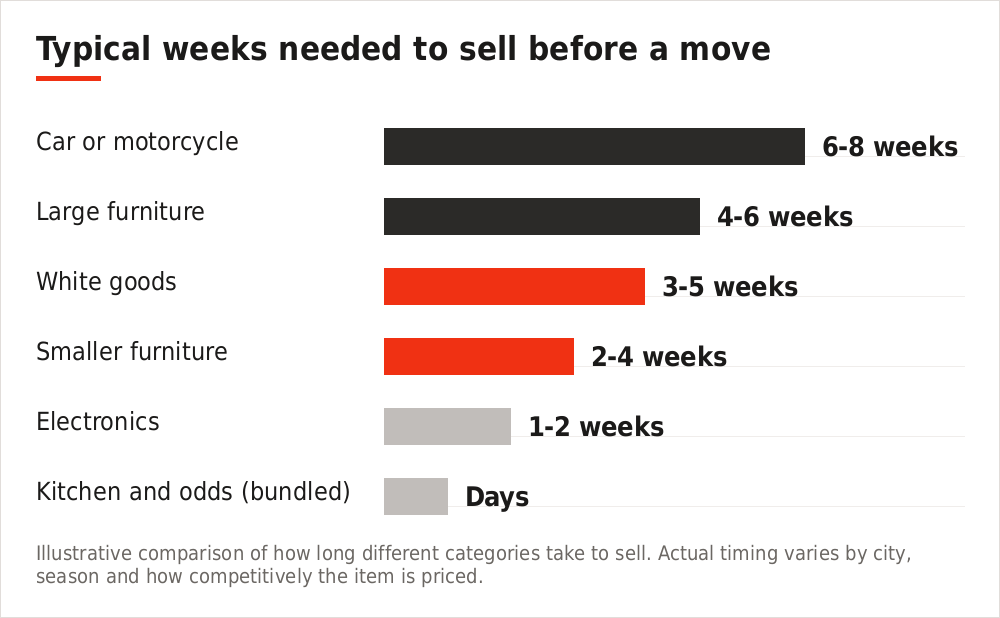
Illustrative comparison of how long different categories take to sell. Actual timing varies by city, season and how competitively the item is priced.
| When | What to do |
|---|---|
| 8 weeks out | Vehicle listed. Settle any outstanding finance now — it takes longer than you think |
| 6 weeks | Large furniture, appliances, anything needing a van |
| 4 weeks | Smaller furniture, electronics, bicycles, garden and sports equipment |
| 3 weeks | Decide what ships. Get a firm shipping quote before selling anything borderline |
| 2 weeks | Kitchenware, soft furnishings, remaining electronics. Start bundling |
| 1 week | Bed, sofa, fridge, washing machine — the things you used until the end |
| Final days | Bundle the remainder as a job lot or arrange a charity collection |
Sell in reverse order of need
Work through the home in the order you can most afford to lose things.
Spare rooms and storage first
Guest beds, unused desks, boxed items, the contents of the cupboard nobody opens. You lose nothing by selling these eight weeks out.
Then decorative and duplicate items
Second televisions, spare chairs, art, rugs, anything you own two of.
Then daily-use furniture
Dining table, wardrobe, coffee table. You can live around their absence for a fortnight.
Essentials last
Bed, fridge, washing machine, kettle. Price these to move quickly because you have no time left to negotiate.
Take all your photographs while the home is still tidy and full. Trying to photograph a sofa in a half-empty flat surrounded by boxes produces listings that look like a fire sale, and buyers price accordingly.
Sell, ship, donate or bin
Most people ship far too much. Shipping is priced by volume, so bulky low-value items are exactly what you should not be paying to move.
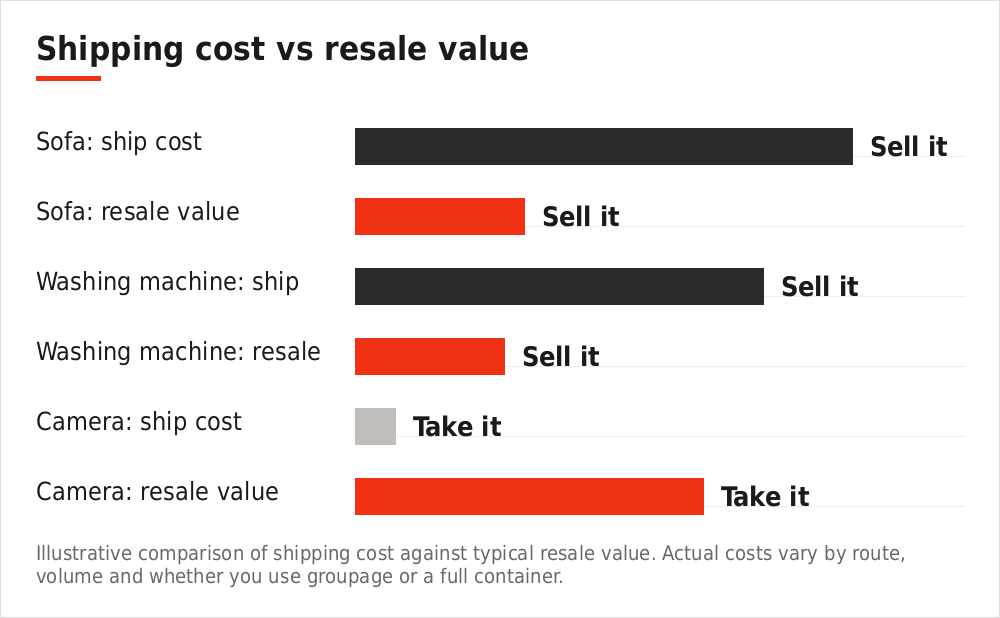
Illustrative comparison of shipping cost against typical resale value. Actual costs vary by route, volume and whether you use groupage or a full container.
| Category | Usually | Why |
|---|---|---|
| Sofas, beds, wardrobes | Sell | Volume makes shipping cost more than replacement |
| White goods | Sell | Heavy, and voltage or plug standards may not match |
| Books and media | Sell or donate | Extremely heavy for their value |
| Kitchenware | Bundle and sell | Cheap to replace, tedious to pack |
| Laptops, cameras, jewellery | Take with you | High value, low volume — hand luggage |
| Quality tools | Judge individually | Hold value well and are compact |
| Sentimental items | Ship | The one category where cost is not the deciding factor |
A firm quote changes decisions. People routinely sell a good dining table for very little, then discover the shipping quote had room for it. Quote first, then decide, then list.
List everything free, in one place
Unlimited free listings, no commission, and buyers can filter by distance for collection.
Pricing against a deadline
Normal pricing advice assumes you can wait. You cannot, and pretending otherwise costs money.
- Price at market while you still have six weeks — you can afford to hold
- Reduce by 10–15% at the halfway point if there is no genuine interest
- In the final fortnight, price to clear — an item unsold on the day is worth nothing
- Decide your walk-away number in advance for each item
- Accept the first fair offer late on. Holding out for slightly more usually loses the sale entirely
- Do not list everything at once — stagger it, so something of yours is always recent in results
The things nobody wants individually
Cleaning supplies, half-used toiletries, plants, kitchen odds, cables, coat hangers, storage boxes. Individually these are unsellable and collectively they are the reason the last week is so stressful.
- Bundle by room — a kitchen lot, a bathroom lot, a cleaning cupboard lot
- Photograph the whole lot laid out so buyers see what they are getting
- Price for clearance, not per item
- Offer it to whoever buys your furniture — they are already coming with a van
- Plants go early — they cannot travel and nobody wants them at the last minute
Saying you are leaving
Some sellers hide the deadline, worried buyers will lowball. In practice stating it plainly works better.
“Relocating on the 30th, everything must go” explains why a good item is keenly priced. Without that context a low price reads as suspicious. With it, the listing reads as a genuine opportunity — and it attracts exactly the buyers who want to take several things at once.
People furnishing a home look specifically for relocation sales, because they can get a whole flat’s worth of furniture from one address in one trip. Being explicit puts you in front of them.
Vehicles need the longest lead time
Settle outstanding finance first
You cannot transfer a vehicle with a loan against it. Request the settlement figure the moment you know you are leaving.
Gather the paperwork
Registration document, service history, roadworthiness certificate, and anything proving the vehicle is clear of claims.
List it eight weeks out
Vehicles attract fewer, slower buyers than furniture, and the transfer process itself takes time.
Complete the transfer properly
Until ownership is formally transferred, fines and liabilities remain yours — and you will be in another country.
Never agree to finish the paperwork later
This is the single most common way relocating sellers end up with problems they cannot resolve remotely.
The final week
- Group collections into set windows rather than agreeing to a dozen separate times
- Be honest about access — floor, lift, stairs, parking. A buyer who cannot get it out will not take it
- Take cash or confirm cleared transfers before items leave
- Have a charity collection booked as a backstop for whatever does not sell
- Keep one set of essentials aside and label it clearly so it is not sold by accident
- Remove every listing as it sells, so you are not fielding messages from an airport
Admin that catches people out
- Wipe every device before selling — sign out of accounts first, then factory reset
- Check the car for documents in the glovebox before handover
- Cancel utilities after your last collection day, not before — buyers may need lights and lifts
- Keep a record of what sold and for how much if you are settling accounts with a partner or landlord
- Check tenancy terms on fixtures — some items you think are yours may belong to the landlord
- Leave a forwarding contact in case a buyer needs to reach you
Frequently asked questions
How early should I start?
Eight weeks for a full household, and immediately if you have a vehicle. Two weeks is not enough for anything bulky.
Is it cheaper to ship or replace?
For furniture and white goods, almost always cheaper to sell and replace. For high-value, low-volume items, ship or carry them.
Should I say I am relocating?
Yes. It explains a keen price honestly and attracts buyers who want several items at once.
What do I do with what does not sell?
Bundle it as a free or very cheap job lot in the final days, or book a charity collection in advance as a backstop.
Can I sell a car with finance on it?
Not until the finance is settled. Request the settlement figure as soon as you know you are leaving, because it takes time.
How do I handle collections in the last week?
Set two or three collection windows and group buyers into them. Agreeing individual times across a week is unmanageable while packing.
The short version
Start eight weeks out and photograph everything while the home still looks lived in. Sell in reverse order of need. Get a shipping quote before deciding what goes. Say plainly that you are relocating. Deal with the vehicle first, and book a charity collection as your backstop.
Selling up before you fly?
List everything free in one place. No commission, and buyers nearby can filter by distance.
You can also browse listings across 238 countries to see what similar items are fetching.