



Clearing a House or Estate: A Practical Guide to Selling
Selling for someone else — a relative who has died, a parent moving into care, an estate you are responsible for — is different from clearing your own possessions. There is more to sort through, less knowledge of what things are, and usually other people with an interest in the outcome. A methodical approach makes it considerably less overwhelming.
What this covers
Key takeaways
- Confirm you have authority to sell before listing anything from an estate.
- Sort everything before valuing anything — you cannot price what you have not catalogued.
- Get specialist items valued properly rather than guessing.
- Keep a record of what sold and for how much, for everyone involved.
- There is no need to rush. Take longer than feels necessary.
Establish authority before selling anything
Selling assets from an estate before you have legal authority can create serious problems, including personal liability. Requirements differ by country, but generally an executor or administrator must be formally appointed before estate property is disposed of. If someone is alive but unable to manage their affairs, a power of attorney or equivalent is usually required. Take legal advice if you are unsure — this is not an area to assume.
- Confirm who is legally entitled to deal with the property
- Check whether a grant of probate or equivalent is needed first
- Identify anything specifically bequeathed to a named person — it is not yours to sell
- Agree the approach with other beneficiaries before starting
- Check for outstanding finance on vehicles and larger items
- Confirm insurance remains in place while property sits unoccupied
Sorting before valuing
The instinct is to start pricing immediately. Resist it. Until everything is sorted you do not know what you have, and items get sold cheaply simply because nobody realised what they were.
Work one room at a time
Complete a room fully before moving on. Working everywhere at once is how weeks disappear with nothing finished.
Use four categories
Keep, sell, donate, dispose. Every item goes into one, and nothing goes back into an undecided pile.
Check inside everything
Pockets, books, envelopes, tins, the backs of drawers. Documents, jewellery and cash turn up regularly.
Photograph as you go
Particularly anything you are unsure about. It makes seeking opinions much easier later.
Set aside anything unidentified
Rather than guessing. The unfamiliar things are where value most often hides.
What people routinely undervalue
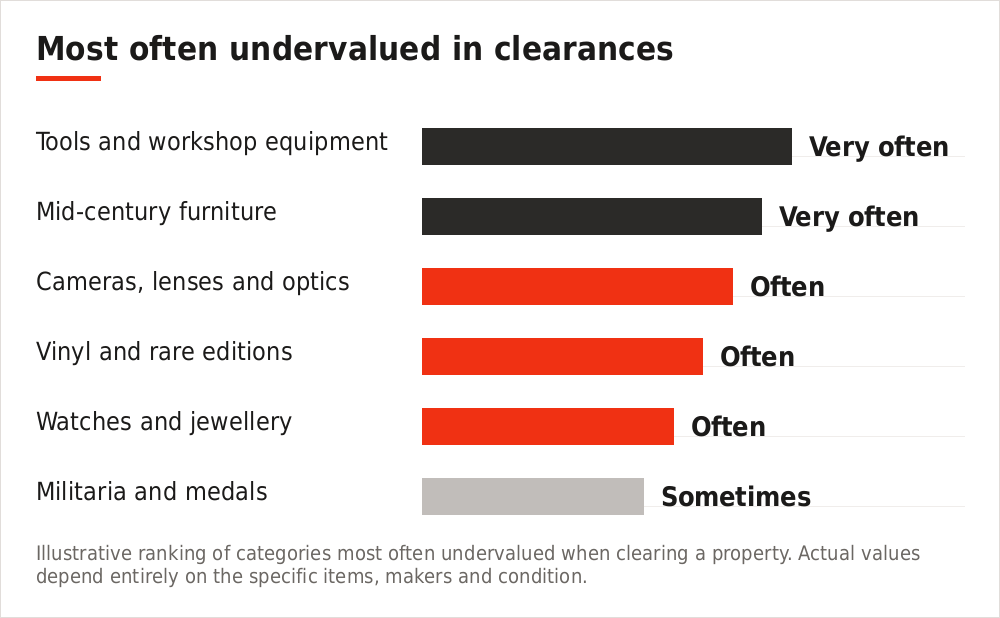
Illustrative ranking of categories most often undervalued when clearing a property. Actual values depend entirely on the specific items, makers and condition.
| Category | Why it is missed |
|---|---|
| Mid-century furniture | Looks dated rather than collectable to an untrained eye |
| Tools and workshop equipment | Older quality tools hold value remarkably well |
| Cameras, lenses and optics | Assumed obsolete; frequently sought after |
| Watches and costume jewellery | Dismissed without checking makers marks |
| Vinyl, books and ephemera | Value concentrated in specific pressings and editions |
| Musical instruments | Condition looks poor but the instrument may be good |
| Militaria and medals | Specialist market unfamiliar to most people |
| Sewing and craft equipment | Quality older machines are actively sought |
List individually, free, at your own pace
60-day listings, free renewal, no commission at any value.
Getting things valued
- Research sold prices, not asking prices, for anything you recognise
- Photograph makers marks and stamps and search those specifically
- Get a formal valuation for anything potentially significant — it may also be required for probate
- Ask more than one specialist for genuinely valuable items
- Be cautious of anyone offering to buy while valuing — those interests conflict
- Do not restore or clean antiques and collectables before valuation
People approach recently bereaved families offering to buy contents quickly. Some are legitimate; others rely on the family not knowing what things are worth and wanting the process over. Never accept an on-the-spot offer for anything you have not had valued independently.
What to sell in what order
| Order | What | Why |
|---|---|---|
| First | Vehicles | Insurance, tax and depreciation continue |
| Early | Specialist and valuable items | Take longest to find the right buyer |
| Middle | Furniture and appliances | Needed while clearing continues |
| Later | Smaller household goods | Bundle where individually low value |
| Last | Remainder | Donate or clear |
House clearance versus selling individually
Both are legitimate. The right answer depends on how much time you have and what is actually there.
| Clearance company | Selling individually |
|---|---|
| Fast — days rather than months | Slow — weeks or months |
| Much lower return | Substantially higher return |
| No effort required | Considerable effort |
| Risk of valuable items leaving cheaply | You control what goes and for how much |
| Sensible for bulk low-value contents | Sensible where quality items exist |
The usual answer is both: sell the identifiable value individually, then use a clearance service for the remainder. What you should not do is clear the house first and sell afterwards.
Keeping records
- List every item sold with the date and price
- Keep valuations and any specialist correspondence
- Retain receipts for anything of significance
- Share the record with other beneficiaries as you go
- Note what was donated and to whom
- Keep it all together — estate accounts may require it
Family disagreements about estate contents are common and usually arise from absence of information rather than bad faith. A simple shared spreadsheet showing what sold and for how much removes most of that risk entirely.
Giving yourself time
This is practical advice rather than sentiment. Decisions made quickly under pressure are the ones people regret, and items sold in a rush are the ones sold too cheaply.
- Do not start immediately unless a property deadline forces it
- Set aside anything you are unsure about keeping and revisit later
- Work in short sessions rather than long ones
- Ask for help with the physical work
- Photograph things before they go if that matters to anyone
- Accept that some things will simply be disposed of — that is normal
Frequently asked questions
Can I sell before probate is granted?
Rules vary by country, and selling estate assets without authority can create personal liability. Check your position, and take legal advice if unsure.
How do I know if something is valuable?
Photograph any makers marks and search those specifically. Where there is real doubt, get a specialist valuation rather than guessing.
Should I use a house clearance company?
Often yes, for the bulk remainder — but sell identifiable value individually first, not afterwards.
What about items left to specific people?
Those are not yours to sell. Identify them early and set them aside before anything else begins.
Should I clean things before selling?
Ordinary household items yes. Antiques, collectables and anything potentially valuable, no — cleaning frequently reduces value.
How long does this usually take?
Longer than expected. Several months is normal, and there is rarely any advantage in compressing it.
The short version
Confirm you have authority to sell before listing anything. Sort completely before valuing. Get specialist items looked at properly and never accept doorstep offers. Sell the value individually and clear the remainder. Keep a record for everyone involved. And take longer than feels necessary.
No deadline, no commission
Free listings, free renewals, and whatever you sell for is what you keep.
Or browse by category and location to check the local market first.