


How to Sell Collectables and Antiques
Collectables are the category where the gap between a careless listing and a careful one is widest. The same object can fetch a modest sum from a passing buyer or a serious price from someone who has been searching for it for years — and the difference is almost entirely in how you identify and describe it.
What this covers
Key takeaways
- Identify the exact edition, maker or variant before pricing anything.
- Never clean, polish or restore — it frequently destroys value.
- Research sold prices, not asking prices.
- Describe condition against recognised grading, and disclose every flaw.
- Never claim an attribution you cannot support.
Identify before you price
In most categories a rough description is enough. In collectables it is the difference between two figures that may be an order of magnitude apart.
- Maker marks, stamps and signatures — photograph and search these specifically
- Edition, pressing or print run — first editions and early pressings differ hugely from later ones
- Catalogue or reference numbers where a standard reference exists
- Date and period, established rather than guessed
- Country of manufacture — often distinguishes variants
- Matrix and runout details for records
- Serial numbers for instruments, watches and equipment
Condition is everything
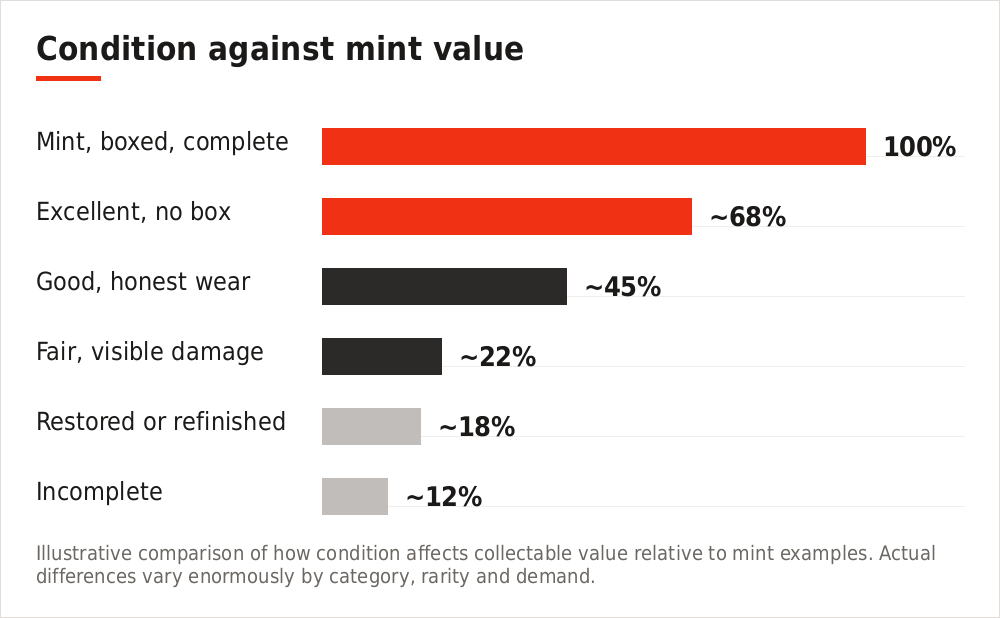
Illustrative comparison of how condition affects collectable value relative to mint examples. Actual differences vary enormously by category, rarity and demand.
Most collecting fields use established grading language, and using it correctly signals that you know what you have. Using it loosely does the opposite.
| Element | Why collectors care |
|---|---|
| Original packaging | Frequently worth a substantial share of total value |
| Completeness | Missing components can halve the value |
| Original finish | Refinished items are worth far less |
| Paperwork and receipts | Establishes provenance |
| Storage history | Damp, sunlight and heat cause invisible degradation |
| Previous repairs | Must be disclosed; affect value significantly |
Why you should not clean or restore
Polishing metal, refinishing wood, cleaning coins, washing textiles, retouching paint — all routinely reduce value substantially and sometimes destroy it entirely. Collectors want original surfaces, including the patina and honest wear that comes with age. Leave it exactly as you found it and let the buyer decide.
The only safe intervention is removing loose dust. Anything beyond that should wait until a specialist has seen it, and frequently should not happen at all.
Working out what it is worth
Find sold prices, not asking prices
Anyone can ask anything. Completed sales for the same edition in the same condition are the only reliable guide.
Match condition precisely
A mint example and a worn one are different products at different prices, not the same item with a discount.
Check specialist references
Most established fields have price guides, catalogues or collector forums.
Get a valuation for anything significant
And ask more than one specialist where real value is possible.
Be wary of anyone valuing and offering to buy
Those interests conflict directly.
Reach collectors worldwide
238 countries, free to list, no commission at any value.
Photographing collectables
- Natural light, plain background, no filters whatsoever
- Every maker mark and stamp, sharply focused and readable
- All sides, including the base and reverse
- Every flaw, photographed deliberately rather than hidden
- Something for scale where size is not obvious
- Original packaging and paperwork if present
- Serial or edition numbers clearly legible
Collectors assume that anything not photographed is being concealed. A listing that clearly shows the chip, the scratch and the foxing reads as trustworthy, and the rest of your description becomes credible as a result.
Writing the listing
Title: Maker + Item + Edition or date + Condition.
Include the exact terms collectors search for. They are looking for a specific reference, not browsing a category, and a vague title never reaches them.
The description should cover identification, all markings, dimensions, condition against recognised grading, every flaw, completeness, provenance where known, and storage history.
Authenticity and honest description
If you are not certain an item is genuine, say so plainly. Phrases like “bearing a mark for”, “in the style of” or “unverified, sold as seen” are honest and protect you. Asserting an attribution you cannot evidence invites a legitimate dispute and, where the item is a reproduction, potentially worse.
- Describe what you can see, not what you hope it is
- State how you acquired it where that adds provenance
- Disclose any restoration you know about
- Never remove or alter marks to make something look older
- Check reproduction is legal to sell in your jurisdiction and clearly labelled
Where and how to sell
| Route | Suits | Cost |
|---|---|---|
| International classifieds | Anything with dispersed buyers | Free |
| Specialist auction | High-value, authenticated items | Substantial commission |
| Collector forums and fairs | Knowledgeable buyers | Varies |
| Dealer sale | Speed over price | Well below retail |
| General local platform | Poor fit — buyers are elsewhere | Free |
Collectables are the clearest case for listing internationally. The buyer for a specific edition is wherever that collector happens to live, and restricting the listing to your own country is usually the decision that costs the most.
Packing collectables for shipping
Once you are selling to distant buyers, packing becomes part of the transaction. Damage in transit turns a good sale into a dispute, and the seller usually absorbs it.
Photograph the item and the packing process
Every stage, including the sealed parcel. This is your only evidence if a claim arises.
Double-box anything fragile
An inner box with the item well cushioned, inside a larger box with padding on all six sides. Single boxes fail.
Immobilise, do not just cushion
An item that can move inside the box will move for the entire journey. Fill every void.
Protect paper and textiles from moisture
Sealed plastic inside the box, because parcels sit outdoors more often than people assume.
Insure for the full sale value
Standard carrier cover is usually far below what a collectable is worth.
Do not label the contents as valuable
A parcel marked as containing antiques or collectables invites attention it does not need.
For genuinely valuable pieces, dealers and collectors frequently prefer to send their own specialist shipper. Provided payment has cleared first, that moves transit risk to them and is usually better for both parties.
What matters in different collecting fields
| Field | What buyers check first |
|---|---|
| Records | Matrix and runout codes, label variant, sleeve and vinyl graded separately |
| Books | Edition, printing, dust jacket condition, inscriptions |
| Coins and stamps | Grade, mint mark, never cleaned |
| Watches | Reference and serial, original parts, service history, box and papers |
| Cameras | Serial, shutter function, glass condition, fungus and haze |
| Toys and models | Boxed condition, completeness, original finish |
| Ceramics and glass | Maker mark, chips and hairline cracks, restoration |
| Militaria | Provenance, authenticity, legality of sale |
Each field has its own vocabulary, and using it correctly tells buyers you understand what you have. Searching the terms that appear in comparable listings is the quickest way to learn it.
Frequently asked questions
Should I clean it first?
No. Cleaning, polishing and restoring routinely reduce value substantially. Remove loose dust and nothing more.
How do I know what edition I have?
Photograph every mark and search those specifically. Most collecting fields have references distinguishing variants.
What if I am unsure it is genuine?
Say so in the listing. Honest uncertainty is respected; unsupported claims are not.
Is an auction better than selling directly?
For very high-value authenticated items, sometimes. Commission is substantial, so weigh it against selling directly.
Do collectors really buy internationally?
Routinely. They arrange shipping without hesitation for the right item.
Should I split a collection or sell it whole?
Usually individually for identifiable value, though complete matched sets can be worth more together.
The short version
Identify the exact edition before pricing anything. Do not clean or restore. Research sold prices in matching condition. Photograph every mark and every flaw deliberately. Never claim an attribution you cannot support. And list internationally, because your buyer is probably not local.
The right collector may be anywhere
238 countries, free to list, no commission at any value.
Or start by browsing the marketplace to see comparable items.