


Do You Pay Taxes When You Sell Stuff Online? 1099-K Rules for 2026
If you sell your own used things online for less than you paid for them, you do not owe tax on that money. Tax only comes into it when you sell something for a profit, or when you buy things in order to resell them, which makes it a business. Receiving a Form 1099-K from PayPal, Venmo or eBay does not change those rules. For 2026, the federal trigger for a 1099-K is back to more than $20,000 in payments and more than 200 transactions, though a few states still use a $600 limit. This guide explains who gets a 1099-K in January 2027, when selling your stuff is taxable, and exactly what to do if a form shows up.
Thresholds and filing steps are taken from the IRS’s Form 1099-K FAQs, updated after the One, Big, Beautiful Bill, and from PayPal’s state threshold list. This is general information, not tax advice. If you sold a lot or ran a side business, talk to a tax professional.
What this covers
Key takeaways
- Selling personal items at a loss is not taxable, and the loss is not deductible either. Most used goods sell for less than they cost.
- A profit is taxable as a capital gain, and collectibles such as coins and art can be taxed at up to 28%.
- The federal 1099-K threshold for 2026 is more than $20,000 and more than 200 transactions, after the One, Big, Beautiful Bill scrapped the planned $600 rule.
- Vermont, Massachusetts, Virginia and Maryland still use $600, and Illinois uses $1,000 with four or more transactions, so residents there get forms far sooner.
- Gifts and shared bills are not sales. Payments for goods or services are what get reported.
The short answer: is it taxable?
The IRS treats almost everything you own for personal use as a capital asset. Sell it for more than you paid and the difference is a taxable gain. Sell it for less and there is no tax, but you cannot deduct the loss either. The IRS states it plainly: the loss on the sale of a personal item is not deductible, and the gain on the sale of a personal item is taxable.
| What you sold | Taxable? |
|---|---|
| Your old sofa, bought for $1,200, sold for $350 | No. You sold at a loss. |
| A phone, laptop or bike you used yourself, sold below cost | No. Same rule, however many items you sell. |
| A sports card bought for $40 and sold for $400 | Yes. The $360 profit is a capital gain. |
| Concert tickets resold above what you paid | Yes. The profit is taxable. |
| Thrift-store finds you buy in order to flip | Yes. That is business income, reported on Schedule C. |
| Friends paying you back for dinner or rent | No. Shared costs and gifts are not sales. |
Compare what you sold it for with what you paid. If the sale price is lower and the item was for your own use, there is nothing to pay. Keep proof of what you paid in case you are asked.
What Form 1099-K is
Form 1099-K is an information return. Payment apps and online marketplaces, which the IRS calls third-party settlement organizations, use it to report the payments you received for selling goods or services. Card processors use it to report card payments to businesses. A copy goes to you and a copy goes to the IRS, which is why it matters that the numbers on your return make sense next to it.
Two things often get mixed up. First, the form reports gross payments, not profit. A $900 total on your 1099-K says nothing about what you originally paid for the items. Second, the threshold only decides whether a platform has to send the form. In the IRS’s words, all income is taxable unless the tax law says it isn’t, even if you don’t get a Form 1099-K. The reverse is true too: getting a form does not make untaxable money taxable.
The 1099-K threshold for 2026
For tax year 2026, the forms that arrive in early 2027, a payment app or marketplace has to file a 1099-K only when your payments for goods and services pass $20,000 and you had more than 200 transactions on that platform. Both conditions must be met. Someone who sells a $25,000 car through one payment would not get a federal 1099-K, and nor would someone with 300 sales totalling $4,000.
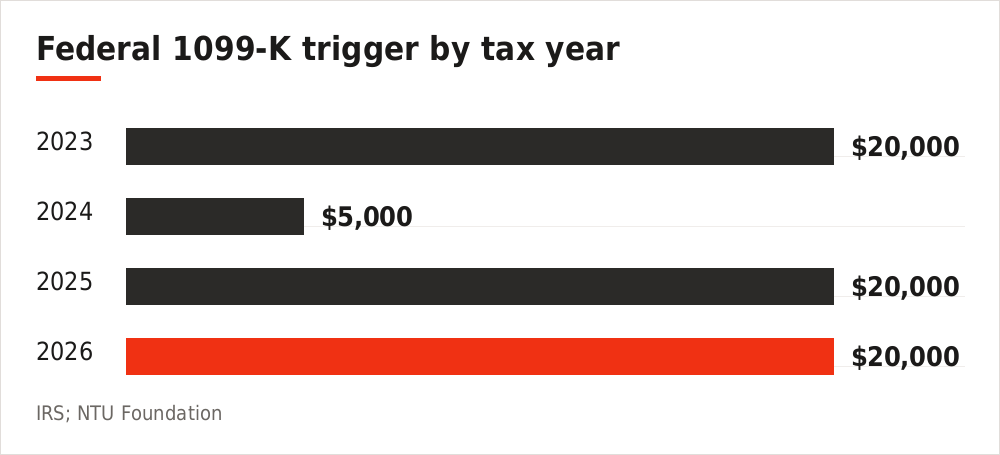
The payment level that triggers a federal Form 1099-K, by tax year. Every year shown except 2024 also requires more than 200 transactions. Sources: IRS, National Taxpayers Union Foundation.
It has been a bumpy road. The American Rescue Plan Act of 2021 cut the threshold from $20,000 and 200 transactions to just $600 with no transaction minimum. The IRS delayed it twice, used $5,000 for 2024, and planned $2,500 for 2025 and $600 for 2026. At the time, the IRS expected the $600 rule to push the number of 1099-Ks it received to about 44 million, up from roughly 14 million. Then the One, Big, Beautiful Bill, signed in July 2025, retroactively restored the original $20,000 and 200-transaction test. The IRS confirmed the change in its updated FAQs in October 2025.
| Tax year | Federal trigger used |
|---|---|
| 2022 and 2023 | More than $20,000 and 200 transactions (the $600 rule was delayed) |
| 2024 | More than $5,000, as an IRS transition step |
| 2025 | More than $20,000 and 200 transactions |
| 2026 | More than $20,000 and 200 transactions |
A platform is still allowed to send you a 1099-K below those amounts. The IRS says a payment app may send one for lower amounts, so do not panic if one arrives even though you sold far less.
Clearing out? Keep every dollar of the sale
List It Global is free to use, with no listing fees and no commission. Post your unwanted items in a couple of minutes and sell to buyers near you.
Not sure what to ask? Try our free used item price calculator.
States with lower 1099-K thresholds
The federal change did not change state rules. A handful of states set their own lower reporting limits, and platforms such as PayPal and Venmo report to match them. If you live in one of these states you can receive a 1099-K after a few hundred dollars of sales, even though you would never reach the federal limit.
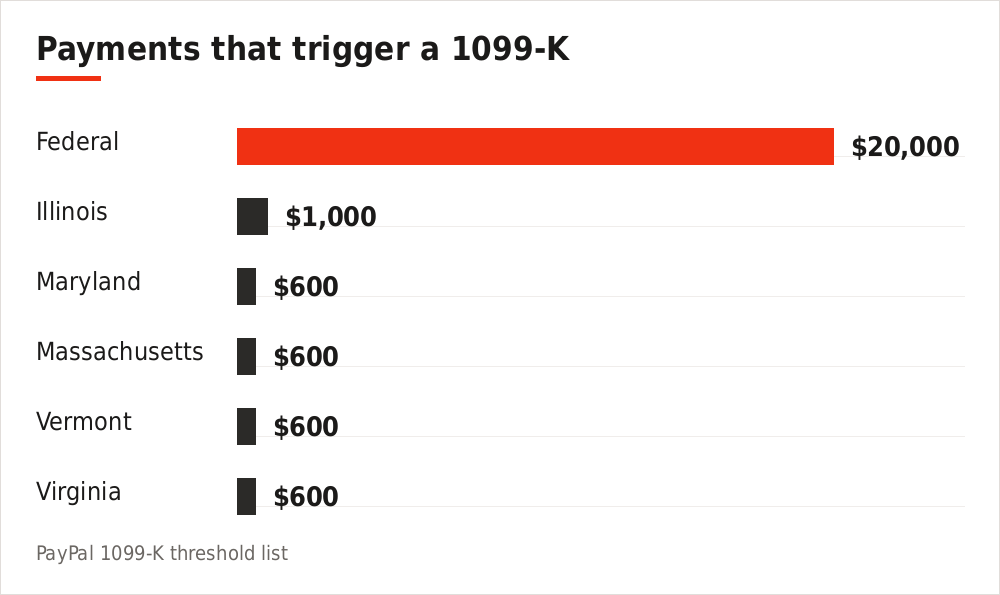
Payment levels that trigger a Form 1099-K, federal versus selected states. Illinois also requires four or more transactions. Source: PayPal, Form 1099-K reporting thresholds.
| Where you live | A 1099-K is sent when |
|---|---|
| Most states | Payments are over $20,000 and there are more than 200 transactions |
| Vermont | $600 or more of goods and services payments in a year, any number of transactions |
| Massachusetts | $600 or more, any number of transactions |
| Virginia | $600 or more, any number of transactions |
| Maryland | $600 or more, any number of transactions |
| Illinois | Over $1,000, with four or more transactions |
State rules change, and other reporting lists also include places such as Washington, DC. Check your payment platform’s tax page for the current list where you live. Remember that a state form is still only a report of payments. The tax rules for personal items at a loss are the same everywhere.
When selling your stuff is taxable
You made a profit on a personal item
If you sell something for more than you paid, the difference is a capital gain, reported on Form 8949 and Schedule D. Whether it is short-term or long-term depends on how long you owned it: more than one year counts as long-term, which usually means a lower rate. Collectibles are the exception. Net gains on things like coins, stamps, art and some trading cards are taxed at a maximum rate of 28%.
You are buying to resell
Flipping is a business, even if it is only on weekends. If you buy items at garage sales, thrift stores or clearance aisles in order to sell them for more, your profit is self-employment income. You report sales and costs on Schedule C, where you can also deduct expenses such as fees, shipping and supplies. If your net earnings from self-employment are $400 or more, self-employment tax applies too.
Selling things that are not yours to declutter
Selling items for a relative’s estate, or on consignment for friends, is not the same as selling your own belongings. The income may belong to the estate or to the owner, and inherited property has its own rules for working out the cost. Our guide to selling a house clearance or estate covers the practical side, and a tax professional can help with the rest.
Got a 1099-K? What to do
Forms for 2026 arrive in early 2027. If one shows up, work through these steps rather than simply adding the total to your income.
- Check that it is right. Make sure the payments were really for goods or services. If a friend repaid you for a trip or a payment was tagged wrongly, contact the platform that issued the form. The IRS cannot correct a 1099-K for you.
- Split the total into groups. Personal items sold at a loss, personal items sold at a gain, and anything you bought to resell.
- Personal items at a loss: the sale is not taxable. The IRS lets you report it on Form 8949 and Schedule D, entering code L and showing the nondeductible loss so the result is zero. In past years it has also allowed matching entries on Schedule 1, lines 8z and 24z. Good tax software will walk you through either.
- Personal items at a gain: report each sale on Form 8949 and Schedule D, using your purchase price as the cost.
- Flipping or a side business: report everything on Schedule C, with your costs and expenses.
- Payments sent to you in error: if you cannot get a corrected form, do not wait. File on time and show the amount on Schedule 1, line 8z, with a matching entry on line 24z, so the net effect is $0.
Even when nothing is taxable, explain the 1099-K amount on your return. The IRS receives a copy, and an unexplained gap between the form and your return is what tends to trigger a letter.
Turn the stuff you no longer use into cash
Most people selling their own things sell at a loss, which means no tax to pay. Post them on List It Global for free and reach buyers near you and in 238 countries.
Sell it free on List It Global →
First time? Read how to post your first free ad.
Records worth keeping
- What you paid. Receipts, order confirmations, bank or card statements. For older items, a dated photo of an old listing or catalog price helps.
- What you sold it for. Screenshots of the agreed price and messages with the buyer.
- How you were paid. Note which payments were for goods and which were personal, such as a friend repaying you.
- Costs of selling if you are running a business: platform fees, shipping and packaging.
For personal payments, ask friends and family to use the personal or friends-and-family option in apps like PayPal and Venmo. The IRS says gifts and reimbursements for shared costs are not payments for goods or services, and tagging them correctly keeps them off a 1099-K in the first place.
Selling on List It Global
List It Global is a free classifieds site. Buyers and sellers meet and agree the deal between themselves, and we do not handle payments, so we do not issue Forms 1099-K. What matters is how your buyer pays you. Cash and direct bank transfers are not reported on a 1099-K; the IRS notes that payments made through the automated clearing house network, which handles wire transfers, electronic checks and direct deposits, are not reportable on a 1099-K. Payments through an app’s goods-and-services option can be reported if you pass the threshold. Either way, the tax rules above are the same.
For safe ways to get paid, see our guide to safe payment methods for private sales, and read up on payment scams that target sellers before you hand anything over.
Start your January clear-out now
Price it with our calculator, post it in minutes and keep 100% of what you sell for. No fees, no commission.
Need ideas? See our guide to pricing second-hand items.
Frequently asked questions
Do I have to pay taxes on things I sell on Facebook Marketplace, eBay or classifieds sites?
Only if you make a profit, or if you are buying items to resell. Selling your own used belongings for less than you paid is not taxable, wherever you sell them.
What is the 1099-K threshold for 2026?
At the federal level, more than $20,000 in payments for goods and services and more than 200 transactions on one platform. Vermont, Massachusetts, Virginia and Maryland use $600, and Illinois uses more than $1,000 with four or more transactions.
Is the $600 1099-K rule still happening?
Not at the federal level. The One, Big, Beautiful Bill, signed in July 2025, restored the $20,000 and 200-transaction threshold and scrapped the planned $600 rule. Some states still use $600 for their own reporting.
Will Venmo or PayPal report payments from friends?
Gifts and reimbursements for shared costs are not payments for goods or services, so they should not appear on a 1099-K. Ask friends to use the personal or friends-and-family option so payments are tagged correctly.
I got a 1099-K but sold everything at a loss. Do I owe tax?
No. You still need to show the amount on your return so it matches the IRS copy. You can report the sales on Form 8949 and Schedule D with code L, which brings the result to zero.
Can I deduct a loss on items I sold?
No. Losses on personal-use property, such as your furniture, phone or car, are not deductible.
When do 1099-K forms arrive?
Platforms send them early in the new year. Forms for 2026 sales arrive in early 2027, in time for the 2026 tax return due in April 2027.
Does List It Global send a 1099-K?
No. List It Global does not process payments between buyers and sellers, so it does not issue Forms 1099-K. A payment app your buyer uses might, if you pass its reporting threshold.
Sources
- IRS: FAQs on Form 1099-K threshold under the One, Big, Beautiful Bill (IR-2025-107), October 23, 2025
- IRS: Form 1099-K FAQs, general information
- IRS: Form 1099-K FAQs, what to do if you receive a Form 1099-K
- IRS: Form 1099-K FAQs, filing
- IRS: Topic 409, capital gains and losses
- IRS: Topic 554, self-employment tax
- PayPal: current Form 1099-K reporting thresholds
- National Taxpayers Union Foundation: fixing the 1099-K reporting mess
- GAO: report on Form 1099-K reporting threshold, November 2023
This article is general information about US federal tax rules and is not tax, legal or financial advice. Your situation may differ; for advice, speak to a qualified tax professional.