

Safe Payment Methods for Private Sales
In a private sale there is no platform holding the money, no escrow and no dispute team. The payment method you choose is your entire protection — and the difference between a good choice and a bad one is the difference between a completed sale and an unrecoverable loss.
What this covers
Key takeaways
- Only two things count as payment: cash in your hand or cleared funds in your own account.
- A payment notification on the buyer’s phone proves nothing.
- Never refund an overpayment. Cancel the transaction instead.
- Gift cards and cryptocurrency have no legitimate role in a private sale.
- Sellers and buyers face opposite risks — the safest method differs depending which you are.
The principle behind every safe payment
Almost every payment fraud exploits the same gap: the moment between a payment appearing to have been made and it actually being irreversible.
Cheques bounce weeks later. Card payments can be charged back. Transfers can be recalled if made fraudulently. In each case the seller has already handed over the goods.
Payment methods ranked
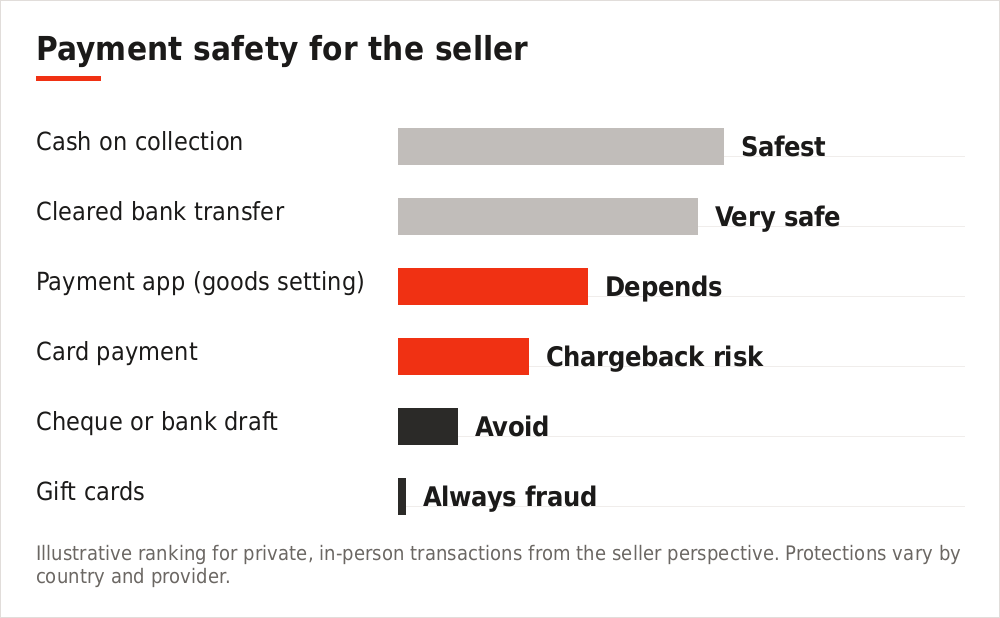
Illustrative ranking for private, in-person transactions from the seller’s perspective. Protections vary by country and provider — check what applies where you are.
| Method | Seller risk | Buyer risk | Verdict |
|---|---|---|---|
| Cash on collection | Very low | Moderate | Best for sellers up to moderate values |
| Bank transfer, cleared | Very low | Moderate | Best for higher values |
| Card payment | High | Low | Good for buyers, risky for sellers |
| Payment app | Varies | Varies | Depends heavily on the service and setting used |
| Cheque or bank draft | High | Low | Avoid |
| Cryptocurrency | Low | Very high | Avoid for private sales |
| Gift cards | Fraud | Fraud | Never, in any circumstance |
Cash: still the safest for sellers
For in-person sales up to a moderate value, cash remains difficult to improve on. It cannot be reversed, recalled or charged back.
- Count it fully before handing anything over — take the time, it is normal
- For larger amounts, meet inside a bank and deposit it immediately
- Check higher-denomination notes for security features
- Do not carry large sums home alone
- Give a written receipt and keep a copy
- Be aware that some countries cap cash transaction amounts by law
Many banks are entirely comfortable with this, and it solves three problems at once: you can verify the notes, deposit immediately, and neither party carries a large sum through a car park.
Bank transfer done properly
For anything above a few hundred, transfer is usually better than cash — provided you follow the sequence.
Give your details, never theirs
You provide your account details to receive. You should never need to send anything to complete a sale.
Watch it arrive in your own app
Not their screen, not an email, not a text. Your own banking app or online banking.
Confirm it is cleared, not pending
A pending or “processing” amount can still fail. Wait for available funds.
Understand instant transfers can still be recalled
If the sending account was compromised, the bank can reverse it later. For very high values, allow time before releasing goods.
Then hand over
And give a receipt showing the amount, date, item and both parties.
Fake payment confirmations are trivially easy to produce and are among the most common frauds in private sales. The only evidence that counts is the money visible in your own account.
Sell on a moderated platform
Every ad reviewed before publication and accounts email-verified. Free to list, no commission.
Methods to refuse outright
| If asked for | What is actually happening |
|---|---|
| Gift cards | Always fraud. No exceptions, no legitimate use case. |
| Cryptocurrency | Irreversible with no recourse. Overwhelmingly used to defraud buyers. |
| Money transfer service to a stranger | Untraceable and unrecoverable once collected. |
| An escrow service they recommend | Almost always controlled by the fraudster. |
| Overpayment with a refund | The original payment will reverse; your refund will not. |
| Payment after delivery | You have given away your item. |
| A verification code you must read out | An account takeover attempt, not a payment at all. |
The buyer sends more than agreed and asks you to return the difference. The original payment was made with stolen funds and reverses days later. Your refund was real money and is gone. If it happens, refund nothing and cancel the entire transaction.
Matching method to value
| Sale value | Recommended | Notes |
|---|---|---|
| Under $100 | Cash | Simple and final |
| $100–$500 | Cash, or transfer | Either works; verify before release |
| $500–$2,000 | Cleared bank transfer | Safer than carrying cash |
| $2,000–$10,000 | Cleared transfer, meet at a bank | Consider waiting for full clearance |
| Over $10,000 | Transfer with clearance time | Vehicles and property — consider professional handling |
If you are the buyer
Your risk is the mirror image. The seller worries about being paid with money that vanishes; you worry about paying for something that never arrives.
- Never pay a deposit for something you have not seen
- Inspect before paying — the whole point of a local sale
- Pay on collection, never in advance
- For higher-value remote purchases, a card payment offers protection cash does not
- Be suspicious of any seller who cannot meet or show the item
- Get a receipt with the seller’s name, address and the item details
The safest method for a seller is often not the safest for a buyer. That is precisely why meeting in person and exchanging goods and payment simultaneously remains the best answer for most private sales.
Remote and international sales
Selling to someone you will never meet raises the risk substantially for both sides. Where it is unavoidable:
Wait for full clearance before shipping
Not instant confirmation — genuinely cleared, settled funds.
Use tracked, insured, signed-for shipping
And keep every receipt and tracking record.
Photograph the item and the packing process
Including the serial number and the sealed parcel.
Never accept a buyer-arranged courier for high-value goods
It removes your evidence and is a common fraud pattern.
Be realistic about customs
International buyers face duties and delays. Agree who pays what in writing beforehand.
Frequently asked questions
Is cash still safe for large amounts?
It is final, which is its advantage, but carrying large sums has its own risk. Above a few thousand, a cleared transfer is usually the better choice — or meet at a bank.
Can a bank transfer be reversed?
Yes, in some circumstances — particularly if the sending account was compromised. For very high values, allow clearance time before releasing goods.
Should I accept a payment app?
Depends on the app and the setting used. Some offer buyer protection that lets the payment be reversed, which shifts risk onto you as seller. Understand the terms before agreeing.
What if the buyer wants to pay in instalments?
Do not release the item until the full amount has cleared. Part payment means part ownership of a problem.
Do I need to give a receipt?
Always, for anything of value. Two copies, showing date, amount, item details and both parties’ names.
Can the platform help if I am defrauded?
We can remove the listing and act on the account, but because we do not process payments we cannot reverse a transaction or refund you. That is why the method matters so much.
The short version
Cash in your hand or cleared funds in your own account. Nothing else is payment. Never refund an overpayment, never read out a code, never accept gift cards, and never let the item go before the money is irreversibly yours.
Buy and sell with confidence
Moderated listings, verified accounts, and no commission on anything you sell.
Or browse what is listed on List It Global to see what is selling near you.