

The 10 Most Successful Shark Tank Deals of All Time
Most Shark Tank deals never become household names. Some never close at all once the cameras stop. A small group did the opposite: they walked out with a handshake and went on to sell hundreds of millions of dollars’ worth of product. A few became the kind of company a global brewer buys for half a billion dollars. These are ten of those pitches: what was said in the Tank, what the Sharks offered, the deal that was actually struck, and what happened next. Each one comes with the original pitch video so you can watch it for yourself.
What this covers
Key takeaways
- Bombas is the biggest Shark Tank deal by reported sales, passing $1.3 billion in retail sales by October 2023, nine years after Daymond John invested.
- Most winners gave away more equity than they asked to. Bombas asked for a $4 million valuation and accepted one of about $1.14 million.
- Picking the right Shark mattered more than picking the biggest cheque. Scrub Daddy and Simply Fit Board both turned down offers that looked better on paper to work with Lori Greiner.
- Almost all of them had real sales before they walked in. The Comfy is the notable exception: it had sold nothing at all.
- The airing is a spike, not a business. The ones that lasted turned a week of TV attention into permanent shelf space.
The ten deals at a glance
The ranking below is based on how far each business went after the show, using the most recent figures the founders, the Sharks or reliable press have published. Sales figures come from different years and are not always measured the same way, so treat the order as a guide rather than an audited league table.
| # | Company | Season | The ask | The deal | Latest reported milestone |
|---|---|---|---|---|---|
| 1 | Bombas | 6 (2014) | $200K for 5% | $200K for 17.5%, Daymond John | $1.3B retail sales by Oct 2023 |
| 2 | Scrub Daddy | 4 (2012) | $100K for 10% | $200K for 20%, Lori Greiner | $926M retail sales by May 2023 |
| 3 | Cousins Maine Lobster | 4 (2012) | $55K for 5% | $55K for 15%, Barbara Corcoran | $585M in sales by 2023 |
| 4 | BeatBox Beverages | 6 (2014) | $200K for 10% | $1M for 33%, Mark Cuban | Anheuser-Busch deal for 85% at about $490M (Dec 2025) |
| 5 | Dude Wipes | 7 (2015) | $300K for 10% | $300K for 25%, Mark Cuban | $110M revenue in 2023 |
| 6 | Squatty Potty | 6 (2014) | $350K for 10% | $350K for 10%, Lori Greiner | Acquired by Aterian in 2021 |
| 7 | Simply Fit Board | 7 (2015) | $125K for 15% | $125K for 20%, Lori Greiner | $160M in sales by 2021 |
| 8 | The Comfy | 9 (2017) | $50K for 20% | $50K for 30%, Barbara Corcoran | $65M revenue in 2020 |
| 9 | Tipsy Elves | 5 (2013) | $100K for 10% | $100K for 10%, Robert Herjavec | $100M+ retail sales by 2019 |
| 10 | Wicked Good Cupcakes | 4 (2013) | $75K for 20% | $75K for a per-jar royalty, Kevin O’Leary | Acquired by Hickory Farms in 2021 |
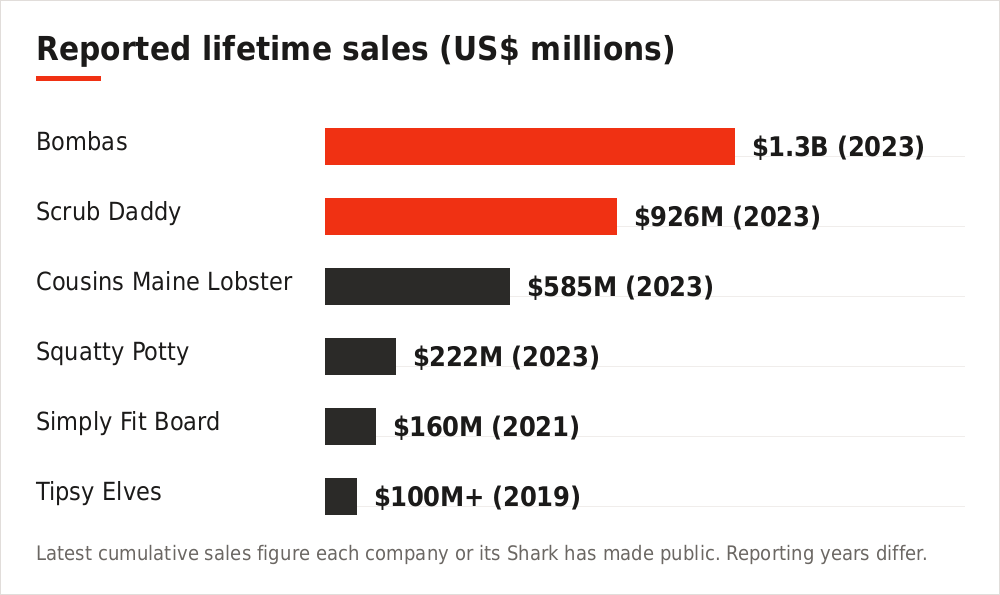
Reported cumulative sales, using the latest figure each company or its Shark has made public. Years differ, so companies that reported earlier will understate their current position. Dude Wipes reports annual revenue rather than a lifetime total, and BeatBox, The Comfy and Wicked Good Cupcakes have not published a comparable figure, so they are not shown.
1. Bombas: the socks Kevin O’Leary told everyone not to touch
The idea
Randy Goldberg and David Heath started Bombas in 2013 after learning that socks are the most requested clothing item in homeless shelters. The model was simple to explain on TV: for every pair a customer buys, Bombas donates a pair. The product itself was a premium, engineered sock built to be noticeably more comfortable than a multipack from the supermarket.
The pitch and the ask
Bombas opened Season 6 in September 2014. The founders asked for $200,000 for 5%, which valued a company barely a year old at $4 million. They had done roughly $450,000 in sales in about nine months and were projecting around $1.1 million for the year, with each pair costing about $4 to make.
How the Sharks reacted
The valuation landed badly. Kevin O’Leary called the numbers ridiculous and went further than usual, telling the other Sharks: “If any of these Sharks give you money at that valuation I will forbid it.” The rest of the panel was cautious. Daymond John, who built FUBU and is the Shark with the deepest apparel background, was the one who saw the opportunity.
The deal
Daymond offered $200,000 for 17.5% and the founders took it. The money was exactly what they asked for, but the implied valuation dropped to about $1.14 million, less than a third of their number. In hindsight, Kevin was right about the valuation and wrong about the business.
What happened next
Revenue passed $100 million in 2018. By October 2023 Bombas had reported $1.3 billion in retail sales, making it the best-selling company ever to come out of the Tank. By 2025 it had donated more than 150 million items to people experiencing homelessness in the United States.
Goldberg and Heath told Fortune they prepared by rehearsing answers to around 200 questions they thought the Sharks might ask. When Kevin went after the valuation, they were not caught cold.
Watch: Bombas pitches Daymond John (Shark Tank: How It Started, CNBC).
2. Scrub Daddy: the sponge that started a bidding war
The idea
Aaron Krause made buffing and polishing pads for the car-detailing trade. He developed a polymer that is firm in cold water and soft in warm water, then noticed how well his leftover sponges cleaned dishes and garden furniture. He cut the material into a yellow disc with a smiling face. The smile is not just decoration: the mouth doubles as a slot for scrubbing both sides of a spoon at once.
The pitch and the ask
Krause asked for $100,000 for 10%, valuing Scrub Daddy at $1 million. He had sold about $100,000 of product, mostly through three QVC appearances plus online sales and four supermarkets around Philadelphia. Each sponge wholesaled at about $2.80 and cost around $1 to make. He wanted the money to build his own factory so supply could keep up with demand.
How the Sharks reacted
Lori Greiner and Daymond John bid against each other, starting at $150,000 for 25% and climbing. Kevin O’Leary changed tack and offered a royalty instead: $100,000 in return for 25 cents a unit until he was repaid, then 7.5 cents a unit after that. He also played to Krause’s pride, suggesting Lori was treating him as if he did not know how to run his own company.
The deal
Lori’s final offer was $200,000 for 20%, with a promise of an infomercial and worldwide retail distribution within weeks. Krause took it. On paper, Kevin’s royalty was cheaper, as the venture capitalist Jeremy Liew pointed out in an analysis at the time. Krause chose the partner who could put his sponge in front of millions of shoppers.
What happened next
The day after the episode aired, Lori and Krause sold 42,000 sponges in under seven minutes on QVC. Scrub Daddy passed $100 million in total revenue in January 2017. By May 2023 it had reported more than $926 million in retail sales, with around 160 products, 273 employees and a presence in about 257,000 retail locations. Lori has said the deal “enriched my life,” not just her bank balance.
Krause had already sold on QVC before the show. The Tank did not invent his demand. It gave him a partner who could multiply it.
Watch: a bidding war breaks out during Scrub Daddy’s pitch (Shark Tank Global).
3. Cousins Maine Lobster: one truck, two months, one Shark left
The idea
Jim Tselikis and Sabin Lomac are cousins who grew up in Maine. They wanted to bring a proper Maine lobster roll to Los Angeles, and opened a “lobster shack on wheels” to do it. When they walked into the Tank the business was about two months old, had one truck and had already taken around $150,000.
The pitch and the ask
They asked for $55,000 for 5%, which Kevin O’Leary quickly pointed out meant a $1.1 million valuation for a single truck. The numbers were tidy: a $13 lobster roll cost them about $5.85, and monthly overhead ran to roughly $20,000. Their edge, they argued, was supply. Family connections in Maine got them good lobster at good prices.
How the Sharks reacted
Mark Cuban, Kevin O’Leary and Daymond John were out within minutes. Robert Herjavec offered $55,000 for 25%. Instead of answering him, the cousins asked Barbara Corcoran whether she was interested, and Robert withdrew his offer in irritation. It was a risky move that left them with one possible investor.
The deal
Barbara opened at $55,000 for 17%. The cousins countered at 12%. They settled on $55,000 for 15%, and the cousins sealed it with “Barbara, welcome to the family.”
What happened next
Cousins Maine Lobster started a charity arm, Cousins for a Cause, in 2013. By 2018 it had 29 trucks, ten restaurants and 21 franchisees, including one in Taiwan. Barbara worked a shift behind the counter when the tenth franchise opened. By 2023 the company had reported $585 million in sales, the highest of any food business from the show. It now also ships fresh and live lobster nationwide.
Barbara has often said she invests in people first. The cousins had one truck and no track record. What she bought was two founders she trusted to keep showing up.
Watch: one lobster truck and $150K in two months (Shark Tank Global).
Got your own “one truck” idea?
Every founder on this list proved people wanted the product before a Shark ever saw it. You can run the same test without a TV studio. Post an ad on List It Global, set your price and see who gets in touch, locally and from other countries. No Sharks, no equity, no commission.
4. BeatBox Beverages: the company that negotiated Mark Cuban up
The idea
BeatBox started in 2011 inside a University of Texas MBA programme. Justin Fenchel, Aimy Steadman and Brad Schultz made a wine-based “party punch” sold in a box, made for parties.
The pitch and the ask
They asked for $200,000 for 10% and had sold about $235,000 in their first 14 months.
How the Sharks reacted
This is one of the rare pitches where several Sharks wanted in and kept raising the stakes. Barbara Corcoran offered $400,000 for 20%. Kevin O’Leary offered $200,000 for 20%. Mark Cuban offered $600,000 for 33%, explaining what he saw in a line that has followed the brand ever since: “You guys don’t sell wine… you guys sell fun.”
The deal
Instead of trimming Mark’s offer, the founders asked for more money. They countered at $1 million for 33%, and Mark agreed. That put the company at about $3 million, higher than the valuation they had walked in with. Very few entrepreneurs leave the Tank with a better valuation than they asked for.
What happened next
The road was not smooth. BeatBox sold about $750,000 in its first year after the show and reached Walmart and 26 states within 18 months. Then sales flattened in 2017. In 2018 the team switched to cheap single-serve cartons, and sales grew from about $1 million to $4 million within a year. By September 2022 they had passed $57 million in sales since the show and were in around 2,000 7-Eleven stores. In December 2025, Anheuser-Busch agreed to buy 85% of BeatBox for about $490 million, with the option to buy the rest after five years.
BeatBox’s breakthrough came four years after the show. The Tank bought them time and credibility. The pivot to small, cheap single serves is what made the business.
Watch: BeatBox Beverages in the Tank (ABC).
5. Dude Wipes: Mark Cuban walked out, then came back
The idea
Four friends from Chicago, Sean Riley, Ryan Meegan, Jeff Klimkowski and Brian Wilkin, started Dude Products in 2012 to sell extra-large flushable wipes aimed squarely at men. The black packaging and the jokes were the strategy.
The pitch and the ask
Riley, Meegan and Klimkowski pitched for $300,000 for 10%, a $3 million valuation. They had done about $300,000 in total sales but had just landed a Kroger contract that was rolling out to around 2,200 stores.
How the Sharks reacted
Mark Cuban went out first, saying he could not represent the company well. Lori Greiner and Barbara Corcoran followed. Robert Herjavec and Kevin O’Leary teamed up to offer $300,000 for 27.5%. Then Cuban came back into the negotiation with $300,000 for 25%.
The deal
The Dudes chose Mark at $300,000 for 25%. According to Forbes, that cheque is still the only outside money the company has ever raised.
What happened next
Sales reached about $3 million in 2016, and the company has been profitable since then. Growth jumped when toilet paper ran out in the 2020 pandemic. Dude Wipes did about $70 million in 2022 and $110 million in 2023, and is now sold in more than 20,000 US stores including Walmart, Target and Kroger. Amazon alone accounts for close to 40% of revenue.
The founders’ stated long-term goal is a billion dollars a year by taking share from toilet paper itself, a category worth around $11 billion in the US.
Watch: Mark Cuban flushes away the other Sharks (Shark Tank: How It Started, CNBC).
6. Squatty Potty: a family stool and a unicorn
The idea
Judy Edwards had constipation, and a therapist suggested raising her feet on a footstool. She kept tripping over it. In 2010 her son Bobby designed a stool that tucks around the base of the toilet instead. The family had a neighbour build 100 wooden samples and sent them to health bloggers. Appearances with Dr. Oz and Howard Stern followed.
The pitch and the ask
Bobby and Judy asked for $350,000 for 10%, a $3.5 million valuation. Unusually for the Tank, they arrived with serious numbers: about $2.7 million in sales and very healthy margins on a product that cost a few dollars to make.
How the Sharks reacted
Robert Herjavec was not a fan and Barbara Corcoran was not convinced. Kevin O’Leary and Lori Greiner both offered the full $350,000 for 10%.
The deal
Bobby took Lori’s $350,000 for 10%. With her help, Squatty Potty got prime placement at Bed Bath & Beyond, a retailer it had been unable to crack alone.
What happened next
Online sales hit about $3 million in the three weeks after the episode aired. In 2015 the family spent around $500,000 with the agency Harmon Brothers on an advert featuring a unicorn. It drew tens of millions of views in its first week and drove revenue far above projections. Squatty Potty passed $15 million in sales that year. In 2021 the consumer products company Aterian bought the business for about $31 million.
QVC reportedly stayed away from Squatty Potty because the product was hard to demonstrate on air. The unicorn advert solved the same problem in a way television never could.
Watch: the Squatty Potty team shocks the Sharks with their sales (Shark Tank Global).
7. Simply Fit Board: turning down double the money
The idea
Linda Clark and her daughter Gloria Hoffman sold a curved balance board you stand on and twist. It works your core while looking like something you could do in front of the TV.
The pitch and the ask
They asked for $125,000 for 15%. They had sold about 15,700 boards in 18 months, bringing in around $575,000.
How the Sharks reacted
Two Sharks made offers. Lori Greiner offered $125,000 for 20%. Kevin O’Leary offered twice the money, $250,000, for 30%.
The deal
They took Lori’s $125,000 for 20% because of her infomercial and home-shopping experience. Their product needed to be seen in use, and Lori knew how to put it on screen.
What happened next
According to Lori, sales went from $575,000 to about $9 million in the seven months after the episode. More than a million boards had sold by late 2016. By 2021 Simply Fit Board had reached around $160 million in sales and was stocked in roughly 50,000 retail stores.
This is the Scrub Daddy lesson again. Kevin’s offer had more money. Lori’s offer had the right distribution. Both times, distribution won.
Watch: Lori wants to go solo on Simply Fit Board (Shark Tank in 5, CNBC).
Your pitch, minus the panel
Linda and Gloria knew their board worked before they walked in, because 15,700 people had already bought one. Start building your proof the same way. List your product in two steps on the List It Global website or app, and every message you get is a data point.
New to selling? Read how to post your first free ad.
8. The Comfy: zero sales, a song and a deal
The idea
Brothers Brian and Michael Speciale from Phoenix, both single fathers at the time, got the idea when they saw their nephew curled up inside one of Brian’s oversized sweatshirts. The Comfy is a giant, reversible, sherpa-lined hoodie you can tuck your whole body into.
The pitch and the ask
They asked for $50,000 for 20% and admitted they had not sold a single unit. Then they sang the Sharks Christmas songs with the lyrics rewritten about their product.
How the Sharks reacted
Lori Greiner thought it was too close to the Snuggie. Mark Cuban and Kevin O’Leary said it was too early. Robert Herjavec summed up the mood: “You have the worst answers to the questions, but it comes across so nice.” He still offered $50,000, but for 50%. Barbara Corcoran offered $50,000 for 30%.
The deal
The brothers tried 25%. Barbara said no, and they took her $50,000 for 30%. On the way out, Kevin joked that you could bring anything into the Tank, sing a song and get $50,000 from Barbara.
What happened next
The Comfy hit $1 million in sales within five weeks of the episode and about $15 million within a year. Revenue reached around $20 million in 2018 and $65 million in 2020. The story then got harder: supply-chain problems and debt followed, and Michael eventually bought out his brother and Barbara to run the company himself. In 2023 Barbara told a podcast the brand “made me $468 million in three years,” though she did not explain how the figure was calculated.
The Comfy is the clearest exception on this list. Every other founder brought proof of demand. The Speciale brothers brought charm, a product you understand in two seconds, and perfect timing for the holiday season.
Watch: Barbara and Robert battle to get Comfy (Shark Tank in 5, CNBC).
9. Tipsy Elves: a lawyer, a dentist and ugly Christmas sweaters
The idea
Evan Mendelsohn was a lawyer and Nick Morton was a dentist who specialised in root canals. In 2011 they started selling novelty Christmas jumpers from San Diego, with a “naughty” range that sold better than the “nice” one.
The pitch and the ask
They asked for $100,000 for 10%, with a little under $1 million in sales from their first two seasons and plans to move into retail stores.
How the Sharks reacted
Kevin O’Leary offered a royalty: $100,000 for $2 a sweater until he was repaid, then $1 a sweater forever, with no equity. Daymond John considered an offer but did not make one. Robert Herjavec offered exactly what they asked for.
The deal
They took Robert’s $100,000 for 10%, one of the few deals on this list made at the founders’ own valuation.
What happened next
Tipsy Elves projected $12 million in revenue for 2014 and had passed $70 million in sales by 2018. In 2019 Mendelsohn said the company had done more than $100 million in retail sales. It has since expanded into novelty clothing for every occasion, from golf outfits to snow suits. Robert has named it his favourite Shark Tank investment.
Tipsy Elves was the first company featured on the spin-off series Beyond the Tank, which follows businesses after their deals.
Watch: the Tipsy Elves pitch starts at 19:02 in this Shark Tank Global holiday compilation.
10. Wicked Good Cupcakes: Kevin’s favourite royalty
The idea
Mother and daughter Tracey Noonan and Dani Desroches baked cupcakes in Cohasset, Massachusetts, and started putting them in jars so friends and family could ship them. In 2011 airport security confiscated one of their cupcakes in Boston because the icing exceeded the 3-ounce liquid limit. The story went viral and so did the brand.
The pitch and the ask
They asked for $75,000 for 20%. They had sold about $150,000 in the months before the show and were projecting around $360,000 for the year.
How the Sharks reacted
Four Sharks declined. Kevin O’Leary offered the full $75,000 with no equity at all: $1 for every jar sold until he was repaid, then 50 cents a jar after that.
The deal
The founders negotiated the long-term royalty down to 45 cents a jar. Tracey’s response, “Come to Mama!”, became one of the show’s best-known moments.
What happened next
Within weeks of airing they had taken roughly a year’s worth of orders, and growth was around 600% a year after the show. A later Shark Tank update put sales at about $10 million. Kevin has called it his most phenomenal investment. In 2021 the gift company Hickory Farms bought the business.
Royalty deals are Kevin’s trademark, and many founders hate them. For a food business with predictable unit sales, it meant the founders kept 100% of their company.
Watch: Kevin O’Leary’s wicked offer (Shark Tank in 5, CNBC).
The one that got away: Ring
No list of great Shark Tank pitches is complete without the one that walked out with nothing. In Season 5 (November 2013), Jamie Siminoff pitched DoorBot, a video doorbell that let you answer the door from your phone. He asked for $700,000 for 10%, a $7 million valuation.
Lori Greiner said it was not different enough from rivals to justify its $200 price. Mark Cuban did not see a company that could scale. Daymond John worried big security firms would crush it, and Robert Herjavec thought it might be easy to hack. Kevin O’Leary was the only one still interested, but he and Siminoff could not agree on the structure of a deal, and Siminoff left empty-handed.
He renamed the company Ring. In 2018 Amazon bought it for more than $1 billion, and a few months later Siminoff returned to the Tank as a guest Shark in the Season 10 premiere.
Watch: the Sharks struggle to understand DoorBot’s value (Shark Tank Global).
What the winning pitches have in common
Put the ten deals side by side and a few patterns stand out. None of them is about being lucky on the night.
They had proof before they had a Shark
Scrub Daddy had sold through QVC. Squatty Potty had millions in sales. Simply Fit Board had sold 15,700 boards. Cousins Maine Lobster had taken $150,000 in two months. The Sharks were betting on demand they could already see.
They gave up equity and did not regret it
Most of the founders accepted a lower valuation than they asked for, some by a lot. What they got back was a partner, and every one of these companies is now worth far more than the stake they gave away.
They picked the partner, not the price
Scrub Daddy and Simply Fit Board both turned down Kevin O’Leary’s cheaper or bigger offers to work with Lori Greiner, because she could put their products on screen and on shelves.
They turned a week of attention into permanent distribution
Bed Bath & Beyond for Squatty Potty, QVC for Scrub Daddy, Kroger and Walmart for Dude Wipes, 7-Eleven for BeatBox. An episode fades after a few days. Shelf space does not.
Their products explain themselves in seconds
A smiling sponge. A hoodie you climb into. A stool around the toilet. If you can understand a product from one photo, you can sell it from one ad.
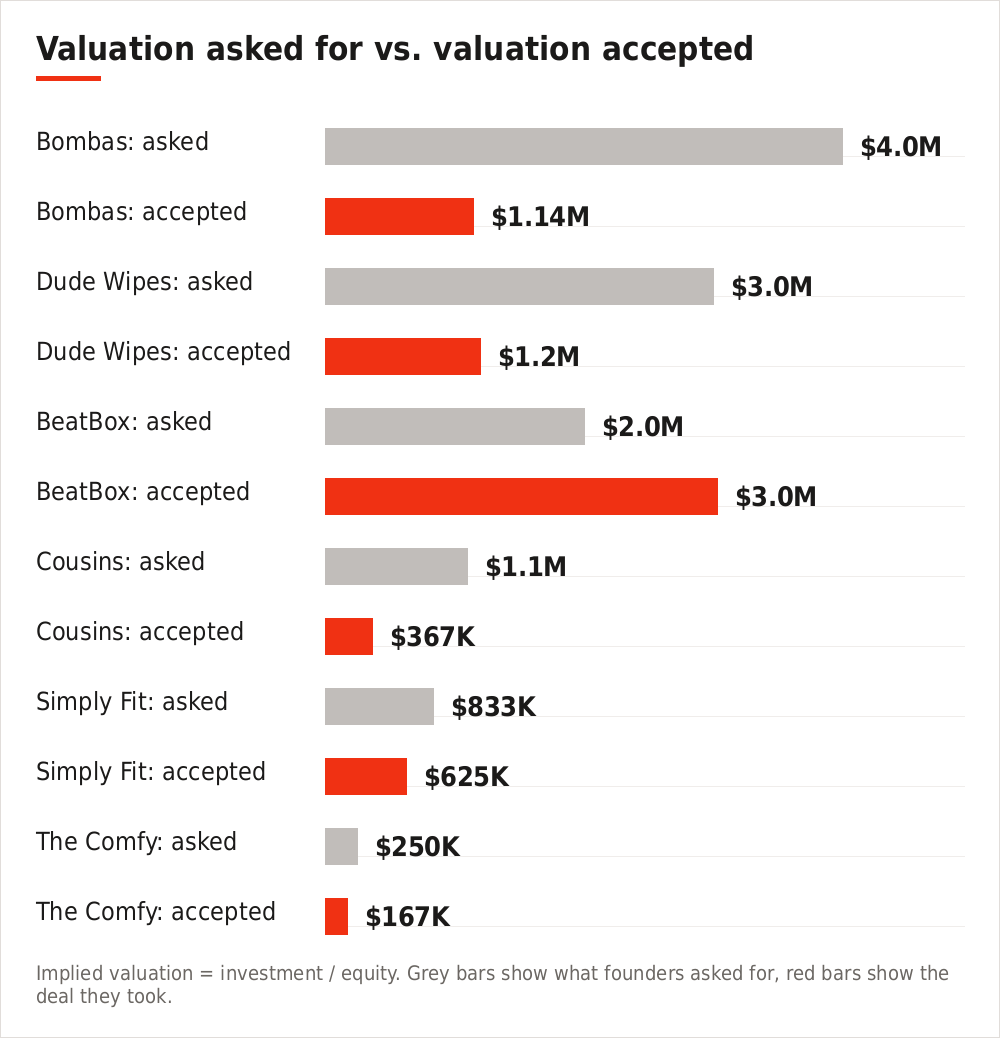
Implied valuation is the investment divided by the equity offered. BeatBox is the outlier: the founders talked Mark Cuban up from $600,000 to $1 million for the same 33%.
That is the part you can start on today. You do not need a TV appearance to find out whether people want what you make. Writing a clear listing, with a title that gets clicks and photos that sell, is a small version of the same test. If you sell to businesses as well as consumers, our guide to classified ads for small businesses covers how to approach it.
Frequently asked questions
What is the most successful Shark Tank product ever?
By reported sales, Bombas, with $1.3 billion in retail sales by October 2023. Scrub Daddy is close behind at more than $926 million. Ring became worth more after Amazon bought it for over $1 billion, but it never took a deal on the show.
Do Shark Tank deals always close after the show?
No. A handshake on TV is followed by due diligence, and a significant share of deals change or fall apart after filming. Every deal on this list did close.
Which Shark has made the most successful investments?
Lori Greiner has three companies on this list: Scrub Daddy, Squatty Potty and Simply Fit Board. Daymond John has the single biggest deal by sales with Bombas. Mark Cuban’s BeatBox deal produced the largest company sale on the list.
Why do founders accept less than they ask for?
The Sharks usually argue the valuation down because early companies are risky. Founders accept because the right Shark brings retail contacts, manufacturing know-how and publicity that would cost far more to buy.
Where can I watch the original pitches?
Official clips are published on YouTube by Shark Tank Global, ABC and CNBC, and every pitch in this article is embedded from those channels. Full episodes are available on streaming services, which vary by country.
How can I test a product idea without going on Shark Tank?
List it where buyers already look. A free ad on List It Global lets you set a price, reach people locally and in other countries, and measure real interest before you spend money on stock or advertising.
You don’t need $200,000 to start. You need your first buyer.
Every company here began with one product and one person willing to pay for it. Put yours in front of buyers in 238 countries today. Posting is free, and we never take a commission on what you sell.
Prefer your phone? Get the List It Global app and post in two steps. Here is why we don’t charge commission.
Sources
Deal terms come from the original episodes and contemporary reports. Sales figures are the latest each company, Shark or publication has made public, and are dated where possible.
- Bombas, Wikipedia, and Fortune (December 2024)
- On Sharks, Scrubbies and Why Money Isn’t Everything, Entrepreneur (October 2012), and Scrub Daddy, Wikipedia
- Cousins Maine Lobster, Tasting Table (July 2025)
- BeatBox Beverages after Shark Tank, Food Republic, and Anheuser-Busch to acquire BeatBox, Food Manufacturing (December 2025)
- Dude Wipes’ billion-dollar plan, Forbes (May 2024)
- Squatty Potty, Entrepreneur (2016), and Looper (2023)
- Simply Fit Board after Shark Tank, Looper (2023)
- The Comfy pitch, Inc. (2017), and Barbara Corcoran on The Comfy, CNBC (2023)
- Tipsy Elves, Wikipedia
- Wicked Good Cupcakes after Shark Tank, Food Republic (2023)
- What happened to DoorBot, SlashGear (2025)