


How to Advertise a Business for Sale
Selling a business is not like selling a car. The buyer is assessing years of trading history, staff, contracts and goodwill — and the advertisement has to attract serious enquiries without disclosing information that would damage you if it reached staff, customers or competitors. Getting that balance right is most of the work.
What this covers
Key takeaways
- Advertise anonymously unless you have decided disclosure is safe.
- Buyers need turnover, profit and asking price to enquire seriously.
- Have three years of accounts ready before you list.
- Use a confidentiality agreement before releasing detailed figures.
- Most business sales need an accountant and a solicitor — budget for both.
Business sales involve tax, employment and contract law that vary substantially by country and by how the business is structured. Take advice from an accountant and a solicitor before committing to anything.
The confidentiality problem
This is the tension that shapes every business-for-sale advertisement. Say too little and nobody enquires. Say too much and your staff learn from a listing, your customers get nervous, and your competitors gain information they should not have.
| Safe to publish | Hold until later |
|---|---|
| Sector and general activity | Trading name |
| Region rather than exact address | Precise location |
| Turnover and profit bands | Detailed accounts |
| Years established | Named customers or contracts |
| Number of staff | Individual roles and salaries |
| Reason for sale | Supplier terms and margins |
| Asking price | Lease terms and covenants |
Preparing before you advertise
Serious buyers ask for the same things every time. Having them ready shortens the process and signals a well-run business.
- Three years of accounts, filed and reconciled
- Current year management figures
- An asset list — equipment, vehicles, stock, with values
- Lease documentation — term remaining, rent, break clauses
- Staff details — roles, length of service, contract types
- Key contracts and whether they transfer with the business
- A confidentiality agreement drafted and ready to send
- Clarity on what is being sold — assets, or the whole entity
Selling the trading assets is very different from selling the company itself, with substantially different tax and liability consequences for both parties. Decide which you are offering before you advertise, and take advice on which suits your circumstances.
How businesses are valued
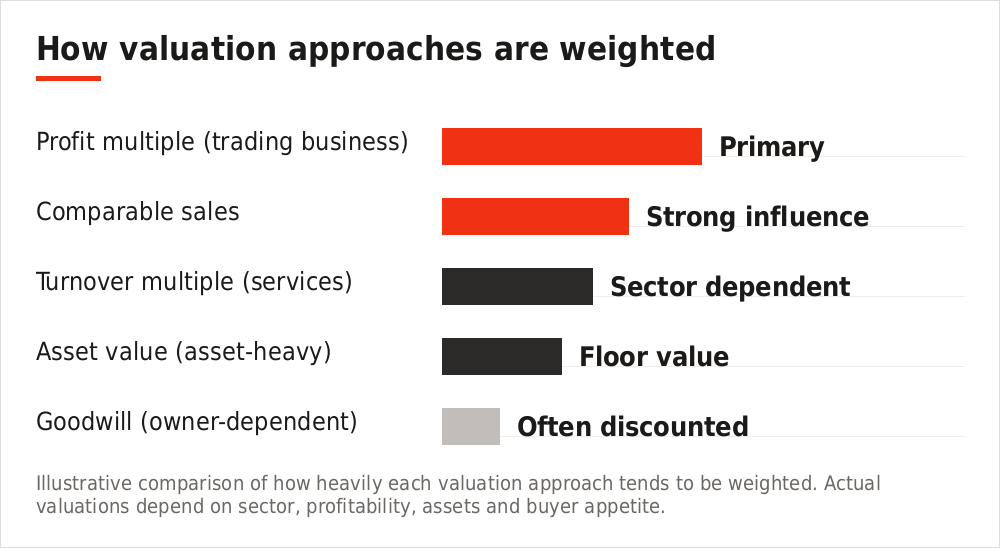
Illustrative comparison of how heavily each valuation approach tends to be weighted by business type. Actual valuations depend on sector, profitability, assets and buyer appetite.
| Method | How it works | Suits |
|---|---|---|
| Multiple of profit | Adjusted profit times a sector multiple | Established, profitable trading businesses |
| Asset based | Net value of what the business owns | Asset-heavy or low-profit businesses |
| Turnover multiple | A fraction of annual revenue | Service businesses with recurring income |
| Comparable sales | What similar businesses achieved | Common business types with an active market |
Owner-dependence is the factor sellers most often underestimate. A business that cannot run without you is worth considerably less than one with systems and staff that continue regardless, because the buyer is purchasing a job rather than an asset.
Advertise your business free
No listing fees and no commission on the sale — unlike brokers who charge a percentage.
Writing the advertisement
Title: Business type + Region + Headline figure.
Established plumbing business for sale, North West, turnover $420k
Describe what the business does
Clearly but without identifying it. Sector, customer type, how revenue is generated.
Give the financial headlines
Turnover, adjusted profit, and the asking price. Listings without figures attract almost no serious enquiries.
Explain why you are selling
Retirement, relocation, ill health, pursuing something else. Buyers assume the worst if you do not say.
Set out what is included
Equipment, vehicles, stock, goodwill, customer base, premises or lease.
Be honest about owner involvement
Hours you work and whether the business runs without you. This shapes the whole valuation.
State the process
That detailed information follows a signed confidentiality agreement.
What to disclose and when
| Stage | Release |
|---|---|
| Advertisement | Sector, region, turnover band, asking price, reason for sale |
| Initial enquiry | General background; qualify the buyer |
| After confidentiality agreement | Accounts, location, business name, asset list |
| After serious interest shown | Lease, staff structure, key contracts |
| Under offer | Full due diligence access |
Plan how and when you will tell your team, and make sure the advertisement cannot identify the business before that conversation. Discovering it accidentally is corrosive and can cost you the people the buyer is paying for.
Qualifying enquiries
Business listings attract a high proportion of unqualified interest. Filter early and politely.
- Ask what experience they have in the sector
- Ask how the purchase would be funded
- Ask what timescale they are working to
- Ask whether they have bought a business before
- Require a signed confidentiality agreement before figures
- Be cautious of anyone wanting detail without answering any of the above
The sale process
Advertise anonymously
Attract enquiries without identifying the business.
Qualify and sign confidentiality agreements
Before releasing anything meaningful.
Share the information memorandum
Accounts and detail, in a controlled way.
Meet serious buyers
Usually away from the premises initially.
Agree heads of terms
Price, structure, timing and conditions, in writing.
Due diligence
The buyer verifies everything you have said. Accuracy throughout matters here.
Completion
Contracts, payment, transfer of assets and staff.
When you need professional help
Advertising the business yourself saves broker commission, which on a business sale is a substantial sum. But some elements genuinely need professional input.
- An accountant — valuation, tax structuring, preparing figures
- A solicitor — sale agreement, warranties, staff transfer obligations
- A surveyor — where property or a lease is involved
- A broker — optional, and worth weighing against their percentage
The advertising is the part you can straightforwardly do yourself. The legal and tax mechanics are not.
Frequently asked questions
Should I advertise anonymously?
Usually yes, at least initially. Staff, customers and competitors learning through a listing can damage the business you are trying to sell.
Do I have to state the asking price?
Listings without a price attract far fewer serious enquiries. A range is acceptable if you prefer flexibility.
How long does a business sale take?
Commonly several months from advertising to completion. Due diligence alone often takes weeks.
What about my staff?
Employment transfer rules apply in most countries and are not optional. Take legal advice early — the obligations are significant.
Can I sell just the customer list?
Sometimes, though data protection law restricts transferring personal data. Take advice before assuming it is possible.
Is it free to advertise here?
Yes — no listing fee and no commission on the sale, which on a business sale is a meaningful saving against broker fees.
The short version
Advertise anonymously with real financial headlines. Have three years of accounts ready before you list. Use a confidentiality agreement before releasing anything meaningful. Be honest about how dependent the business is on you. And take proper advice on the legal and tax mechanics.
List your business, keep the proceeds
No listing fee, no commission on the sale.
You can also browse listings across 238 countries before you decide on a price.