

Classified Ads for Small Businesses: A Beginner Guide
Classified advertising is one of the few channels where a small business competes on equal terms with a large one. There is no bidding war for placement, no minimum spend, and a well-written listing from a sole trader sits alongside one from a national chain. For local service businesses in particular, it remains one of the most cost-effective lead sources available.
What this covers
Key takeaways
- Buyers browsing a category already have purchase intent — no persuasion needed.
- There is no cost per click and no competitor outbidding you.
- Naming the specific towns you cover matters more than any other single detail.
- Business sellers usually have legal disclosure obligations consumers do not.
- Response speed is the biggest determinant of whether an enquiry converts.
Why classifieds work for small business
The mechanics are different from most advertising. You are not interrupting someone’s attention and hoping to create demand — you are appearing in front of somebody who has already decided they need a plumber, a van, a rental property or an office chair, and is actively looking.
- Intent-driven traffic — people searching, not scrolling
- No auction for placement — you cannot be outbid
- No minimum spend or contract
- Local by design — buyers filter by distance
- Multiple listings — each item or service can have its own
- Direct contact — the enquiry comes straight to you
Compared with paid advertising
| Classified listing | Paid search advertising | |
|---|---|---|
| Cost to appear | Free | Per click, competitively bid |
| Competitor bidding | None | Directly raises your cost |
| Setup complexity | Minutes | Requires ongoing management |
| Buyer intent | High | High |
| Volume ceiling | Limited by category traffic | Scales with budget |
| Speed to first lead | Hours to days | Immediate with budget |
Paid search scales in a way classifieds cannot — if you need fifty leads a week, budget buys them. But for a sole trader or small firm wanting a steady handful of local enquiries without a monthly cost, classifieds do that job well.
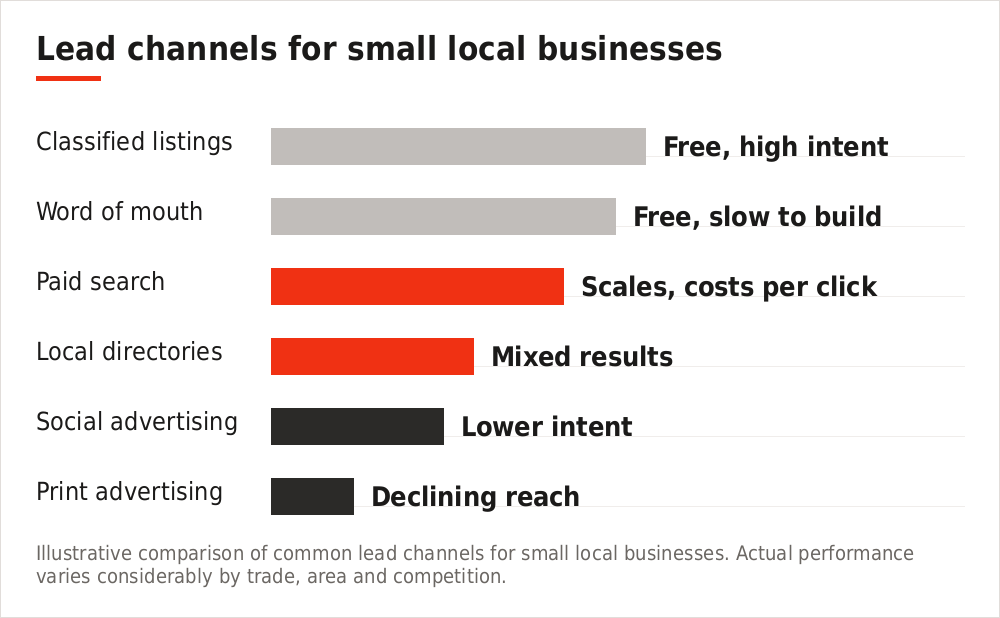
Illustrative comparison of common lead channels for small local businesses. Actual performance varies considerably by trade, area and competition.
Which businesses benefit most
| Business | What to list | Why it works |
|---|---|---|
| Tradespeople | Services by area | Buyers search with immediate need |
| Car dealers | Stock with full specification | Buyers filter by make, model, year, mileage |
| Landlords and agents | Rentals and property | Location-first search matches how tenants look |
| Recruiters and employers | Vacancies | Reaches candidates outside job boards |
| Wholesalers | Job lots, clearance stock | Trade buyers browse these categories directly |
| Equipment dealers | Machinery, tools, plant | Specialist buyers search nationally and abroad |
| Tutors and instructors | Services by area and subject | Parents and students search locally |
| Removals and transport | Services by route or area | Frequently needed at short notice |
Advertise your business free
478 categories, no listing fees, no commission, no monthly cost. Unlimited listings.
Writing a business listing
Business listings differ from private ones in an important way: you are selling capability and trust rather than a single object.
Lead with the trade and the area
“Qualified electrician, Manchester and surrounding areas” tells a buyer everything they need in six words.
List what you actually do
Specific services as bullet points. Vague “all work undertaken” converts poorly because buyers cannot tell whether you do their particular job.
State qualifications and insurance
Certifications, registrations, public liability cover. This is the single biggest trust signal in trade categories.
Be clear about pricing
Hourly rate, day rate, call-out charge, or free quotation. Listings with no pricing indication get more enquiries but far more time-wasters.
Give realistic availability
Typical lead time and working hours. Managing expectations upfront prevents most complaints.
Say how and when to contact you
And then actually answer within that window.
Getting found locally
This is where most business listings fail, and it is easily fixed.
“Greater Manchester and surrounding areas” is invisible to someone searching their own town. Listing the actual places you cover — Stockport, Altrincham, Sale, Salford — means you appear when they search, which is how people genuinely look for a tradesperson.
- Pin your location accurately — buyers filter by distance
- Name specific towns in the description
- Use the deepest relevant category rather than a broad one
- Create separate listings for genuinely different services
- Keep listings current — renew before they expire
- Use the exact words customers use, not trade jargon
Handling enquiries properly
Lead handling matters more than listing quality once the enquiries start arriving.
| Practice | Why it matters |
|---|---|
| Reply within the hour | Most people contact several businesses; the first useful reply usually wins |
| Answer the actual question | Generic replies read as automated |
| Give a price range early | Saves both parties time when budgets do not match |
| Confirm in writing | Scope, price and timing, to prevent disputes |
| Follow up once | Many enquiries go quiet simply because life intervened |
| Ask how they found you | The only way to know which channel is working |
Legal obligations for traders
In most countries a trader must identify themselves as a business, and buyers gain rights they would not have in a private sale — often including a cancellation period and a right to repair or refund. Presenting yourself as a private seller to avoid this is unlawful in many jurisdictions.
- State that you are a business in your listings
- Give your trading name and, where required, a registered address
- Comply with consumer protection law — returns, cancellation, guarantees
- Hold appropriate insurance and say so
- Show required registrations — trade bodies, licences, safety certifications
- Handle customer data lawfully under your local privacy rules
Measuring whether it works
Track it simply, over a full quarter rather than a fortnight.
- Number of enquiries received per listing
- How many converted to quotations
- How many quotations became work
- Average job value from this channel
- Time spent responding
Even a modest number of jobs from a free channel with no ongoing cost is worth continuing. The comparison is not against your best channel — it is against the zero it costs you.
Frequently asked questions
Can businesses post free ads?
Yes. There is no listing fee, no commission and no cap on how many listings you post.
Should I say I am a business?
Yes — in most countries it is a legal requirement, and it also builds trust rather than undermining it.
How many listings should I have?
One per genuinely distinct service or item. Do not duplicate the same listing across categories, which reads as spam.
Is this better than paid advertising?
Different rather than better. Paid search scales with budget; classifieds provide steady local enquiries at no cost. Most small firms benefit from both.
How long do listings stay live?
Sixty days, with free renewal and an email reminder before expiry.
Will my listing be reviewed?
Yes, every listing is moderated before publication. This usually happens quickly.
The short version
List each service separately, name the towns you actually cover, state your qualifications and pricing, and answer enquiries within the hour. Say plainly that you are a business. It costs nothing, and for local trades it consistently produces work.
Free advertising for your business
Unlimited listings, no fees, no commission, no monthly cost.
Have a look at what is currently listed to judge the going rate.