

Classified Ads vs Google Ads for Small Budgets
Both put your business in front of people actively looking to buy. One charges every time somebody clicks; the other charges nothing. That difference matters enormously for a small business with a modest budget — but paid search does things classifieds cannot, and pretending otherwise would be unhelpful.
What this covers
Key takeaways
- Paid search scales with budget; classifieds are capped by category traffic.
- Classifieds cost nothing per click and cannot be outbid.
- Competitive trades can see high costs per click on paid search.
- For a small local business, classifieds often deliver the better return on effort.
- They are complementary rather than alternatives.
How each actually works
Paid search is an auction. You bid on search terms, and your position depends on your bid combined with a quality assessment. Every click costs money whether or not it becomes an enquiry, and competitors bidding harder directly increases your cost.
Classified listings place your advertisement in a category that buyers browse and filter. Position is determined by relevance and recency rather than payment. Nobody can outspend you into a lower position.
The cost comparison
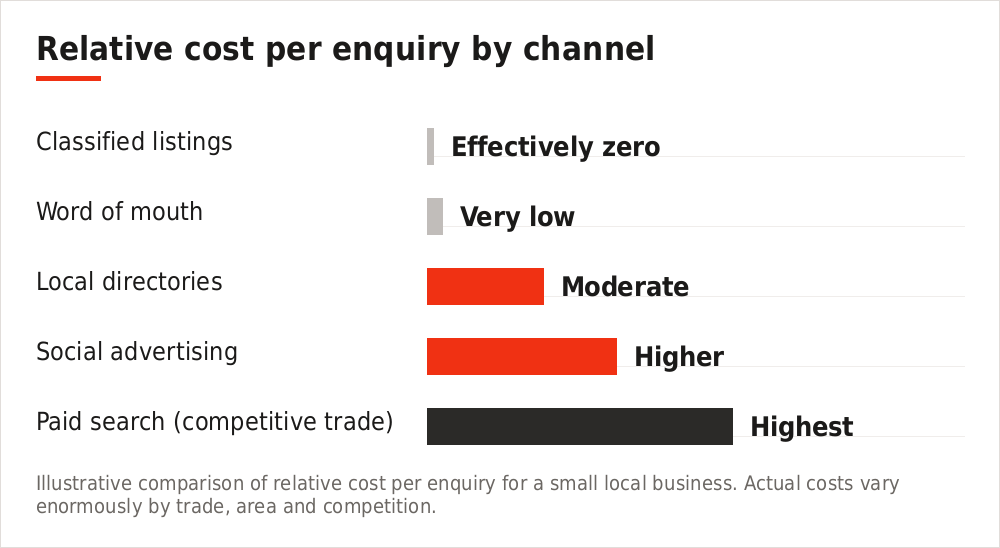
Illustrative comparison of relative cost per enquiry across channels for a small local business. Actual costs vary enormously by trade, area and competition.
| Paid search | Classified listing | |
|---|---|---|
| Cost to appear | Per click, bid-based | Free |
| Cost per enquiry | Several clicks per enquiry | Zero |
| Competitor effect | Raises your costs | None |
| Setup time | Hours, plus ongoing management | Minutes |
| Skill required | Significant | Minimal |
| Volume ceiling | Scales with budget | Limited by category traffic |
| Speed to first lead | Immediate | Hours to days |
The figure that matters is cost per enquiry, not cost per click. If it takes several clicks to produce one message, the real cost of a lead is a multiple of the click price — and in competitive trades that can be a substantial sum for a single conversation.
Where paid search wins
Worth being straightforward about, because for these situations it is the right tool.
- You need volume now — budget converts directly into traffic
- Precise targeting — specific search terms, times, locations, devices
- Testing offers quickly — results within days rather than months
- High-value services — where one job justifies significant acquisition cost
- Categories with no classified presence — some sectors simply are not represented
- Detailed measurement — conversion tracking is far more granular
Advertise your business at no cost
Unlimited listings, no cost per click, no monthly spend to justify.
Where classifieds win
| Situation | Why |
|---|---|
| Small or no budget | Zero cost means zero risk |
| Local trades | Buyers browse by area with immediate need |
| Selling physical stock | Buyers filter by specification, not keywords |
| Property and vehicles | Structured search fields match how people look |
| Job vacancies | Paid search is poorly suited to recruitment |
| No time to manage campaigns | Listings need no daily attention |
| Quiet trading periods | No spend to cut when work slows |
If your budget is small
This is where the decision is clearest. A very small monthly paid-search budget in a competitive trade may buy only a handful of clicks — possibly not even one enquiry — while the same effort spent writing several good classified listings costs nothing and runs continuously.
Start with free listings
Write one per service, name your towns, add photographs of finished work.
Measure what arrives
Track enquiries for a full quarter before concluding anything.
Add paid search only when you need more
Once the free channel is saturated and you still have capacity.
Start paid search narrowly
One tightly defined service, one small area, exact-match terms.
Compare cost per enquiry, not per click
It is the only number that lets you compare the two channels honestly.
Using both together
For established businesses the sensible position is not choosing but combining. Classifieds provide a baseline of enquiries at no cost; paid search adds volume when you need it and can be switched off when you do not.
The combination also hedges a real risk: relying entirely on paid search means your lead flow stops the moment the budget does.
Why lead quality differs
Cost is only half the comparison. The two channels also produce different kinds of enquiry, and that affects how much work each one actually generates.
| Paid search lead | Classified lead | |
|---|---|---|
| How they arrived | Searched a phrase, clicked an advert | Browsed a category, read a full listing |
| What they already know | Little beyond the advert headline | Your services, area, pricing, qualifications |
| Typical first message | General enquiry | Specific question about a specific job |
| Price expectations | Often unset | Often already aligned |
| Comparison shopping | Frequently clicking several adverts | Frequently contacting several listings |
Neither is inherently better, but a classified enquiry has usually read more before making contact — which is why a complete listing with pricing and qualifications tends to produce fewer, better conversations.
Whichever channel you use, the information you publish does the qualifying. A listing that states your rate, your area and what you do not do will produce fewer enquiries and more jobs.
Common paid search mistakes
If you do run paid campaigns alongside free listings, these are the errors that waste the most money for small advertisers.
- Broad match without negatives. You pay for clicks on searches unrelated to what you sell.
- Sending traffic to a homepage. The click should land on the specific service.
- No conversion tracking. Without it you cannot tell which terms produce work.
- Bidding on your own brand unnecessarily. Often paying for traffic you would have had free.
- Running ads outside working hours when nobody answers the phone.
- Too wide a radius. Paying for clicks from people you would never travel to.
- Setting it and forgetting it. Costs drift upward without regular review.
Measuring each properly
- Ask every caller how they found you — the simplest and most reliable method
- Track enquiries per channel over a full quarter, not a fortnight
- Record conversion to quotation, then quotation to work
- Note average job value per channel — they often differ
- Include your own time in the cost of each
- Compare cost per job won, which is the number that actually matters
Frequently asked questions
Which gives better return?
For small local businesses, classifieds usually win on return because the cost is zero. Paid search wins on volume and speed when budget is available.
Can classifieds replace paid advertising entirely?
For many sole traders, yes. For businesses needing predictable high volume, they are a supplement rather than a replacement.
Do I need marketing knowledge?
Not for classifieds — writing a clear listing is the whole skill. Paid search genuinely requires ongoing management.
How long before I see results?
Classified enquiries typically start within days. Paid search can produce clicks immediately but needs weeks of tuning to become efficient.
What about social media advertising?
Different again — lower intent because you are interrupting rather than being searched for, but useful for awareness and visual businesses.
Should I stop paid search if classifieds work?
Not necessarily. Measure both and keep whichever produces work at an acceptable cost.
The short version
Paid search buys volume and costs money per click. Classifieds cost nothing and cannot be outbid, but are capped by how many people browse the category. If your budget is small, start free, measure honestly, and add paid search only when you have exhausted what the free channel can produce.
Start with the free channel
Unlimited listings, no cost per click, no monthly commitment.
Or browse by category and location to check the local market first.