

Wholesalers and Job Lots: Reaching Trade Buyers
Clearance stock, end-of-line goods, customer returns and bankrupt stock all have to go somewhere. Trade buyers actively hunt these categories, and classified platforms are one of the few places where a small wholesaler reaches them without paying a percentage of every deal to an intermediary.
What this covers
Key takeaways
- Trade buyers need quantity, condition and cost per unit before anything else.
- A manifest transforms enquiry quality — provide one wherever you can.
- Be explicit about graded stock: returns, seconds and unchecked goods are different things.
- State pallet count, weight and loading arrangements clearly.
- Trade buyers move fast when the numbers work — and vanish when they are vague.
Who buys job lots
Understanding the buyer changes how you write the listing. These are not consumers looking for a bargain — they are businesses calculating margin.
| Buyer | What they want | How they decide |
|---|---|---|
| Market traders | Mixed consumer goods, low cost per unit | Margin after their pitch fees |
| Online resellers | Identifiable branded stock | Comparable sold prices minus fees |
| Discount retailers | Volume, consistent lines | Shelf price against landed cost |
| Exporters | Full loads, simple documentation | Freight cost per unit |
| Repairers and refurbishers | Faulty and returned goods | Yield after repair |
| Charities and community groups | Usable mixed stock | Whether it can be distributed |
Types of trade stock
Terminology matters here because it sets expectations, and misusing it is the fastest way to a dispute.
- New, boxed — unopened, as supplied
- End of line — new but discontinued
- Customer returns — may be perfect, may be faulty, usually unchecked
- Graded stock — inspected and sorted by condition, grade defined
- Seconds — cosmetic defects, functionally sound
- Spares or repair — known faulty, sold as such
- Shelf pulls — removed from display, packaging may be marked
Customer returns are returned for a reason. Unless you have tested every unit, say plainly that the stock is unchecked and price accordingly. Trade buyers accept that readily — what they will not accept is discovering it after purchase.
Listing a job lot properly
Title: Quantity + Product + Condition + Key detail.
200 mixed branded homeware units, customer returns, unchecked, single pallet
Lead with the numbers
Unit count, pallet count, approximate total weight. This is the first thing a trade buyer needs.
State the condition grade precisely
Using the terms above, not vague phrases like “mostly fine”.
Describe what is actually in it
Product types, brands where you can name them, approximate split if mixed.
Give retail value and asking price
Trade buyers work in percentages of retail. Give them both figures.
Explain collection
Location, loading facilities, forklift availability, access for a curtainsider.
Say whether you will split
Some buyers want part of a load. Decide in advance and state it.
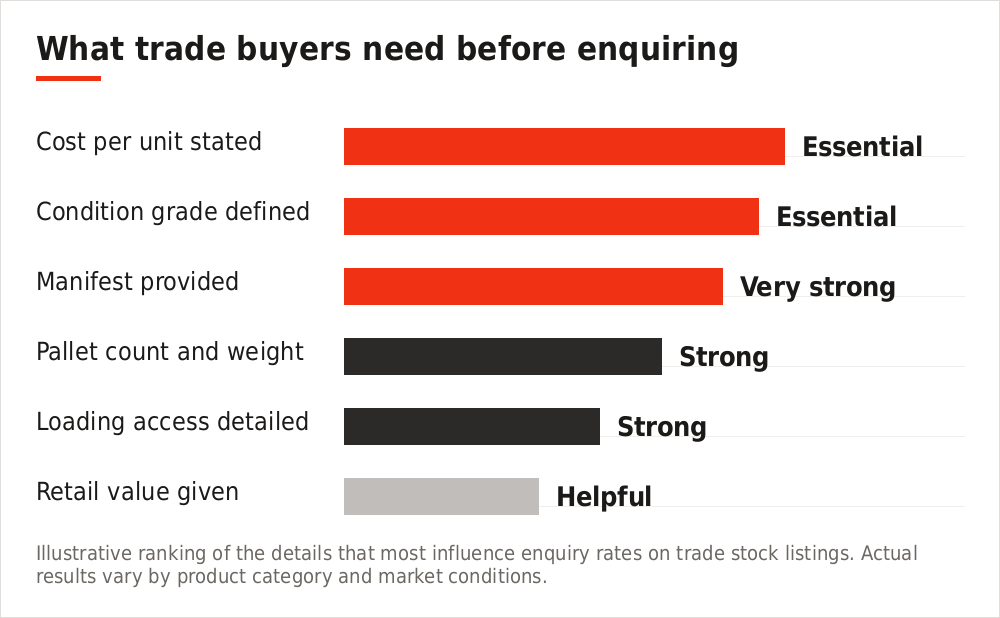
Illustrative ranking of the details that most influence enquiry rates on trade stock listings. Actual results vary by product category and market conditions.
List trade stock free
No listing fees, no commission on the deal, and buyers across 238 countries.
The manifest question
A manifest — a line-by-line list of what is in the load — is the single biggest differentiator between a listing that gets serious enquiries and one that does not.
| With a manifest | Without |
|---|---|
| Buyers can calculate margin precisely | They must assume the worst |
| Fewer, better-qualified enquiries | Many speculative low offers |
| Commands a higher price | Discounted for uncertainty |
| Faster decisions | Buyers want to inspect first |
If a full manifest is impractical, a partial one still helps — a sample of fifty lines from a mixed pallet tells a buyer far more than a category description alone.
Pricing trade stock
Trade buyers price backwards from what they can realise, minus their costs and margin. Understanding that arithmetic helps you price sensibly.
- New, boxed, current lines — typically a meaningful fraction of trade price
- End of line — discounted further for being unsupported
- Graded returns — priced by grade, with the grade defined
- Unchecked returns — heavily discounted; the buyer carries all the risk
- Spares or repair — priced on recoverable component value
“$1,400 for the pallet” means little. “$1,400 for 200 units, $7 each against a $34 retail” lets a buyer decide in seconds — and that speed is what closes trade deals.
Photographing a pallet
- The complete pallet, wrapped, from two angles
- The pallet unwrapped showing depth of stock
- Several individual units, boxed and unboxed
- Any labelling, barcodes or product codes
- A representative sample laid out
- Any damage to packaging or product
- The loading area, so buyers can assess access
Collection and haulage
Trade deals collapse at the logistics stage more often than at the price stage. Answer these in the listing.
| State clearly | Why it matters |
|---|---|
| Number and size of pallets | Determines the vehicle needed |
| Total approximate weight | Affects haulage cost and legality |
| Loading bay or ground level | Tail lift requirement |
| Forklift available on site | Whether the driver needs one |
| Access for an articulated vehicle | Many sites cannot take one |
| Collection hours | Hauliers book by time slot |
| Whether you can arrange delivery | Widens the buyer pool considerably |
Qualifying trade buyers
Ask what they do
A genuine trade buyer answers immediately and specifically.
Ask how they will collect
Vague answers usually mean they have not thought it through and will not proceed.
Agree payment before loading
Cleared funds. Goods do not leave the premises otherwise.
Confirm the terms in writing
Quantity, condition, price, collection date, and that the stock is sold as described.
Be wary of the sight-unseen buyer
Anyone agreeing to a large load without questions is often not a real buyer.
Legal points for wholesalers
Stock must be as described, you must have the right to sell it, and safety-regulated goods must comply with current standards. Recalled products, counterfeit goods and items failing safety requirements must not be sold on at any price.
- Identify yourself as a business in every listing
- Describe condition accurately using recognised trade terms
- Confirm you own the stock outright and it is clear of any finance
- Check for recalls before listing regulated products
- Keep documentation of what was described and agreed
- Handle branded goods carefully — some brands restrict resale channels
- Meet export documentation requirements where goods leave the country
Frequently asked questions
Do I need a manifest?
Not required, but listings with one attract better enquiries and higher prices. Even a partial sample list helps considerably.
Should I split pallets?
It widens your buyer pool but multiplies the handling. Decide before listing and state your position clearly.
How do I price unchecked returns?
Heavily discounted, because the buyer carries all the risk. Be explicit that nothing has been tested.
Can I sell to international buyers?
Yes. Export buyers actively look for full loads. Agree freight, documentation and payment terms in writing first.
What if the buyer disputes the condition?
An accurate written description and photographs are your protection. Vague listings are where disputes originate.
Is there a listing limit?
No cap and no fees. List as many loads as you have.
The short version
Lead with quantity, condition grade and cost per unit. Provide a manifest if you possibly can. Be precise about what “returns” actually means. Answer the haulage questions in the listing. And take cleared payment before anything is loaded.
Reach trade buyers free
No listing fees, no commission, and buyers searching internationally.
Or browse what is listed on List It Global to see what is selling near you.