

How to Sell Musical Instruments Online
Musical instruments are unusual among second-hand goods: many hold their value for decades and some appreciate. A well-made guitar or a decent upright piano can be worth more after twenty years than the equivalent new instrument costs today — which makes accurate identification the most valuable thing you can do before listing.
What this covers
Key takeaways
- Identify the exact model and year before pricing. Value varies enormously within a brand.
- Serial numbers usually date the instrument and are worth including.
- Never repair or refinish before selling — it frequently reduces value.
- Original case, paperwork and parts add meaningfully to the price.
- Buyers want to play it — make that easy and expect it.
Why instruments hold value
Unlike electronics, instruments are not superseded. A guitar built in 1975 does the same job today as it did then, and in many cases does it better for having been played.
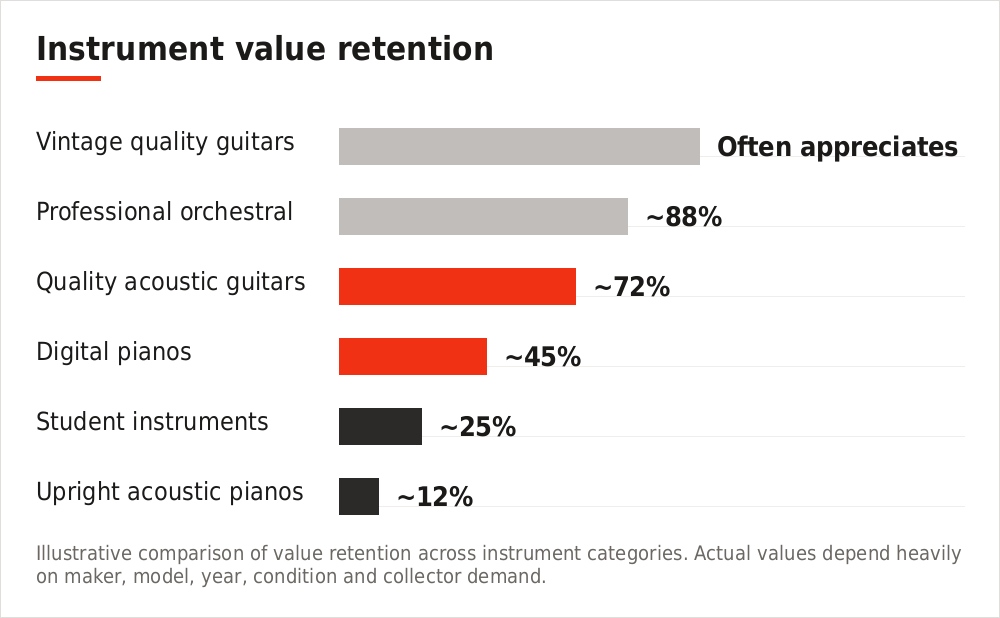
Illustrative comparison of value retention across instrument categories. Actual values depend heavily on maker, model, year, condition and current collector demand.
That said, the market is sharply divided. Quality instruments from recognised makers hold value well; beginner instruments from unbranded manufacturers are worth very little second-hand, because new ones are cheap and plentiful.
Identifying what you have
This is where sellers most often leave money on the table — or price themselves out of a sale by guessing high.
- Maker and model — on the headstock, label, or stamped into the body
- Serial number — usually dates the instrument and confirms where it was made
- Country of manufacture — often affects value substantially within the same brand
- Year or period — certain years command premiums
- Original versus replaced parts — originality matters to collectors
- Any case, paperwork or receipts
A brand may produce both entry-level instruments and professional ones under the same name, made in different countries, differing tenfold in value. The model and serial number are what distinguish them — the logo alone tells a buyer almost nothing.
Guitars and basses
| Check | Why buyers care |
|---|---|
| Neck straightness | Sight down it; a warped neck is expensive or impossible to correct |
| Fret wear | Grooves under the strings mean a refret is due |
| Action height | Indicates whether setup or structural work is needed |
| Cracks in the body or headstock | Headstock breaks substantially reduce value even when repaired |
| Electronics | All pickups, switches and controls working without crackle |
| Original hardware | Replaced tuners or bridges reduce collector value |
| Bridge lifting (acoustics) | A serious and costly structural issue |
Pianos and keyboards
Acoustic pianos are a special case, and worth being realistic about.
- Upright pianos are hard to sell. Many are given away because moving costs exceed their value.
- State when it was last tuned and whether it holds pitch
- Check every key and note any that stick or fail to sound
- Test the pedals individually
- Look for cracks in the soundboard and rust on the strings
- Be explicit about moving — pianos need specialists, and buyers must budget for it
- Digital pianos and stage keyboards sell far more readily — state the model and whether the action is weighted
A buyer who arrives with a van and two friends expecting to move an upright piano will leave without it. Say clearly that specialist movers are required and roughly what that costs in your area — it prevents wasted journeys and reflects well on you.
List your instrument free
Reach musicians locally and collectors internationally. No fees, no commission.
Orchestral and brass
- Violins and strings — note the maker label, but be cautious: many carry copies of famous labels. Describe what the label says rather than claiming what it is.
- Bows — often valuable separately; note the maker, weight and hair condition
- Brass — check for dents, valve action, and whether slides move freely
- Woodwind — pad condition is the main cost; note when it was last serviced
- All of them — the case matters, and student versus professional models differ enormously in value
A great many violins carry labels naming famous makers. The overwhelming majority are factory-made copies, which was normal practice rather than forgery. Say what the label reads and that you cannot verify it — claiming authenticity you cannot support invites a legitimate dispute.
Assessing condition
Musicians expect wear on an instrument that has been played. What they do not accept is undisclosed structural damage.
| Acceptable | Must be disclosed |
|---|---|
| Finish wear and playing marks | Cracks in wood or joints |
| Minor scratches and dings | Previous repairs of any kind |
| Fret wear on an older guitar | Neck warping or twisting |
| Tarnish on brass | Replaced or non-original parts |
| Slightly worn pads or hair | Anything not currently working |
This is counterintuitive and important. Refinishing a vintage instrument can remove most of its value, and an amateur repair is worth less than honest damage. Sell it as it is and let the buyer decide — collectors strongly prefer original condition, even damaged.
Pricing realistically
Research sold prices for the exact model, year and country of manufacture. Adjust for condition, originality and whether the case is included.
For anything you suspect may be genuinely valuable — an old violin, a vintage guitar, a quality bow — get an opinion before listing. A specialist dealer or auction house will often give an indication free, and the difference between a guess and an informed price can be substantial in either direction.
Photographing and listing
- Full front and back in even daylight
- Headstock or maker label, clearly readable
- Serial number close up
- Down the neck from the body, showing straightness
- Fret, pad, valve or hair condition depending on instrument
- Every crack, repair or replaced part
- The case, inside and out
- Any paperwork or receipts
Title: Maker + Model + Year + Key detail.
Yamaha FG180 acoustic guitar, 1970s, original hard case
Collection and shipping
Buyers reasonably want to play an instrument before buying, so expect and encourage that. Have it tuned and ready, and let them take their time.
For shipping, instruments need proper packing — loosened strings, a hard case, and substantial outer protection. Insure it for the full value, and photograph the packing process. Pianos and large items are collection only, and should say so.
Frequently asked questions
Should I get it serviced before selling?
A setup or tuning helps it demonstrate well. Structural repairs and refinishing usually reduce value — leave those to the buyer.
How do I date my instrument?
The serial number, cross-referenced against the maker’s published records where available. Include the number in your listing so buyers can check.
Is my old violin valuable?
Most labelled violins are factory copies rather than the named maker. Describe the label without claiming authenticity, and get an expert opinion if you suspect otherwise.
Why will nobody buy my piano?
Upright pianos are difficult to move and plentiful second-hand. Many change hands free to collect, with the buyer paying specialist transport.
Should I include the case?
Yes — original cases add value and protect the instrument in transit.
Can I ship internationally?
Yes, though check restrictions on certain materials in older instruments, which some countries regulate.
The short version
Find the exact model, serial number and country of manufacture before pricing anything. Disclose every crack and repair. Do not refinish or fix it first. Include the case and paperwork. And let buyers play it — that is how instruments sell.
Reach musicians and collectors
Free to list, free to sell, and buyers across 238 countries.
Or browse what is listed on List It Global to see what is selling near you.