
How to Sell Farm and Agricultural Machinery
Agricultural machinery is one of the categories where a worldwide listing genuinely changes the outcome. Within fifty miles there might be three plausible buyers for a particular baler. Across a continent there are hundreds, and several of them will pay considerably more because they have been looking for exactly that specification.
What this covers
Key takeaways
- Hours and service history matter more than age for most machinery.
- Buyers travel long distances — do not restrict yourself to local listings.
- Export demand is significant and often pays above the domestic market.
- Photograph it working, not just parked.
- Be explicit about loading — weight, dimensions and whether it can be driven on.
Understanding the buyer pool
Agricultural machinery buyers fall into distinct groups, and each values different things.
| Buyer | Wants | Decides on |
|---|---|---|
| Working farmers | Reliable machine ready to use | Hours, condition, parts availability |
| Contractors | Capacity and throughput | Specification and downtime risk |
| Smallholders | Smaller, older, affordable | Price and simplicity |
| Dealers | Stock to refurbish and resell | Margin after reconditioning |
| Exporters | Machines in demand overseas | Shipping cost and destination demand |
| Collectors and restorers | Vintage and classic tractors | Originality and completeness |
The specifications buyers need
- Make, model and year — exactly, including any variant suffix
- Engine hours — the primary measure of use
- Engine power and whether it has been rechipped or modified
- Transmission type and number of speeds
- Drive — two or four wheel
- Hydraulic specification — spool valves, flow rate, linkage category
- PTO speeds available
- Tyre condition as a percentage, front and rear
- Attachments included — loader, bucket, weights, implements
- Serial or chassis number
A set of tractor tyres represents a substantial cost, so buyers price them explicitly. Stating “fronts 40%, rears 70%” is far more useful than “tyres good” and signals a seller who knows the machine.
Hours, condition and honesty
Machinery buyers are experienced and will inspect thoroughly. Overstating condition wastes a journey that may have been several hundred miles.
| Disclose | Why it matters |
|---|---|
| Genuine hours | Replaced clocks must be declared with the true figure |
| Known faults | Hydraulic leaks, electrical issues, warning lights |
| Major work done | Engine or transmission rebuilds — a positive if documented |
| Structural repairs | Welded chassis or loader brackets |
| What it was used for | Arable, livestock, contracting or council work all wear differently |
| Storage | Shedded or outside affects condition considerably |
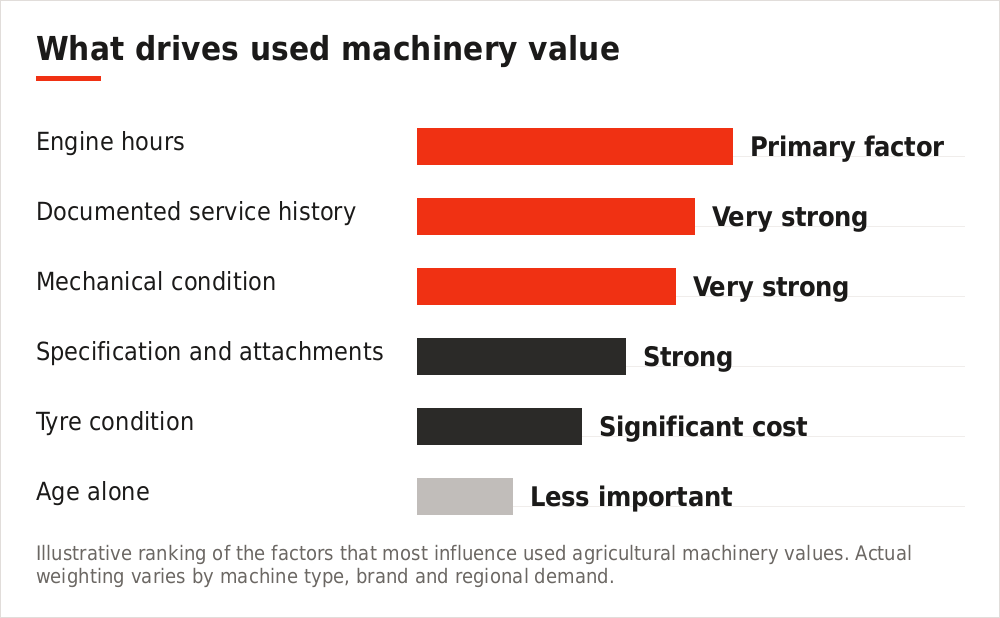
Illustrative ranking of the factors that most influence used agricultural machinery values. Actual weighting varies by machine type, brand and regional demand.
Reach machinery buyers worldwide
238 countries, no listing fees and no commission on the sale.
Documentation that adds value
- Service records — the single most valuable document you can offer
- Original purchase invoice proving ownership history
- Registration documents where the machine is road-registered
- Recent inspection or test certificates
- Operator and parts manuals
- Receipts for major components fitted
- Finance settlement figure if anything is outstanding
Machinery is frequently bought on finance or lease. You cannot sell a machine you do not own outright. Obtain a settlement figure and be transparent with buyers about how it will be cleared before completion.
Pricing farm machinery
Values are driven by hours, condition, specification and current demand, and they move with the farming cycle — buyers have money after harvest and are cautious before it.
Research recent sold prices for the same model and comparable hours, allowing for specification differences. Attachments and implements should be priced separately in your own mind, even if sold as a package, so you know what you are actually giving away in a negotiation.
Photographing large equipment
Wash it first
Caked mud hides condition and suggests neglect. A clean machine photographs far better and buyers read it as cared for.
Shoot in open space
Away from clutter, in even light, with the whole machine in frame from several angles.
Photograph the hour meter
Clearly readable. Buyers will ask for this immediately if it is missing.
Show the working parts
Hydraulics, linkage, PTO, loader brackets, tyres individually.
Include the cab interior
Seat, controls, glass. Cab condition indicates how the machine was treated.
Photograph every fault
Leaks, dents, worn tyres, cracked glass. Buyers travelling far need to know.
Add a video if you can
Cold start and a minute of it running answers more questions than twenty photographs.
Selling for export
Export buyers are a significant part of this market and frequently pay above domestic prices for machines in demand overseas.
- State the specification precisely — export buyers cannot inspect first
- Provide plenty of photographs and video — this substitutes for viewing
- Give exact dimensions and weight for container or low-loader planning
- Confirm whether it can be driven onto a trailer
- Wait for fully cleared funds before release — without exception
- Agree who handles documentation and export paperwork
- Be clear the machine is sold as seen where that applies
Transport and loading
Machinery deals fail at collection more often than at price. Answer these in the listing.
| State clearly | Why |
|---|---|
| Weight and dimensions | Determines the trailer and whether permits are needed |
| Whether it runs and drives | A non-runner needs winching |
| Loading facilities on site | Ramp, hard standing, telehandler available |
| Access for a low-loader | Many farm tracks cannot take one |
| Collection hours | Hauliers book by time slot |
| Whether you will help load | Sets expectations before arrival |
Legal and safety points
- Guards and safety devices must be present and functional — removing PTO guards is unlawful in most countries
- Disclose known defects affecting safe operation
- Confirm ownership and clear any finance before sale
- Check for manufacturer safety notices on the model
- Business sellers carry additional obligations on description and quality
- Drain or declare fluids where required for shipping
- Provide a written receipt recording condition as sold
Frequently asked questions
Do buyers really travel for machinery?
Routinely. For the right specification at the right price, buyers cross countries — which is why restricting yourself to a local listing costs money.
Should I service it before selling?
A basic service and a wash pay for themselves. Major work rarely returns its cost unless it fixes a known fault.
What if the hour meter has been replaced?
Declare it clearly with the true total hours where known. Undeclared clock changes are fraud in most jurisdictions.
Is it worth selling a non-runner?
Yes — dealers, restorers and parts buyers want them. Describe the fault precisely and price for parts.
Should I sell implements separately?
Often you achieve more selling them individually, though a package can suit a buyer setting up. Price both ways before deciding.
How do I handle an export buyer?
Full specification and video upfront, cleared funds before release, and written agreement on who arranges transport and paperwork.
The short version
State hours, specification and tyre percentages precisely. Wash it and photograph it working, including every fault. Provide service records. Be explicit about weight, access and loading. And list it worldwide — the buyer who pays most is rarely the closest one.
List machinery to a worldwide market
Free to list, free to sell, no commission at any value.
You can also browse listings across 238 countries before you decide on a price.