How to Sell Construction and Plant Equipment
Plant and construction equipment holds value well and has an unusually international market. Machines regularly cross borders because demand and pricing differ sharply between regions — which means a listing restricted to your own country is often leaving money on the table.
What this covers
Key takeaways
- Hours and wear items drive value more than age.
- Plant theft is common — buyers expect proof of ownership.
- Export demand is substantial and frequently exceeds domestic prices.
- Video of the machine working answers more questions than any description.
- Transport weight and dimensions are essential information, not detail.
Who buys used plant
| Buyer | Priorities |
|---|---|
| Groundwork contractors | Ready to work, reliable, parts available |
| Plant hire companies | Low hours, good condition, common models |
| Small builders | Affordable, simple, versatile |
| Dealers | Margin after refurbishment |
| Exporters | Models in demand overseas, shipping practicality |
| Farmers and estates | Occasional use, price sensitive |
Specifications buyers need
- Make, model and year including variant
- Operating weight — the primary classification for excavators
- Engine hours and whether the meter is original
- Engine make and emissions standard — increasingly important for site access
- Tracks or wheels, and their condition as a percentage
- Attachments included — buckets, breaker lines, quick hitch type
- Hydraulic circuits fitted
- Cab specification — heating, air conditioning, camera
- Serial or PIN number
Many urban sites and some cities now restrict machines below a given emissions standard. Stating it clearly tells contractors immediately whether they can use the machine where they work, and it is a question you will otherwise be asked repeatedly.
Hours, condition and wear items
Plant buyers assess a small number of expensive wear items. Address them directly and you remove most of the negotiation.
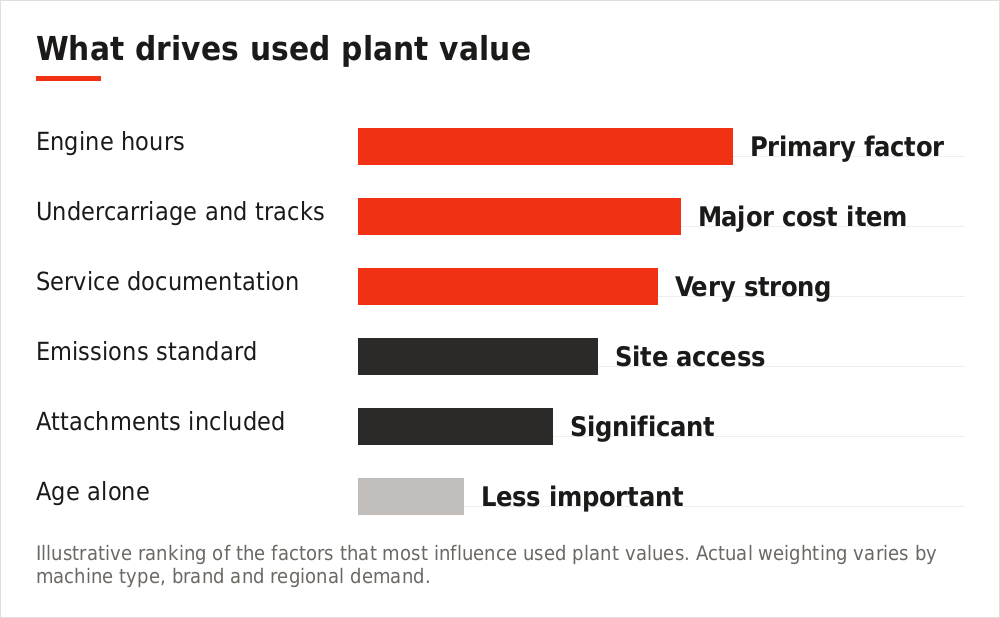
Illustrative ranking of the factors that most influence used plant values. Actual weighting varies by machine type, brand and regional demand.
| Wear item | What buyers check |
|---|---|
| Tracks or tyres | Percentage remaining — a substantial replacement cost |
| Undercarriage | Rollers, idlers, sprockets; expensive as a set |
| Pins and bushes | Play in the boom and dipper joints |
| Hydraulic rams | Scoring, pitting, weeping seals |
| Slew ring | Play when rotating — a major cost if worn |
| Bucket and teeth | Wear and whether replacements are included |
| Glass and cab | Cracks, seals, seat condition |
Reach plant buyers worldwide
238 countries, no listing fees, and no commission on any sale value.
Documentation and compliance
- Service records — the most valuable document you can provide
- Original purchase invoice
- Current inspection certificate where your jurisdiction requires periodic examination
- Lifting certification for machines used in lifting duties
- Operator and parts manuals
- Receipts for major components fitted
- Finance settlement figure if anything is outstanding
In many countries, plant used in lifting operations requires periodic thorough examination by law, with current certification. Selling a machine with expired or missing certification limits who can legally put it to work — disclose the position clearly.
Proving ownership
Plant theft is a significant and organised problem, so serious buyers routinely check provenance. Being ready marks you out as genuine.
- Keep the original invoice and be willing to show it
- Know the serial or PIN number and let buyers verify it against the machine
- Mention any plant register or marking scheme the machine is enrolled in, and transfer it at sale
- Be willing to meet at your yard rather than a neutral location
- Provide a detailed written receipt recording serial number and condition
Pricing plant
Values track hours, condition of wear items, specification and current construction activity. They also vary regionally, which is exactly why export buyers appear.
Research recent sold prices for the same model and comparable hours. Price attachments separately in your own mind even when selling as a package, so you know what a negotiation is actually costing you.
Photographing and filming
Pressure wash it first
Mud conceals condition and reads as neglect. A clean machine consistently achieves more.
Shoot all four sides in open ground
Even light, whole machine in frame.
Photograph the hour meter
Clearly readable, with the display lit.
Cover every wear item
Tracks, undercarriage, pins, rams, bucket, slew.
Show the cab and controls
Interior condition indicates how it has been treated.
Film it working
Cold start, full boom and dipper movement, slew both ways, tracking forward and back. Two minutes of video replaces a great deal of correspondence.
Photograph every fault
Buyers may travel hundreds of miles. Surprises end deals.
Selling attachments and ancillary equipment
Buckets, breakers, augers and quick hitches have their own active market, and sellers frequently undervalue them by treating them as an afterthought bundled with the machine.
- State the hitch type and pin size — this determines what the attachment fits, and is the first thing any buyer asks
- Give the width and capacity for buckets
- Note the machine weight class the attachment suits
- Describe wear on cutting edges and teeth, and whether spares are included
- For hydraulic attachments, state flow and pressure requirements
- Mention hoses and couplings supplied
A contractor who already owns an excavator needs a particular bucket now, not eventually. Listing attachments separately reaches those buyers, and they typically make decisions within days rather than weeks.
When to sell
Plant values track construction activity, which follows a reasonably predictable annual pattern in most markets.
| Period | Market conditions |
|---|---|
| Late winter to spring | Strongest — contractors gearing up for the season |
| Summer | Steady, though buyers are busy working |
| Early autumn | Reasonable — end-of-season fleet changes |
| Deep winter | Weakest — work slows and cash is tight |
| Financial year end | Can lift demand where buyers are managing tax position |
If you have flexibility, listing in late winter rather than late autumn frequently makes a meaningful difference to what you achieve.
Export and international buyers
- Full specification and video — this substitutes for inspection
- Exact weight and dimensions for container or low-loader planning
- Whether it fits a standard container or needs flat rack
- Cleared funds before release — without exception
- Agree who handles export documentation
- Be clear it is sold as seen where that applies
- Be wary of buyer-arranged collection before payment settles
Loading and haulage
| State clearly | Why |
|---|---|
| Operating weight | Determines the trailer and any permits |
| Transport dimensions | Height and width when prepared for travel |
| Whether it starts and drives | A non-runner needs winching |
| Loading facilities on site | Hard standing, ramp, telehandler |
| Access for a low-loader | Many yards and sites cannot take one |
| Collection hours | Hauliers work to booked slots |
Frequently asked questions
Do buyers really travel internationally for plant?
Routinely. Regional price differences make export viable, and exporters actively search for specific models.
Should I replace worn tracks before selling?
Usually not — you rarely recover the cost. State the percentage remaining and price accordingly.
What if the hour meter has failed?
Declare it plainly with the best estimate of true hours. Undeclared meter issues are treated as fraud in most jurisdictions.
Is a non-runner worth listing?
Yes. Dealers and parts buyers actively want them. Describe the fault precisely.
How do I prove the machine is not stolen?
Original invoice, serial number verification and willingness to meet at your yard. Genuine sellers have no reason to avoid any of it.
Should attachments be sold separately?
Often you achieve more individually, though a package suits a buyer setting up. Price both ways before deciding.
The short version
State hours, operating weight, emissions standard and wear-item percentages. Wash it and film it working. Have the invoice and serial number ready for provenance questions. Give exact transport weight and dimensions. And list internationally — that is where the strongest prices usually come from.
List plant to an international market
Free to list, free to sell, no commission at any value.
You can also search listings worldwide without creating an account.