
Advertising Pets Responsibly: Rules and Best Practice
Advertising animals is unlike any other category. The rules are stricter, the responsibilities are greater, and the consequences of getting it wrong fall on a living creature. This guide covers what the law generally requires, what responsible advertising looks like, and how to screen the people who respond.
Rules on advertising and selling animals vary substantially between countries and often between regions. Many jurisdictions require licensing to breed or sell, prohibit sales of animals below a minimum age, ban the sale of certain species entirely, and require specific information in every advertisement. Check the law where you are before advertising anything. This is general guidance, not legal advice.
What this covers
Key takeaways
- Check licensing requirements before advertising — many places require it to sell animals.
- Minimum age rules exist almost everywhere and are not negotiable.
- Buyers should always see the animal with its mother, in its home.
- Never accept a deposit from someone who has not visited.
- Screening the new owner properly is the most important thing you will do.
Legal requirements to check first
These vary by country, but the categories of requirement are broadly consistent. Check each one against your local rules before writing an advertisement.
- Licensing — many jurisdictions require a licence to breed or sell animals, sometimes above a threshold of litters per year
- Minimum age — commonly eight weeks for puppies and kittens; often illegal to separate earlier
- Microchipping — frequently required before sale, with registration transferred to the new owner
- Mandatory advertisement content — some countries require the licence number, country of origin, and age to appear in every listing
- Prohibited species — restricted, dangerous and protected animals
- Health certification — vaccinations, veterinary checks, parasite treatment
- Third-party sale bans — several countries now prohibit selling puppies and kittens other than by the breeder
Where licensing exists, the licence number frequently must appear in the advertisement itself. Listings without it may be removed and the seller may be committing an offence. This is one of the few categories where the law dictates what your listing must say.
What should never be advertised
| Never | Why |
|---|---|
| Animals below the legal minimum age | Illegal, and harmful to the animal |
| Protected or endangered species | Serious criminal offence in most countries |
| Restricted or banned breeds | Prohibited where breed-specific legislation applies |
| Animals as free giveaways or prizes | Attracts unsuitable homes; often unlawful |
| Pregnant animals for sale | Banned in many jurisdictions |
| Animals you cannot legally sell | Including those requiring licences you do not hold |
| Wild-caught animals | Illegal in most places and unethical everywhere |
Rehoming versus selling
These are genuinely different situations with different considerations.
Rehoming an animal you can no longer keep — because of illness, relocation, changed circumstances — is a responsible act when done carefully. Be honest about why, about the animal’s temperament and any behavioural or medical issues, and screen the new home properly.
Breeding and selling carries the full weight of licensing, health and welfare obligations. If you are producing litters, you are almost certainly subject to rules that occasional rehoming is not.
For rehoming, a reputable rescue will screen homes far more thoroughly than you can, and will usually take the animal back if the placement fails. For many animals that is the better outcome than a private advertisement.
What a responsible advertisement contains
- Species, breed or type — honestly, including crossbreeds
- Age and date of birth
- Sex, and whether neutered
- Microchip status and that registration will transfer
- Vaccination and worming record
- Health history, including any known conditions
- Temperament and how the animal is with children and other pets
- Why it is being rehomed
- Licence number where required
- That viewing is expected before any commitment
An animal with a medical condition or a behavioural issue can still find the right home — but only if the new owner knows and is prepared for it. Concealing it leads to the animal being returned, passed on again, or abandoned.
Photographs
- Recent, genuine photographs of the actual animal — never stock images
- The animal in its home environment, not against a blank background
- With its mother where it is a young animal — buyers should expect this
- Several angles and a clear view of condition
- No filters or heavy editing
- Nothing suggesting poor conditions — if the environment does not photograph well, address the environment
Listings here are reviewed before publication
Every advertisement is checked by a moderator, and listings that breach our rules on animal welfare are removed. Reports are acted on.
Screening potential owners
This matters more than anything else in the process. You are deciding where an animal spends its life.
Ask about their circumstances
Home, garden, working hours, other animals, children, previous experience with the species.
Ask what happens if things change
Holidays, moving house, illness. Their answer tells you a great deal.
Insist they visit
Anyone unwilling to come and meet the animal should not be taking it.
Watch the interaction
How they handle the animal, and how it responds to them.
Be willing to say no
You are under no obligation. “I do not think this is the right match” is a complete answer.
Offer to take the animal back
If the placement fails. Responsible sellers make this offer and mean it.
Wanting to buy immediately without meeting the animal. Asking about multiple animals at once. Unwilling to answer questions about their home. Offering to pay a deposit sight unseen. Asking whether the animal is good for guarding or fighting. Any of these should end the conversation.
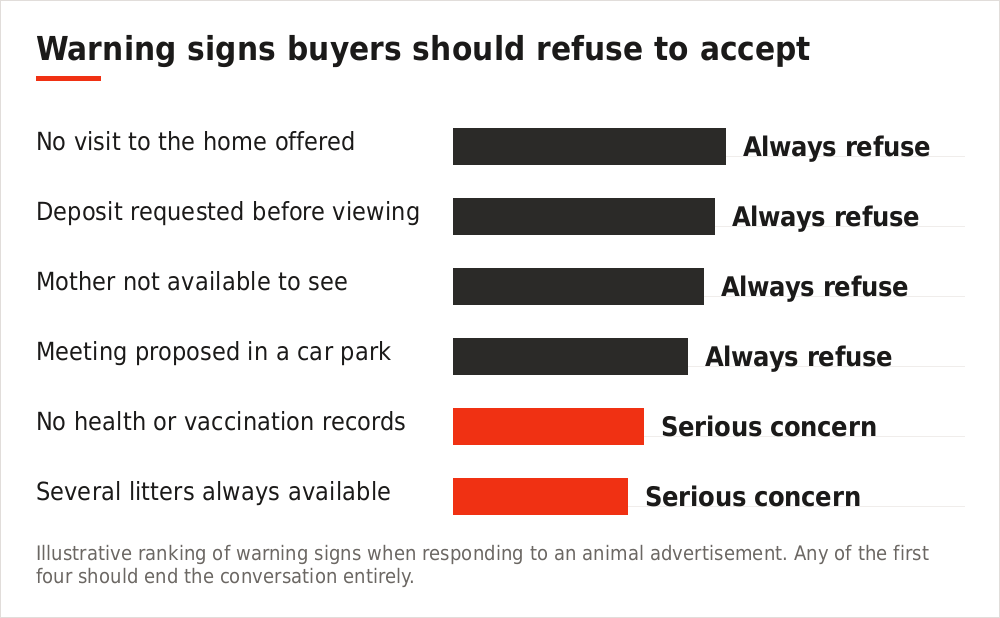
Illustrative ranking of warning signs when responding to an animal advertisement. Any of the first four should end the conversation entirely.
The handover
- Transfer the microchip registration on the day
- Provide all veterinary records and vaccination cards
- Give written details of diet, routine and any medication
- Send some current food to avoid an abrupt change
- Provide a written receipt recording the animal and both parties
- Offer ongoing contact for questions in the first weeks
- Never hand over an animal in a car park — the new owner should see where it came from
If you are looking for an animal
The same rules read from the other side, and buyers have real power to discourage bad practice by refusing to engage with it.
- Always see the animal with its mother, in the home where it was raised
- Never pay a deposit before visiting
- Never meet in a car park or motorway services to collect an animal
- Ask for health records and check the microchip is registered to the seller
- Walk away from anything that feels wrong — and report it
- Consider a rescue — animals of every type and age need homes
Buyers who insist on seeing the mother, refuse to pay deposits remotely and will not meet in car parks make illegal breeding and importing unprofitable. It is the single most effective thing an individual can do.
Frequently asked questions
Do I need a licence to sell animals?
In many countries yes, particularly for breeding. Requirements and thresholds vary considerably — check your local rules before advertising.
What is the minimum age?
Commonly eight weeks for puppies and kittens, and separating them earlier is unlawful in many places. Check the rule where you are.
Should I advertise an animal as free?
Generally no. Free listings attract unsuitable homes and are prohibited in some jurisdictions. A modest fee encourages consideration.
Can I rehome an animal I can no longer keep?
Yes, and doing it carefully is responsible. Be honest about the reason and any issues, and screen the new home properly.
What if the new owner cannot cope?
Offer to take the animal back. Responsible sellers make that offer at the outset and honour it.
How do I report a suspicious listing?
Use the report button, and contact your national animal welfare body if you suspect illegal breeding or importing.
The short version
Check the law where you are before advertising anything. Include the age, health record, microchip status and licence number where required. Insist that buyers visit and see the animal in its home. Screen properly, be willing to refuse, and offer to take the animal back if the placement fails.
Advertise responsibly on a moderated platform
Every listing reviewed before publication, and reported listings acted on.
Or start by browsing the marketplace to see comparable items.