

How Long Should You Leave an Ad Online?
Most sellers either give up too early or leave an unchanged listing running for months. Neither works. An advertisement has a natural life, and knowing when to leave it, when to change it and when to withdraw it entirely saves a great deal of wasted effort.
What this covers
Key takeaways
- Most items that sell do so in the first week, while the listing is still near the top.
- Two weeks of silence is enough information to act on.
- Reposting an identical listing rarely works — the same buyers see the same ad.
- Change one thing at a time, or you learn nothing from the result.
- Some categories genuinely take months — know which yours is.
The natural life of a listing
Classified results are ordered largely by recency. Your listing appears near the top when published, then descends steadily as newer ones arrive. That descent is what shapes everything.
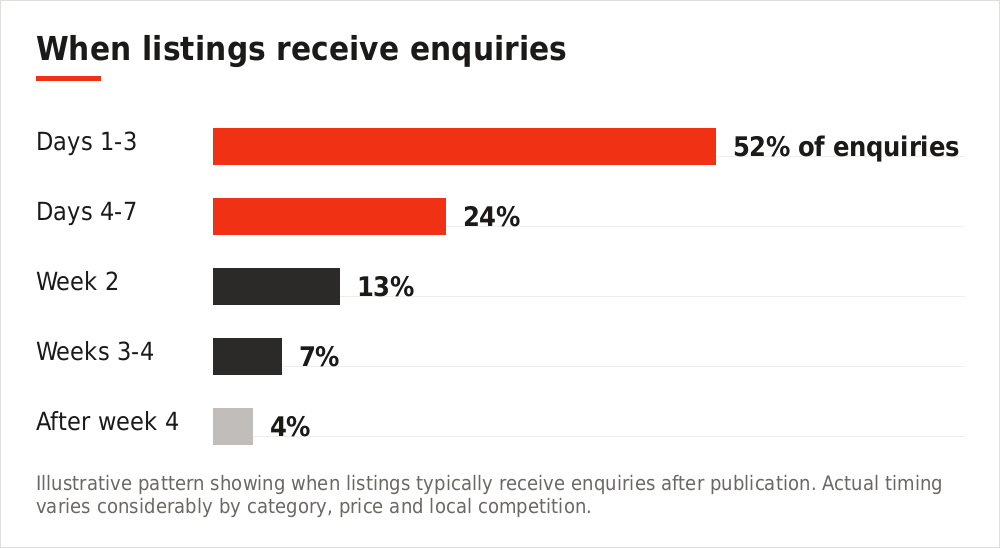
Illustrative pattern showing when listings typically receive enquiries after publication. Actual timing varies considerably by category, price and local competition.
The first week
This is when a correctly priced item with good photographs will sell. Your job is mostly to be responsive.
- Reply within the hour where you can — second-hand buying is impulsive
- Do not adjust anything yet — you have insufficient information
- Watch the view count, which is your diagnostic
- Answer questions fully and add anything asked twice to the description
- Keep the listing live until money changes hands, not when someone promises to come
Sellers frequently cut the price within seventy-two hours. It is too early. You have not yet learned whether the problem is price, photographs or simply that the right buyer has not looked this week.
The two-week decision
Two weeks with no genuine enquiries is enough to act on. What you change depends entirely on what the numbers show.
| What you see | Diagnosis | Change |
|---|---|---|
| Almost no views | Nobody is finding it | Rewrite the title; check the category and location |
| Views, no messages | Price or photographs | Reshoot in daylight, or drop 10–15% |
| Messages, no viewings | Description missing detail | Add measurements, condition, collection terms |
| Viewings, no sale | Condition overstated | Describe flaws accurately and reprice |
| Only low offers | Above market | Recheck comparables honestly |
Drop the price and reshoot simultaneously and you will never know which worked, and you may have given away money you did not need to. Adjust one variable, observe for a week, then adjust the other.
Edit your listing any time, free
Unlimited edits, 60-day listings and free renewal. No commission at any value.
Refreshing versus reposting
These are different things and produce very different results.
| Refreshing | Reposting unchanged |
|---|---|
| New photographs, revised price, better title | Identical listing, published again |
| Reaches buyers who passed before, with something new | Same buyers see the same thing and pass again |
| Keeps your view history as diagnostic data | Loses the history |
| Usually effective | Usually pointless |
Editing an existing listing is generally better than deleting and recreating it, because you keep the view count that tells you whether your changes are working.
Expiry and renewal
Listings here run for 60 days, with an email before expiry so nothing disappears without warning. Renewal is free and unlimited.
- Treat the reminder as a prompt to review, not just to click renew
- If it has not sold in 60 days unchanged, it will not sell in the next 60 unchanged
- Reshoot the photographs before renewing
- Revisit the price against current comparables
- Consider the season — some items are worth pausing until the right month
- Withdraw it if you no longer genuinely want to sell
Items that legitimately take months
Not every slow listing is a mistake. Some categories have thin buyer pools and simply require patience, provided the price and presentation are already right.
| Category | Why it takes longer |
|---|---|
| Specialist equipment | Few buyers exist; you are waiting for one |
| Very high value items | Fewer buyers, longer decisions |
| Collectables | The right collector may look once a month |
| Out of season goods | Demand returns with the season |
| Unfashionable furniture | Currently slow almost everywhere |
| Rural locations | Small local pool; widen the radius instead |
Waiting is a legitimate strategy for a specialist item that is well photographed and sensibly priced. It is not a strategy for an overpriced item with one dark photograph — that will still be there in six months.
Running several listings at once
Clearing a house or selling a collection changes the arithmetic. Twenty listings all published on the same afternoon compete with each other for attention, and they all expire on the same day two months later.
Stagger publication
Release a few each day rather than all at once. Because results favour recency, a steady flow keeps something of yours near the top continuously.
Lead with the most valuable items
They take longest to sell and deserve the most attention while you still have energy for the process.
Bundle the low-value remainder
Fifteen individual listings for items worth very little each is a great deal of work for a small return. One job lot is quicker for everyone.
Keep a simple record
What is listed, at what price, when it expires. Without it you will lose track and let things lapse unnoticed.
Review weekly rather than reacting
Half an hour once a week to remove sold items, renew what is expiring and reprice what has not moved.
If you are moving out on a fixed date, price for the deadline you actually have rather than the market rate. An item that must be gone by Friday is worth what someone will pay before Friday, and holding out usually ends with a free-to-collect listing on the final evening.
When to withdraw entirely
- It has sold — remove it immediately, everywhere you listed it
- You have decided to keep it — do not leave a listing you will not honour
- You cannot meet the collection terms you advertised
- The item is no longer as described — further damage, missing parts
- You are away for a period and cannot respond — pause rather than ignore
- The season is wrong and you can wait for a better one
Nothing frustrates buyers more than enquiring about something already gone, and for anyone selling regularly it is the fastest way to acquire a poor reputation locally. Remove listings the moment money changes hands.
Frequently asked questions
How long should I wait before dropping the price?
Two weeks with no genuine enquiries. Earlier than that and you are guessing rather than responding to information.
Is it better to edit or repost?
Edit. You keep the view history, which tells you whether your changes are working. Repost only if the listing has expired.
How much should I reduce by?
10–15%. Smaller cuts rarely reach new buyers or cross a search filter boundary.
What happens when a listing expires?
It stops being visible. You are emailed beforehand and renewal is free and unlimited.
Should I relist in a different season?
For strongly seasonal items, yes. Refresh the photographs and revisit the price rather than republishing the same ad.
Can I pause a listing?
You can remove it and republish later. For anything seasonal that is often better than leaving it running through the wrong months.
The short version
Leave it alone for the first week and reply quickly. At two weeks, read the view count and change one thing. Refresh rather than repost. Treat the 60-day reminder as a prompt to reshoot and reprice. And remove it the moment it sells.
List, edit and renew, all free
60-day listings, unlimited free renewals, no commission at any value.
Have a look at what is currently listed to judge the going rate.