


A Complete Guide to Selling Worldwide for Free
Selling something online should not cost you a slice of the sale. Yet on most large marketplaces it does — and the amount grows with the value of what you sell. This guide explains how free classified advertising actually works, what commission really costs on the platforms most people default to, how to write an ad that sells, and how to do it safely whether your buyer is two streets away or two continents away.
What this guide covers
- What a classified ad actually is
- The four business models behind “free”
- What commission really costs you
- The global platform landscape
- Why national platforms limit your buyers
- Photography that sells
- Writing titles buyers actually search for
- Pricing: the single biggest lever
- The description template
- When to post and how long to wait
- Handling enquiries and offers
- Staying safe
- Selling as a business
- Twelve mistakes that kill ads
- Frequently asked questions
Key takeaways
- Commission marketplaces typically take 5–20% of the final sale price — on a $5,000 item that is $250 to $1,000 gone.
- Classified platforms connect you directly to the buyer and take nothing from the transaction.
- Most classified sites are national. If your buyer is abroad, they will never see your ad.
- Photographs and price account for the overwhelming majority of whether an ad sells.
- Most items that sell do so in the first week. If two weeks pass in silence, the problem is price or photos, not exposure.
What a classified ad actually is
A classified ad is a structured listing organised by category and location. You describe what you are selling, set a price, add photographs, and buyers contact you directly. The platform’s job is discovery: putting your item in front of people who are already looking for it.
That is a genuinely different model from an e-commerce marketplace. On Amazon, Etsy or eBay’s fixed-price listings, the platform sits between you and the buyer. It processes the payment, holds the funds, manages disputes, and takes a percentage for doing so. There is real value in that service — but you pay for it on every single sale.
A classified platform does none of those things. It does not touch the money. You and the buyer agree the price, arrange the handover, and settle payment between yourselves. The platform’s only role is helping you find each other.
If you are selling a $30 phone case, commission is irrelevant. If you are selling a car, a tractor, a camera kit or a piano, the difference between the two models can be hundreds or thousands of currency units on a single transaction.
The four business models behind “free”
“Free” is used loosely across the industry. Four distinct models sit behind that word, and knowing which one you are dealing with tells you what a sale will actually cost.
| Model | What you pay | Cost on a $2,000 sale | Typical of |
|---|---|---|---|
| Genuinely free | Nothing to list, nothing on sale | $0 | Classified platforms |
| Free with paid boosts | Optional visibility fees | $0–$30 | Most large classified sites |
| Free listing, paid sale | 5–20% commission | $100–$400 | Payment-processing marketplaces |
| Subscription | Monthly fee regardless of sales | Varies | Trade and dealer platforms |
None of these models is dishonest, and each suits a different seller. A high-volume trader may find a subscription cheaper than per-sale commission. A first-time seller shifting one item almost never does.
The model that catches people out is the third. The listing is free, so there is no barrier to posting — and the cost only becomes visible when the money arrives and a percentage has already gone.
What commission really costs you
Commission is charged on the final sale price, not on your profit. This is the part sellers consistently underestimate. If you buy a camera for $1,800 and sell it two years later for $1,200, a 13% commission takes $156 — from a transaction on which you already lost $600.
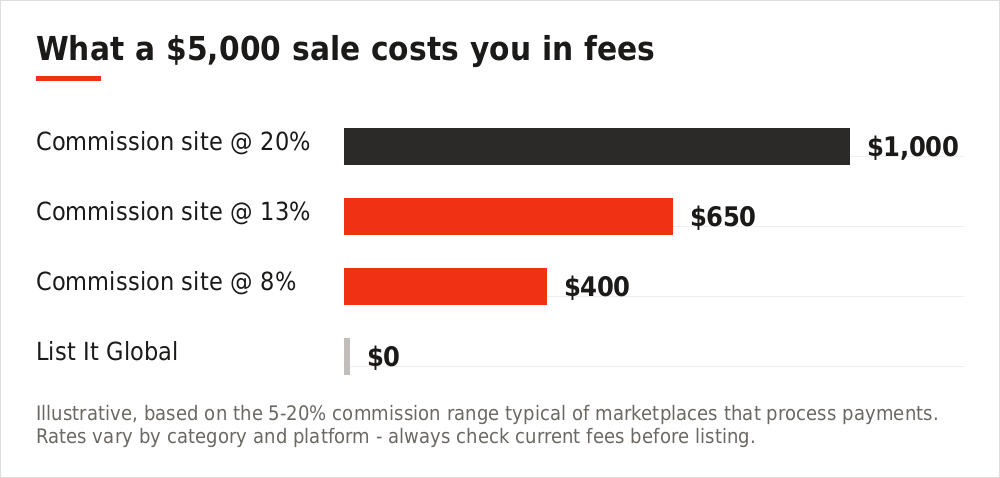
Illustrative, based on the 5–20% commission range typical of marketplaces that process payments. Rates vary by category and platform — always check current fees before listing.
Scale that across a year of selling and the numbers become serious. Somebody clearing a garage, upgrading equipment or trading vehicles might move $20,000 of goods annually. At 13%, that is $2,600 — the price of the next item they were saving for.
The hidden costs beyond commission
Headline commission is rarely the whole picture. Depending on the platform you may also encounter:
- Payment processing fees — commonly around 2.9% plus a fixed amount per transaction, sometimes charged on top of commission.
- Currency conversion — a spread applied when the buyer pays in a different currency.
- Withdrawal fees — charged to move your own money to your own bank account.
- Promoted listing fees — optional in theory, close to mandatory in saturated categories.
- Shipping subsidies — “free shipping” that comes out of your margin.
Stack those and an advertised 10% can land closer to 15% by the time funds reach your account.
Keep 100% of what you sell
List It Global charges no listing fee, no commission and no subscription. Whatever you agree with your buyer is what you keep — whether that is $20 or $20,000.
The global platform landscape
Classified advertising is strikingly regional. Most people know one or two platforms — whichever dominate where they live — and assume that is the market. It is not.
| Platform | Strongest in | Model | Best known for |
|---|---|---|---|
| Craigslist | United States | Mostly free | Housing, jobs, community |
| Gumtree | UK, Australia | Free with paid tiers | Second-hand goods, cars, rentals |
| Kijiji | Canada | Free with paid tiers | General classifieds |
| OLX | Many emerging markets | Free with paid tiers | Electronics, vehicles |
| Dubizzle | UAE and Gulf | Free with paid tiers | Property, cars, jobs |
| Facebook Marketplace | Global, but local-first | Free | Local pickup items |
| eBay | Global | Commission | Collectables, parts, auctions |
Each of these is genuinely good at what it does. If you are selling a sofa in Manchester, Gumtree is a sensible first stop. If you want a bidding war on a rare vinyl pressing, eBay’s auction format is hard to beat.
The gap appears when your buyer is not in your country.
Why national platforms limit your buyers
National platforms segment by design. Post a listing on a UK site and it is served to UK users. That is exactly right for a wardrobe nobody will ship. It is exactly wrong for anything where the natural buyer pool is thin locally and deep internationally.
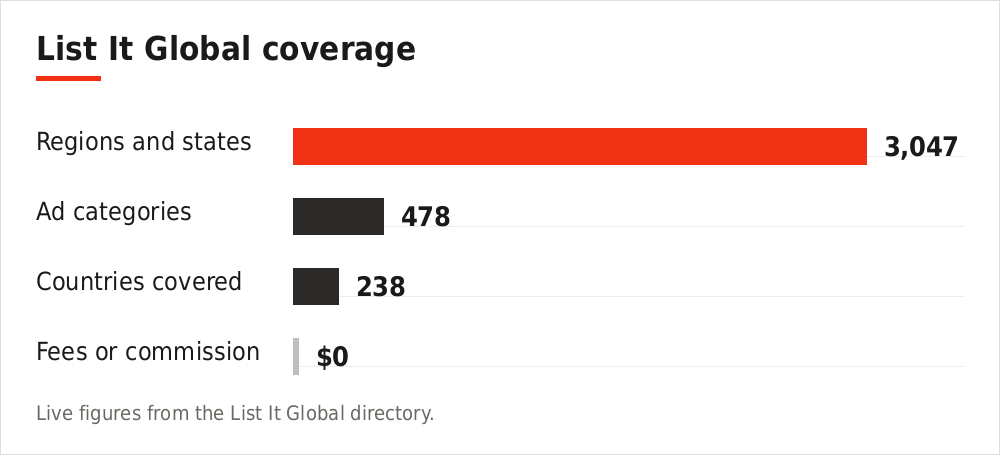
Live figures from the List It Global directory.
Consider a specialist item — a vintage lens, a piece of agricultural machinery, a left-hand-drive classic car, industrial equipment from a business closure. Within 50 miles there might be three plausible buyers. Across a continent there might be three hundred, and several of them will pay a premium because they have been hunting for that exact item.
Post locally and globally. Local platforms move everyday household items quickly. A worldwide platform is where specialist, high-value or hard-to-find items find the buyer who has been searching for months. There is no cost to doing both.
Photography that sells
If you change one thing about how you list, change the photographs. Buyers scroll fast, and the image decides whether they stop. Ads with clear, plentiful photos consistently outperform ads with one dark snapshot — not because of any algorithm, but because buyers will not enquire about something they cannot see.
Use daylight, never flash
Photograph near a window or outdoors on an overcast day. Flash flattens detail, creates harsh shadows and makes fabric and paintwork look worse than they are.
Clear the background
A plain wall, floor or table. Clutter makes an item look neglected, and buyers read a messy background as a messy seller.
Shoot at least eight angles
Front, back, both sides, top, underneath, any serial or model plate, and a close-up of the most important detail. More photos means fewer questions.
Photograph the flaws deliberately
Scratches, wear, missing parts. This feels counterintuitive but it is the single best filter against wasted viewings. A buyer who sees the chip in the photo and comes anyway is a buyer who will complete.
Add scale and context
A hand, a coin, a room shot. “Large” means nothing without reference, and returns and disputes often start with a size misunderstanding.
Clean it first
Ten minutes with a cloth is the highest-return work you will do. Dust reads as neglect and knocks money off the price a buyer is willing to offer.
Buyers of second-hand goods want to see your item in your condition. A catalogue photo signals that you are hiding something — and on moderated platforms it is a common reason for rejection.
Writing titles buyers actually search for
Your title is a search query in disguise. Buyers type what they want, and the closer your title matches that phrasing, the more often you appear.
| Weak title | Strong title | Why it works |
|---|---|---|
| Sofa for sale | 3-seater grey fabric sofa, 2 years old, smoke-free home | Size, colour, material, age, condition signal |
| iPhone | iPhone 13 Pro 256GB Graphite, unlocked, battery 91% | Model, storage, colour, network, battery health |
| Car for sale cheap | 2016 Toyota Corolla 1.6 petrol, 78,000 km, one owner | Year, make, model, engine, mileage, ownership |
| Bike | Trek Marlin 7 mountain bike, medium frame, hydraulic brakes | Brand, model, size, key specification |
Three rules govern good titles:
- Lead with what it is. Brand and model first. Buyers scan the first few words and nothing else.
- Include the details people filter on. Size, capacity, year, condition — whatever is decisive in that category.
- Skip the noise. “Bargain”, “must go”, “grab a deal” and rows of exclamation marks occupy space that specifics could use. Nobody searches for “bargain”.
Ready to write yours?
Choose from 478 categories, pin your exact location on the map, and reach buyers in 238 countries. Posting takes about five minutes and costs nothing.
Pricing: the single biggest lever
Price does more to determine whether an item sells than everything else combined. It is also where sellers most often go wrong, for an understandable reason: we price on what we paid, or what we wish it were worth, rather than what the market is currently paying.
Research sold prices, not asking prices
This is the most important distinction in the whole exercise. Asking prices tell you what optimistic sellers hope for. Sold prices tell you what buyers actually paid. Those two numbers can differ by 40% in a soft category.
Search completed or sold listings wherever you can, look at three to five comparable items in similar condition, and be honest about where yours sits. “Excellent condition” means something specific to a buyer inspecting it in person.
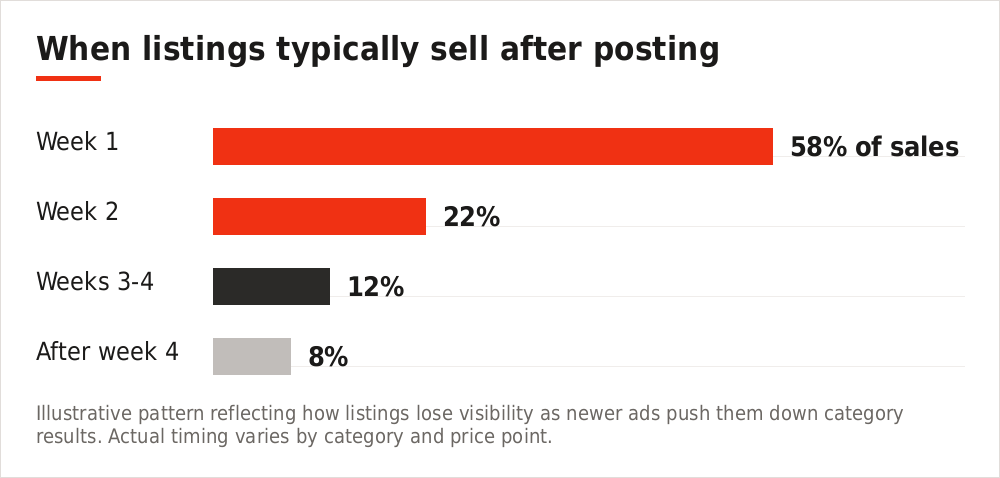
Illustrative pattern reflecting how listings lose visibility as newer ads push them down category results. Actual timing varies considerably by category and price point.
Pick a strategy and commit
| Strategy | How it works | Best for | Trade-off |
|---|---|---|---|
| Market price, firm | Price at the going rate, state “price firm” | Common items with clear comparables | Deters hagglers, may sit slightly longer |
| Slight premium, negotiable | Add 10–15% and expect to negotiate | Sellers comfortable with haggling | Some buyers skip anything above market |
| Priced to move | Set below market for a fast sale | House moves, deadlines, bulky items | You leave money on the table |
| Free to collect | Give it away | Low-value bulky items | Attracts no-shows; expect several |
If you have had no genuine enquiries in two weeks, the price is wrong or the photographs are. Exposure is rarely the issue — a well-priced item with good photos gets messages within days. Drop the price by 10–15%, or reshoot, and relist.
The description template
A good description pre-answers the questions you would otherwise field one message at a time. Structure beats prose — buyers scan rather than read.
- What it is — full make, model, specification, year
- Condition — honestly stated, with every flaw listed
- Age and usage — how long owned, how heavily used
- What is included — box, charger, manuals, spare keys, accessories
- Measurements — dimensions and weight for anything bulky
- Why you are selling — upgrading, moving, no longer needed; this builds trust
- Collection or delivery — where it is, whether you can deliver, whether you will ship
- Payment accepted — cash on collection, bank transfer, and so on
It sounds trivial, but “selling because I have upgraded” or “clearing the garage before a move” answers the question every second-hand buyer silently asks: what is wrong with it? A plain reason defuses that immediately.
When to post and how long to wait
Timing matters less than price, but it is free to get right.
- Evenings and weekends see the most browsing. An ad posted Sunday evening tends to catch more eyes than one posted Tuesday at 3pm.
- Seasonality is real. Garden furniture sells in spring, ski gear in autumn, bicycles as the weather turns. Listing a barbecue in November is a slow road.
- Post-holiday periods are strong for electronics and hobby equipment, as people upgrade and clear space.
Ads on List It Global stay live for 60 days, with an email before expiry so you can renew, edit or withdraw. Refreshing a stale ad with better photographs and a revised price consistently works better than reposting the identical listing — the market already saw that version and passed.
Handling enquiries and offers
Once messages arrive, a few habits separate smooth sales from wasted afternoons.
Reply quickly
Second-hand buying is impulsive. A reply within an hour dramatically outperforms one the next day, by which point they have often bought elsewhere.
Answer the question asked
Short, direct, complete. If they ask about battery health, give the number rather than “it’s fine”.
Treat lowballs calmly
An offer at half price is not an insult, it is an opening position. Either counter once at a number you would accept, or reply politely that the price is firm. Do not argue.
Confirm the details in writing
Price agreed, time, place, payment method. A one-line confirmation prevents most no-shows and misunderstandings.
First to arrive, not first to promise
Plenty of buyers say they will take it and never appear. Keep the ad live until money changes hands, and say so upfront so nobody feels misled.
Staying safe
Direct-contact selling is safe when you take a handful of basic precautions. Most of these are common sense, but they are worth stating plainly because the small minority of bad actors rely on people not following them.
- Meet in a public place in daylight — a supermarket car park, a café, a police station forecourt
- Take somebody with you for high-value items, and tell someone where you are going
- Use traceable payment; be wary of anything requiring you to act before funds clear
- Never send money to someone you have not verified, and never share bank credentials
- Inspect thoroughly before paying, and test anything electrical
- Be sceptical of overpayment offers — a buyer “accidentally” sending too much and asking for the difference back is a classic fraud
- Do not accept courier collection arranged and paid for entirely by the buyer for high-value goods
- Report suspicious listings so moderators can act
Overpayment with a request for a refund of the difference. Payment “held” by a fake escrow service until you ship. Buyers who will not speak on the phone or meet. Pressure to move the conversation off-platform immediately. Any of these should stop the transaction.
On List It Global every advertisement is reviewed by a moderator before publication, accounts require email verification, and any listing can be reported for review. That does not remove the need for judgement, but it raises the floor considerably.
Selling as a business
Classified advertising is not only for individuals clearing a spare room. Tradespeople, dealers, recruiters, landlords and wholesalers all use classified platforms as a lead channel — and the economics are very different from paid advertising.
| Business type | What they list | Why classifieds work |
|---|---|---|
| Tradespeople | Services by area | Buyers search with immediate intent |
| Car dealers | Stock with specifications | Buyers filter by make, model, year, mileage |
| Landlords and agents | Rentals and property | Location-first search matches how people look |
| Recruiters | Vacancies | Reaches candidates outside job boards |
| Wholesalers | Job lots, clearance stock | Trade buyers hunt these categories directly |
| Equipment sellers | Machinery, tools | Specialist buyers search nationally and abroad |
The advantage over paid search is straightforward: you are not bidding against competitors for every click. Someone browsing a category is already in the market, and your listing sits alongside others on equal footing rather than being outspent.
Say so in your listings. Many jurisdictions require business sellers to identify themselves, and buyers have different legal rights when buying from a trader. Being upfront also builds the repeat trade that makes the channel worthwhile.
Twelve mistakes that kill ads
- One photograph, taken at night. The most common and most costly error.
- A vague title. “Table for sale” matches almost nothing anyone types.
- Pricing on sentiment. What you paid is irrelevant to what it is worth now.
- Hiding damage. It surfaces at the viewing and the sale collapses.
- No dimensions. Furniture buyers will simply move on.
- Wrong category. Your item never appears in the filters buyers use.
- Vague location. “London area” loses everyone filtering by distance.
- Slow replies. Interest cools within hours.
- Writing an essay. Structure and scan-ability beat paragraphs.
- ALL CAPS and exclamation marks. Reads as spam and buries the specifics.
- No stated payment method. Invites awkward conversations at handover.
- Giving up after a week. Adjust price or photos and relist rather than abandoning it.
Frequently asked questions
Is it genuinely free to post an ad?
On List It Global, yes — there is no listing fee, no commission on sales and no subscription. Other platforms use the word differently, so check whether “free” refers to listing, selling, or both.
Do I need an account?
Yes, and this is deliberate. Requiring a verified account keeps spam and fraudulent listings off the platform, and it means buyers can see a seller history rather than dealing with an anonymous post.
How long does my ad stay online?
Sixty days. You will be emailed before it expires so you can renew, edit or withdraw it, and you can remove it at any time once the item sells.
Why is my ad not live immediately?
Every advertisement is reviewed by a moderator before publication. This usually happens quickly, and you will be emailed as soon as it is approved.
Can I sell internationally?
Yes. You choose your country and region when posting, and buyers anywhere can find and contact you. Shipping, customs and payment are arranged between you and the buyer.
What can I not sell?
Weapons, illegal drugs, counterfeit goods, stolen items, adult services, endangered wildlife and anything prohibited by law. The full list is in our Terms and Conditions.
How do buyers contact me?
Through the contact form on your advertisement, which arrives in your inbox. You can also choose to display a phone number, revealed only to logged-in users.
What if my item does not sell?
Revisit price and photographs first — they account for the overwhelming majority of stalled listings. Reshoot in daylight, rewrite the title with specifics, adjust the price, and relist.
Where to start
If you have something to sell today, the fastest route is unglamorous and effective: clean it, photograph it properly in daylight from eight angles, look up what comparable items actually sold for, write a specific title, list every flaw honestly, and post it.
That process takes about twenty minutes end to end, and on a genuinely free platform there is no downside to trying. The worst case is that you adjust the price in a fortnight. The best case is a message within the hour from somebody who has been looking for exactly what is sitting in your garage.
Post your first ad in five minutes
No listing fees. No commission. No subscription. Just your ad, in front of buyers across 238 countries and 3,047 regions.
Or start by browsing the marketplace to see comparable items.