

Best Time of Year to Sell Different Items
The same item can sell in three days or three months depending on when you list it. Seasonality in second-hand markets is stronger than most sellers realise, and it is one of the few advantages available to you that costs nothing at all.
What this covers
Key takeaways
- Sell just before the season people need the item, not during and not after.
- January and early September are the two strongest general periods.
- Sunday evening is the best time of week to publish, almost universally.
- Electronics are the exception — sell immediately, because they only lose value.
- Waiting only pays if the item holds value while you wait.
Why timing matters more than you think
Second-hand demand is driven by need, and need is seasonal. Nobody browses for a garden table in November. Nobody needs skis in June. When you list into a period of low demand, you are competing for the attention of buyers who are not looking.
The effect is not marginal. A garden set listed in April and the identical set listed in October face completely different markets — and the difference usually shows up in both price achieved and time to sell.
The selling calendar
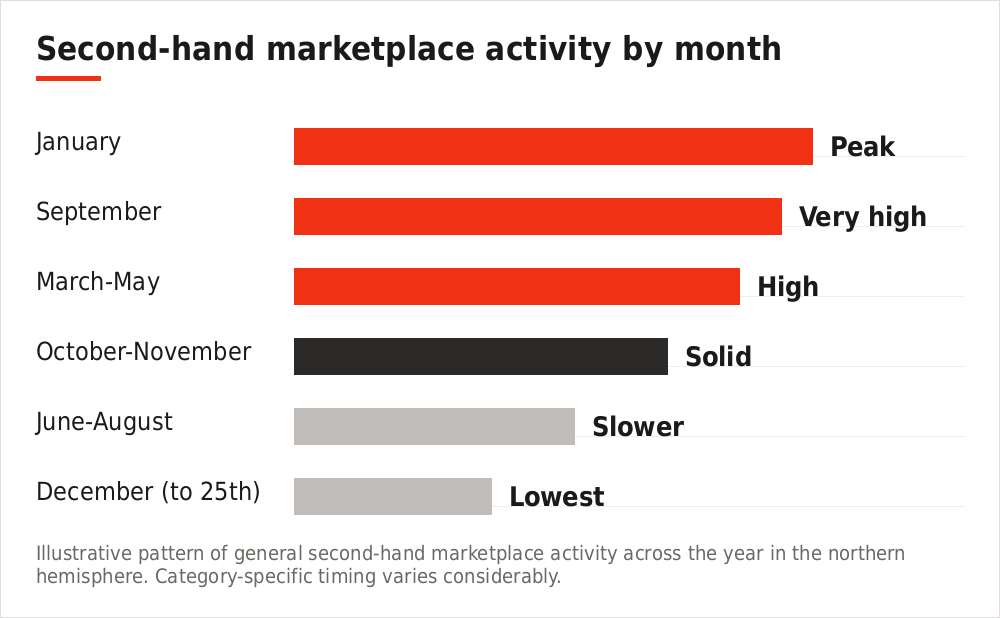
Illustrative pattern of general second-hand marketplace activity across the year in the northern hemisphere. Category-specific timing varies considerably.
| Period | What drives it | Sell now |
|---|---|---|
| January | New year clear-outs, gift replacements, resolutions | Fitness equipment, electronics, storage, furniture |
| February–March | Spring approaching, house moves resume | Garden furniture, bicycles, DIY tools |
| April–May | Good weather, outdoor season | Garden, camping, outdoor sports, motorcycles |
| June–July | Holidays, generally slower browsing | Travel gear, summer clothing, air conditioning |
| August–September | Student moves, back to school and work | Furniture, desks, bikes, laptops, kitchenware |
| October–November | Weather turns, indoor season | Tumble dryers, winter clothing, heaters, games |
| December | Gift buying, then post-holiday clear-out | Collectables early; everything else after the 26th |
Best month by category
| Item | List in | Avoid |
|---|---|---|
| Garden furniture | March–May | October–January |
| Bicycles | March–June | November–January |
| Motorcycles | March–May | December–February |
| Tumble dryers | September–November | May–July |
| Winter coats | September–November | February–July |
| Fitness equipment | December–January | June–August |
| Student furniture | July–September | December–February |
| Camping gear | April–June | October–January |
| Air conditioners | May–July | November–February |
| Games consoles | October–December | February–April |
| Cars | Spring, and before registration changes | Deep winter |
| Baby equipment | Any time — demand is constant | — |
Buyers plan ahead. Garden furniture sells best on the first warm weekend, which means the ad needs to already be live. Aim to list two to four weeks before the season genuinely starts.
List it while the season is right
Free to post, free to sell, and ads run for 60 days with free renewal.
Day of week and time of day
Within any week, browsing follows a consistent pattern.
- Sunday evening is the strongest single window — people plan the week ahead
- Weekday evenings, roughly 7pm to 10pm, are consistently active
- Saturday morning works well for items people collect at weekends
- Weekday mornings are the weakest period
- Listing on a Friday means your ad is fresh for the whole weekend
This matters because most classified results are ordered by recency. A newly published ad sits near the top for a while, and you want that visibility to coincide with when people are actually looking.
Events that move markets
- New product launches — sell your phone or console before the successor is announced, not after
- Vehicle registration changes — where your country uses them, they create predictable used-car cycles
- University terms — late summer drives enormous demand for basic furniture and appliances
- Tax and bonus periods — buyers have more available money
- Major sporting events — televisions and related equipment see short spikes
- Post-holiday weeks — unwanted gifts and replaced items flood the market, increasing supply
Late December and early January bring a surge of listings as people clear out and replace gifts. Demand is high, but so is competition. If your item is common, price sharply or wait until February.
When waiting is wrong
Timing only helps if the item holds its value while you wait. For some categories, waiting costs more than the seasonal uplift is worth.
| Sell immediately | Because |
|---|---|
| Phones and tablets | Value falls every month, sharply at each new launch |
| Laptops | Steady decline; no seasonal recovery |
| Anything you are storing at a cost | Storage fees outweigh the seasonal gain |
| Baby equipment | Demand is constant; safety standards change |
| Items with expiring warranty | Remaining cover is a selling point that decays |
| Anything perishable or dated | Value only goes one direction |
A note on hemispheres
All of the above assumes northern-hemisphere seasons. If you are selling in Australia, New Zealand, southern Africa or South America, invert the weather-driven categories — garden furniture sells in October, winter coats in April.
The non-weather patterns hold regardless: student moves, new year clear-outs, product launch cycles and Sunday-evening browsing all behave the same way worldwide.
Seasons are not the same everywhere
Most seasonal selling advice is written for one hemisphere and quietly assumes everyone shares it. On a worldwide platform that assumption breaks immediately.
| Item | Northern peak | Southern peak |
|---|---|---|
| Winter sports equipment | October to December | April to June |
| Garden furniture and barbecues | April to June | October to December |
| Heaters and warm clothing | September to November | March to May |
| Air conditioning units | May to July | November to January |
| Camping and outdoor gear | April to July | October to January |
This matters more than it first appears. Winter equipment that has just gone out of season where you are may be entering peak demand somewhere else entirely, and a listing that reaches both hemispheres is not competing against the calendar in the same way.
If you have quality equipment that has just missed its local window, listing it internationally rather than storing it for eight months can find a buyer who is preparing for a season you have just finished.
Climate matters more than calendar
Beyond hemispheres, demand follows actual conditions rather than month names.
- Monsoon and rainy seasons slow collection-based selling considerably in affected regions
- Very hot months reduce viewing activity in some markets and increase it in others
- Academic terms drive furniture and household turnover at different points by country
- Major holiday periods vary widely and affect both spending and availability
- Tax and financial year ends prompt business equipment sales at different times
Planning around the cycle
List a few weeks before demand peaks
Buyers plan ahead. Arriving with everyone else who waited is the worst timing.
Store rather than dump at the wrong moment
Selling a snowblower in May at a third of its value is a decision, not an outcome. If you can keep it until October, do.
Widen the listing radius out of season
When local demand is absent, a wider audience compensates.
Do not fight the season on price alone
Cutting the price of a barbecue in November rarely creates demand that does not exist.
Frequently asked questions
Should I hold an item for months to catch the right season?
Only if it holds value and storage is free. For electronics, never — the depreciation exceeds any seasonal gain.
Does listing time of day really matter?
It has a modest effect, mostly because recency affects result ordering. Evening and Sunday listings tend to catch more initial views.
Is it worth relisting in a better season?
Yes, for strongly seasonal items. Refresh the photographs and revisit the price rather than reposting the identical ad.
What about the holiday period itself?
Late December is slow for most items as attention goes elsewhere. Activity rises sharply from the 26th onward.
Do these patterns apply everywhere?
Weather-driven ones invert by hemisphere. Student, new-year and product-launch cycles are largely universal.
What if I need to sell urgently?
Price for the season you are actually in. A realistic price beats perfect timing every time.
The short version
List two to four weeks before people need the thing. Publish on a Sunday evening. Sell electronics immediately regardless of season. And if you cannot wait for the right month, price for the month you are in.
Good timing, no fees
Free to list, free to sell, 60-day listings with free renewal.
You can also explore the full marketplace across every category.