



Selling Old Phones, Cables and Tech You No Longer Use
Almost everyone has a drawer of old phones, cables, chargers and devices that are individually worth very little and collectively worth more than expected. The question is which items are worth listing, which should be bundled, and which should simply be recycled properly.
What this covers
Key takeaways
- Sort into sell individually, bundle, or recycle before listing anything.
- Older cables and adapters for discontinued equipment are worth more than people expect.
- Sign out of accounts before factory reset, or the device is useless to a buyer.
- Broken devices genuinely sell — describe the fault precisely.
- Lithium batteries face real shipping restrictions.
Sorting the drawer
Empty everything onto a table and put each item into one of three piles. Do not skip this step and start listing, because most of what is in the drawer is not worth a listing of its own.
| Pile | What goes in it |
|---|---|
| List individually | Working phones, tablets, laptops, consoles, cameras, anything above modest value |
| Bundle | Cables, chargers, adapters, mice, keyboards, small accessories |
| Spares or repair | Broken devices with identifiable faults |
| Recycle | Perished batteries, damaged chargers, genuinely worthless items |
What still has value
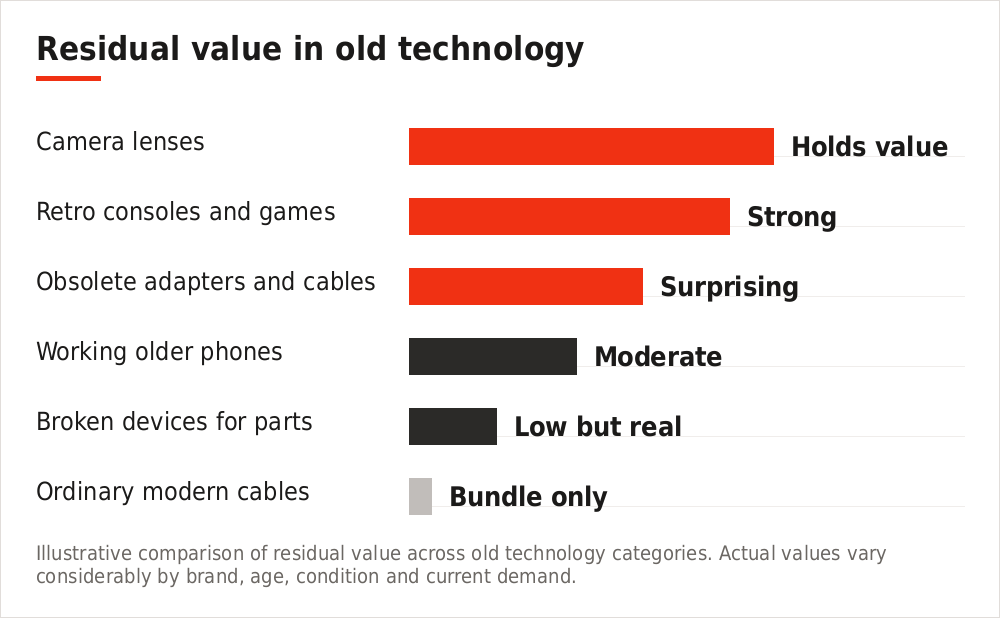
Illustrative comparison of residual value across old technology categories. Actual values vary considerably by brand, age, condition and current demand.
- Older phones in working condition — still useful as spares and backups
- Proprietary cables and adapters for discontinued equipment — frequently sought and hard to find
- Retro consoles and games — an active collector market
- Camera lenses — hold value far better than camera bodies
- Professional audio and video equipment
- Vintage computers and peripherals
- Original packaging for anything collectable
Power supplies and cables for equipment no longer manufactured can be worth considerably more than modern equivalents, because someone with working equipment and a failed adapter has nowhere else to look. Search the exact part number before assuming it is junk.
Bundling small items
Group by type
All charging cables together, all audio adapters together. A coherent lot sells better than a random box.
Photograph everything laid out
Buyers need to see what is actually included. One clear overhead photograph does it.
List the notable items by name
If the bundle contains something specific and searchable, name it in the title.
Price for clearance
The point is one transaction rather than maximum return per item.
Say it is untested where true
Selling a mixed lot as untested is honest and perfectly acceptable.
Clear the drawer, keep the money
Free to list at any value, and no commission on what you sell.
Identifying what you actually have
Much of the drawer is unidentifiable at a glance, and guessing produces listings nobody finds. A few minutes of identification turns a mystery adapter into a searchable part.
| Where to look | What it tells you |
|---|---|
| Moulded text on the plug body | Voltage, amperage and part number |
| Label on the underside of a device | Model, serial and manufacturing date |
| Printing along the cable itself | Specification and sometimes the original device |
| Connector shape and pin count | Which equipment family it belongs to |
| Regulatory markings | Approximate era and market |
Search the part number rather than describing the object. A listing titled with the actual manufacturer code reaches the person who typed that code into a search box, which a listing titled black power adapter never will.
Power supplies that look identical can differ in voltage, current and polarity, and the wrong one damages equipment. State the figures exactly as printed rather than approximating, and let the buyer confirm the match.
Pricing low-value items sensibly
Decide whether it is worth your time
Fifteen minutes of listing, messaging and handover has a value. Below a certain price, bundling or donating is the rational choice.
Price bundles to clear, not to maximise
The goal is emptying the drawer in one transaction rather than extracting the theoretical maximum from each item.
Charge realistically for postage
Small items are frequently killed by postage costing more than the contents. Local collection often works better.
Consider giving some away
Listing genuinely low-value working items free clears space quickly and reaches people who need them.
Wiping data properly
A factory reset on its own does not remove activation locking. If you reset a phone or tablet without first signing out of your manufacturer account, the device remains locked to you and is unusable for the buyer. Sign out first, then reset.
- Back up anything you need before starting
- Sign out of every account — manufacturer, cloud, streaming, banking
- Remove SIM and memory cards, and check twice
- Perform a full factory reset, not a file deletion
- Unpair linked devices — watches, headphones, cars
- For computers, wipe the drive fully or remove it entirely
- Deregister the device from your account with the manufacturer
Selling broken electronics
There is a real market for faulty devices, and it is bigger than most people assume. Repairers, parts harvesters and hobbyists all buy them.
- Describe the fault precisely — will not charge, cracked screen but functional, no display, water damaged
- Say what does still work
- Use the words buyers search — spares or repair, faulty, for parts
- Never describe something faulty as working, in any circumstances
- Wipe the data anyway, even on a broken device, wherever you can
- Mention whether it is locked to an account or network
Say so explicitly if you cannot unlock it. Buyers will discover it immediately and an undisclosed lock turns a legitimate spares sale into a dispute.
Batteries and shipping restrictions
Devices containing lithium batteries face carrier restrictions and are prohibited by some services entirely, particularly by air. Loose batteries are more restricted still. Swollen, damaged or perished batteries must never be posted at all — take them to a recycling point.
- Check carrier rules before promising to post anything battery-powered
- Declare batteries honestly on shipping documentation
- Never post a swollen battery — recycle it
- Consider local collection for battery-heavy items
- Ship devices partially charged where carriers specify it
What to recycle instead
Some things genuinely are not worth listing, and disposing of them properly matters because electronic waste contains materials that should not go to landfill.
- Damaged chargers and frayed cables — a safety risk, not a bargain
- Swollen or perished batteries
- Devices with no identifiable model or purpose
- Anything with liquid damage and no working function
- Obsolete media with no collector interest
- Broken items where postage exceeds any conceivable value
Frequently asked questions
Is an old phone worth selling?
If it works and can be reset properly, usually yes. Even older models have value as backups and spares.
Should I sell cables individually?
Only if they are unusual or for discontinued equipment. Ordinary cables belong in a bundle.
Can I sell a device I cannot unlock?
Yes, as spares or repair, provided you state clearly that it is account-locked.
Is a factory reset enough?
Only after signing out of your accounts first. Otherwise activation locking makes it useless to the buyer.
Can I post a device with a battery?
Often yes, with restrictions. Check the carrier rules, and never post a swollen or damaged battery.
What about very old computers?
Vintage machines have an active collector market. Research the model before assuming it is worthless.
The short version
Sort before listing. Bundle the cables and accessories, list the devices individually, and sell broken items honestly as spares. Sign out of accounts before resetting anything. Check the part number on obsolete adapters before binning them. And recycle what genuinely has no value.
Free at any value
No listing fees, no commission, and no minimum price.
Take a look at List It Global to see what similar items are fetching.