



Should You Accept Offers or Hold Your Price?
Every seller eventually faces the same question: someone has offered less than you asked, and you have about a minute to decide. Handled well, negotiation costs you very little and closes sales faster. Handled badly, it either gives away money you did not need to lose or drives away buyers who would have paid.
What this covers
Key takeaways
- Decide your floor before listing, not while a buyer waits for an answer.
- “Price firm” deters most hagglers and costs you very few genuine buyers.
- A single lowball is a chancer; five is the market telling you something.
- Counter once at a number you would accept, rather than drifting downward.
- Never accept a renegotiation on the doorstep unless something was genuinely undisclosed.
Decide before you list
The single most useful thing you can do is settle two numbers in advance, calmly, before anyone is waiting for a reply.
- Your asking price — based on what comparable items actually sold for
- Your floor — the lowest you would genuinely accept today
- Your deadline — whether you need it gone by a particular date
- What you would swap — extras you could include instead of cutting the price
Signalling whether you will negotiate
Your listing sets expectations before anyone messages you, and the wording genuinely changes who gets in touch.
| Phrasing | What it signals | Result |
|---|---|---|
| Price firm | No negotiation expected | Fewer offers, mostly serious |
| Or nearest offer | Explicit invitation | More offers, many low |
| Open to sensible offers | Some flexibility, within reason | Middle ground |
| No wording at all | Ambiguous | Buyers assume negotiation is possible |
| Round number price | Reads as approximate | Invites an offer |
| Precise number | Reads as considered | Fewer offers |
An item at 500 reads as a rounded guess and invites 450. The same item at 485 reads as a figure someone arrived at deliberately, and attracts noticeably fewer opening offers.
Reading the offer
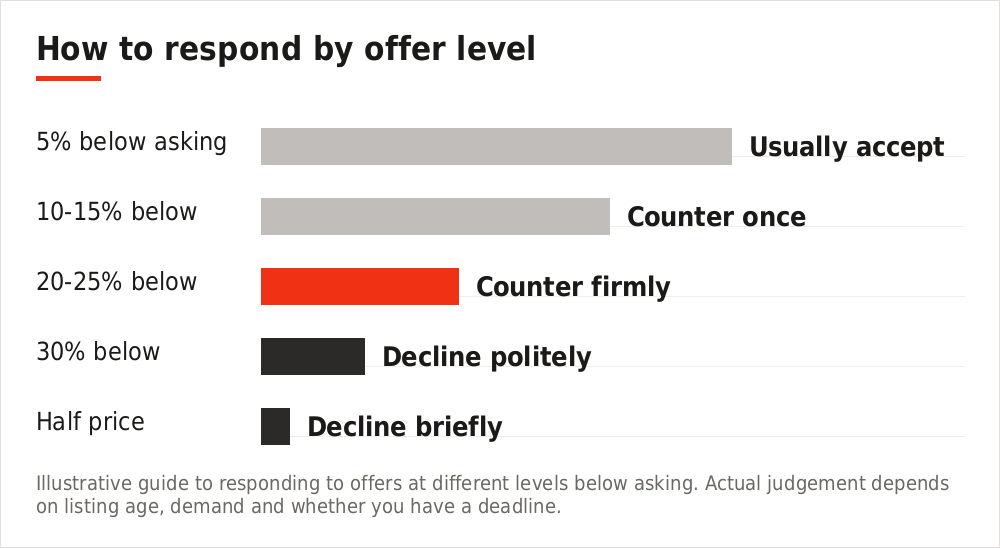
Illustrative guide to responding to offers at different levels below asking. Actual judgement depends on listing age, demand and whether you have a deadline.
| Offer | Usually means | Response |
|---|---|---|
| 5% below | Genuine buyer closing | Accept, or counter at asking with a small extra included |
| 10–15% below | Normal negotiation | Counter once at your target |
| 20–25% below | Testing you | Counter firmly, or decline politely |
| Half price | Chancer, or a reseller | Decline briefly; do not argue |
| Offer with a reason | Serious and informed | Engage properly — they have done the work |
| “Last price?” only | Rarely converts | Restate the price; do not bid against yourself |
List free, negotiate directly
No commission means whatever you agree is what you keep.
How to respond
Reply, even to poor offers
A brief polite decline costs nothing and occasionally produces a better second offer. Silence guarantees nothing.
Counter once, at a number you would accept
Not a staging post on the way down. Incremental haggling frustrates buyers and signals you will keep dropping.
Give a reason if you are holding
“It has only been listed two days and there is interest” is more persuasive than a bare refusal.
Attach a condition to any discount
“I can do that if you collect this evening” converts a concession into a closed sale.
Never argue
A low offer is an opening position, not an insult. Arguing loses buyers who might have paid more later.
Holding firm properly
If your research says the price is right and the listing is new, holding is usually correct. It just needs to be done without friction.
- Be polite and brief — “Thanks, but the price is firm for now”
- Say “for now” where true — it leaves the door open without committing
- Keep their message — if it does not sell in a fortnight, you have a warm contact
- Do not justify at length — a short answer is more confident than a paragraph
- Revisit after two weeks if enquiries dry up entirely
If you declined 400 and the item has not sold three weeks later, there is nothing wrong with messaging that person to say it is still available at their figure. Many sales close exactly this way.
Alternatives to dropping the price
A concession does not have to be money, and non-cash concessions frequently close a deal at less real cost to you.
| Instead of a discount | Why it works |
|---|---|
| Include an accessory | Costs you little, worth more to them |
| Offer local delivery | Solves their real problem for bulky items |
| Help load or dismantle | Genuine value at almost no cost |
| Hold it until the weekend | Convenience buyers will pay for |
| Throw in related items | Clears more of your stock in one trip |
| Meet halfway | Splits the journey rather than the price |
The doorstep renegotiation
A buyer agrees a price by message, travels to collect, then produces a lower offer on the assumption you will take it rather than start again. Unless they have found something genuinely undisclosed, decline. Sellers who accept it teach buyers that the agreed price is negotiable.
The exception matters: if they have discovered a real fault you did not mention, a reduction is fair and you should offer it before they ask. That is a different situation from a manufactured one.
- Restate the agreed price calmly — “We agreed 400, and that is the price”
- Be willing to let them leave — most do not
- Do not feel obliged because they travelled — that was their choice
- Keep the listing live until money has actually changed hands
Frequently asked questions
Should I price high to leave negotiating room?
Only modestly. Buyers filter by price, so pricing well above market makes you invisible to people who would have paid a fair figure.
Do I have to reply to insulting offers?
No, but a brief polite decline costs nothing and occasionally produces a serious second offer.
What if several people offer at once?
Be straightforward: tell each that others are interested and invite their best offer. Do not invent competing bids.
Should I accept the first offer?
If it is at or near asking and the listing is new, usually yes. Holding out for slightly more frequently costs you the sale.
Is a deposit a good idea?
For higher-value items it can secure a commitment. Give a written receipt stating whether it is refundable.
What if I agreed and then get a better offer?
Honour the first agreement. Reputation matters, particularly if you sell regularly in the same area.
The short version
Decide your floor before you list. Signal your position in the wording and use a precise price. Counter once at a number you would accept, attach a condition to any discount, and offer extras rather than cash where you can. And refuse the doorstep renegotiation unless something genuinely undisclosed has turned up.
Whatever you agree, you keep
Free to list, free to sell, no commission at any value.
You can also search listings worldwide without creating an account.