

How to Sell Sports Equipment Online
Sports equipment is bought with enthusiasm and abandoned quietly. Most of it is barely used, which makes it excellent second-hand value — and means the seller’s main job is proving how little use it actually had, and being scrupulously honest about anything safety-related.
What this covers
Key takeaways
- Size and specification belong in the title — gear at the wrong size is useless.
- Never sell a helmet or harness that has taken an impact.
- “Bought and barely used” is your strongest selling point — evidence it.
- Season timing moves prices in this category more than most.
- Brand matters: quality gear holds value, supermarket equipment does not.
What sells and what does not
| Strong demand | Weak demand |
|---|---|
| Quality bicycles and components | Unbranded exercise equipment |
| Golf clubs from known makers | Worn running shoes |
| Ski and snowboard equipment | Used protective padding |
| Home gym weights and racks | Cheap treadmills |
| Camping and hiking gear | Damaged or incomplete sets |
| Water sports equipment | Anything safety-critical with unknown history |
| Climbing hardware (with provenance) | Expired safety equipment |
Sizing is everything
Like bicycles, most sports equipment is unusable at the wrong size. Buyers filter on it before anything else.
- Skis and snowboards — length in centimetres, and rider weight range
- Ski boots — Mondopoint size, plus flex rating
- Golf clubs — shaft flex, length, loft, and left or right handed
- Wetsuits — manufacturer size plus height and chest measurements
- Rackets — grip size, head size, string tension if known
- Boots and footwear — marked size plus insole length in centimetres
- Backpacks — capacity in litres and back length
Manufacturer sizing varies enormously between brands and eras. Actual measurements — chest in centimetres, insole length, shaft length — are objective and are what experienced buyers ask for anyway.
Safety equipment: the hard rules
Helmets that have taken any impact, climbing rope and harnesses with unknown history, expired life jackets, and any load-bearing equipment past its manufacturer service life. These fail without warning and the consequences are severe. Dispose of them rather than selling them.
| Equipment | Position |
|---|---|
| Helmets (any sport) | Only if never impacted, within date, and you owned it from new |
| Climbing rope | Only with full known history; many buyers will not consider used |
| Harnesses and slings | Check manufacturer service life; disclose age |
| Life jackets | Check expiry and servicing requirements |
| Ski bindings | Must be within indemnified list; shops may refuse to adjust old ones |
| Body armour and padding | Disclose impacts; foam degrades after compression |
Manufacturers publish which bindings shops will still service and adjust. Older models fall off that list, and a shop will refuse to set them — making the skis effectively unusable to a buyer. Check before listing and state the position.
List your equipment free
No listing fees, no commission, and buyers filtering by exactly the size they need.
Assessing condition by type
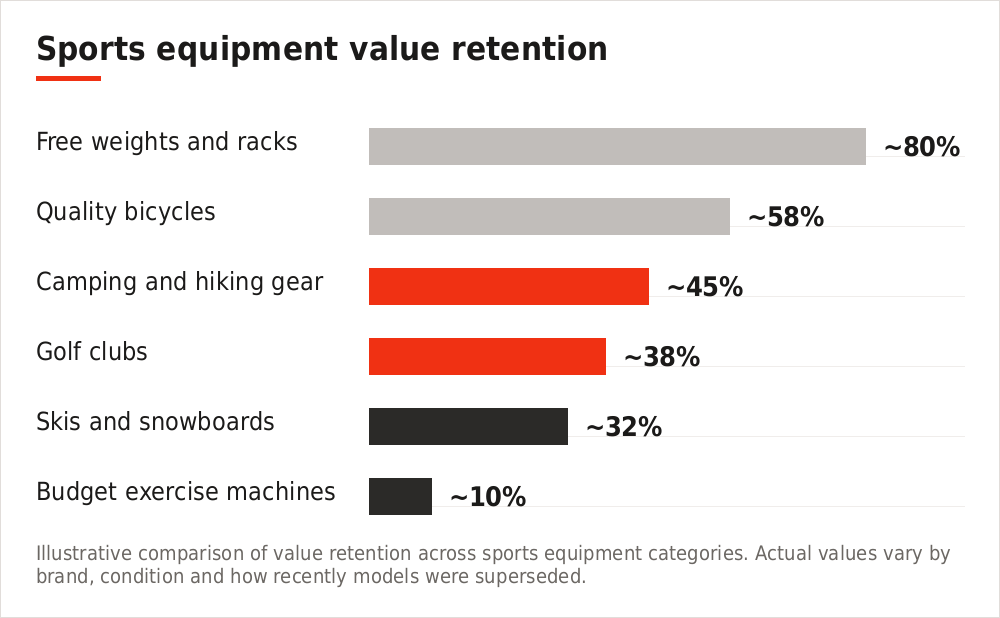
Illustrative comparison of value retention across sports equipment categories. Actual values vary by brand, condition and how recently models were superseded.
| Equipment | Check |
|---|---|
| Skis and boards | Base gouges, edge damage, delamination, binding condition |
| Golf clubs | Face wear, shaft straightness, grip condition, dents on woods |
| Weights and racks | Rust, plate condition, bar knurling and straightness |
| Tents | Waterproofing, seam tape, pole condition, all pegs present |
| Wetsuits | Seam splits, zip function, neoprene stiffness |
| Rackets | Frame cracks, grommet wear, string condition |
| Water sports boards | Dings, water ingress, fin boxes |
Pricing sports gear
Two things dominate: brand and whether the model has been superseded. Equipment from recognised makers holds value; the annual model cycle in skiing, golf and cycling steps prices down predictably each time a new range launches.
Research sold prices for the same model and size. Be realistic about used-once claims — buyers hear it constantly, so evidence it with the receipt or original packaging rather than simply asserting it.
Photographing equipment
- The whole item against a plain background in daylight
- Size markings and model labels, readable
- Contact surfaces — ski bases, club faces, boot soles
- Any wear, scratch or repair
- All included accessories laid out together
- Original packaging or receipt if you have it
- Serial or date codes on safety equipment
Writing the listing
Title: Brand + Model + Size + Key detail.
Salomon QST 92 skis, 177cm, with Warden bindings, used one season
The description should state brand, model, year, all sizing and measurements, honest condition with every mark, how much genuine use it has had, what is included, and for safety equipment its age and impact history.
Selling in the right season
| Sell this | List in |
|---|---|
| Ski and snowboard equipment | October to December |
| Golf clubs | March to June |
| Camping and hiking gear | April to July |
| Water sports equipment | May to July |
| Home gym equipment | December to February |
| Bicycles | March to June |
| Football and team sports kit | August to September |
Demand rises sharply with new year intentions and falls away by March. If you are selling weights or a rack, listing in late December rather than April makes a substantial difference to both price and speed.
Frequently asked questions
Can I sell a used helmet?
Only one you owned from new, that has never taken an impact and is within its service life. State all three. If you cannot, dispose of it instead.
Is used climbing gear sellable?
Hardware sometimes, with full known history. Rope, harnesses and slings are widely considered unsuitable for resale because their history cannot be verified.
How much do sports items lose in value?
Highly variable. Quality bicycles and weights hold value well; superseded ski and golf models drop sharply each season.
Should I sell a set or individually?
Complete matched sets usually achieve more together. Mixed odds and ends do better bundled.
What about equipment I used once?
Your strongest selling point — but evidence it with the receipt, tags or original packaging rather than simply saying so.
Do I need to service it first?
A ski base grind or a club regrip can pay for itself on quality gear. On budget equipment it rarely does.
The short version
Put the size in the title and give real measurements. Be scrupulous about anything safety-critical — if it has taken an impact or you cannot verify its history, do not sell it. Evidence the low usage rather than claiming it. And list before the season, not during it.
Clear the garage, keep the money
Free to list, free to sell, no commission at any value.
You can also explore the full marketplace across every category.