


Why Your Ad Is Not Getting Views
An ad that is not selling is giving you information, and the specific pattern tells you exactly what is wrong. No views is a different problem from views without messages, and messages without viewings is different again. Diagnose it properly and most stalled listings can be fixed in twenty minutes.
What this covers
Key takeaways
- Your view count is the diagnostic. Check it before changing anything.
- No views means a discovery problem: title, category or location.
- Views without messages means price or photographs, almost always.
- Change one thing at a time, or you learn nothing.
- Some categories are genuinely slow. Not every stall is a mistake.
Diagnosing by symptom
| Symptom | Almost always | First fix |
|---|---|---|
| No views | Nobody is finding it | Rewrite the title; check the category |
| Views, no messages | Price or photographs | Reshoot in daylight; drop 10–15% |
| Messages, no viewings | Description missing detail | Add measurements and condition |
| Viewings, no sale | Condition overstated | Describe flaws accurately, reprice |
| Only lowball offers | Priced above market | Recheck comparables honestly |
| Wrong sort of enquiries | Title or category ambiguous | Add disambiguating detail |
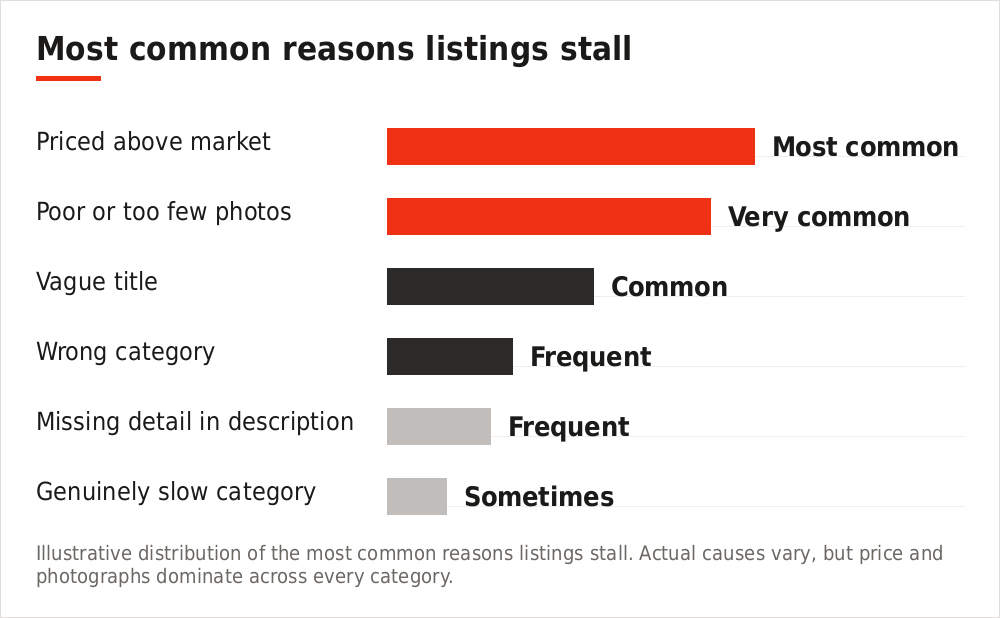
Illustrative distribution of the most common reasons listings stall. Actual causes vary, but price and photographs dominate across every category.
No views at all
This is a discovery problem, and it is entirely fixable. Buyers cannot be interested in something they never see.
Search for your own item
Type what you think a buyer would type. If your listing does not appear, you have found the problem in thirty seconds.
Check the category
Go as deep as the tree allows. An item left at the top level only appears in the broadest, most crowded view.
Rewrite the title with specifics
Brand, model, size, year. “Sofa for sale” matches almost nothing anyone types.
Check your location is set precisely
Buyers filter by distance. A vague or missing location removes you from those results entirely.
Confirm it is actually published
Ads are moderated before going live. Check My Ads to be sure it was approved and has not expired.
Views but no messages
People are finding it and choosing not to contact you. In practice this is nearly always price or photographs.
- Compare against what actually sold, not what others are asking
- Check price filter boundaries — at $520 you are invisible to everyone searching under $500
- Look at your first photograph as a thumbnail alongside competitors’ — is it the brightest and clearest?
- Count your photographs — one or two is rarely enough
- Reshoot in daylight if any were taken under artificial light
- Clean the item and shoot again — it changes perceived value more than sellers expect
If you drop the price and reshoot simultaneously, you will never know which worked — and you may have given away money you did not need to. Adjust one variable, observe, then adjust the other.
Refresh your listing free
Edit photos, price and description any time. No fees, no commission, ever.
Messages but no viewings
People are interested enough to ask, then disappear. Usually the answers are putting them off, or the description forced them to ask something that should have been obvious.
| If they ask | Add to the description |
|---|---|
| “What are the dimensions?” | Full measurements, including diagonal depth for sofas |
| “What condition is it in?” | Specific grade plus every flaw and its location |
| “Does it come with…?” | A clear list of what is and is not included |
| “Where are you?” | Precise area and collection details |
| “Can you deliver?” | Delivery options and any cost |
| “Why are you selling?” | One honest line |
Reply speed matters here too. Second-hand buying is impulsive — a reply within the hour dramatically outperforms one the next day, by which point they have often bought something else.
Viewings but no sale
People are travelling to see it and leaving without buying. That is the most expensive failure mode, because it wastes your time as well as theirs.
A buyer who arrives expecting “excellent” and finds “good” does not negotiate — they leave. Photograph every flaw, describe it precisely, and price accordingly. The people who then come are people who have already accepted it.
Other common causes:
- The item was dirty or not ready to view
- Something did not work when tested
- The size was different from what they imagined — a scale problem in the photographs
- Collection turned out to be harder than described
- You were unavailable, rushed, or unclear at the viewing
Only lowball offers
Persistent low offers are market feedback. One is a chancer; five is a signal.
Recheck comparables honestly. If sold prices genuinely support your figure, hold firm and state “price firm” in the listing — it deters most of them. If they do not, the market has told you something and adjusting is not a defeat.
How to relist properly
Reposting the identical listing rarely works — the same buyers see the same ad and pass again. Change something meaningful first.
Reshoot in daylight
New photographs are the single biggest lever available.
Rewrite the title
More specific, brand and model first.
Adjust the price by 10–15%
Smaller cuts rarely reach a new set of buyers or clear a filter boundary.
Rewrite the description
Add everything people asked about last time.
Consider timing
Post on a Sunday evening rather than a Tuesday afternoon; consider the season for anything weather-dependent.
When the problem is not you
Some things genuinely take longer, and it is worth knowing that before you keep cutting the price.
- Specialist items — a narrow buyer pool means waiting for the right person
- Very high value — fewer buyers, longer decision times
- Out of season — garden furniture in November, ski gear in June
- Unfashionable styles — dark heavy furniture is currently slow almost everywhere
- Rural locations — fewer buyers within collection distance
In these cases, patience genuinely is the answer — provided the price, photographs and description are already right.
Frequently asked questions
How long should I wait before changing something?
Two weeks with no genuine enquiries is enough to act on. Most items that sell do so in the first week.
Is it better to relist or edit the existing ad?
Editing keeps your view history, which is useful diagnostic data. Relist only if the ad has expired or you are changing the item substantially.
How much should I drop the price?
10–15%. Smaller reductions rarely reach new buyers or cross a search filter boundary.
Should I mark it “reduced”?
It can create urgency but also signals you will keep dropping. A confident, well-researched price usually performs better.
What if it genuinely will not sell at any price?
For bulky low-value items, “free to collect” often clears them quickly. Consider whether storage is costing you more than the item is worth.
Does reposting help visibility?
Only if something has changed. The same ad seen by the same buyers gets the same result.
The short version
Look at your view count first. No views means nobody can find it — fix the title, category and location. Views without messages means price or photographs. Then change one thing, wait a week, and see what the market tells you.
Fix it and relist, free
Unlimited edits, unlimited listings, no commission at any value.
Take a look at List It Global to see what similar items are fetching.