

Ad Description Templates You Can Copy
A good description does one job: it answers the questions a buyer would otherwise have to message you about. Every question you pre-empt is a message you do not reply to, a viewing that does not get wasted, and a buyer who arrives already decided. Here are templates you can copy for the most common categories.
What this covers
Key takeaways
- Structure beats prose. Buyers scan; they do not read paragraphs.
- List the flaws yourself — it filters out people who would have walked away.
- Always say why you are selling. It answers the unspoken question.
- State collection, delivery and payment terms explicitly.
- A description that answers everything gets fewer messages and better buyers.
The structure that works
Buyers read descriptions in a specific order, looking for specific things. Match that order and the listing feels effortless to read.
What it is
Full make, model, specification. Confirms they are in the right place.
Condition
Honest, specific, flaws included. This is what they came for.
Details and measurements
Everything they would otherwise have to ask.
What is included
And, where relevant, what is not.
Why you are selling
Defuses suspicion in one line.
Practicalities
Collection, delivery, payment, availability.
Line breaks and short labelled sections outperform flowing prose in every category. A buyer on a phone is scanning for one specific detail — help them find it.
The universal template
[Item name, full specification]
Condition: [Honest grade]. [Every flaw, specifically located.]
Age: [When bought, how heavily used]
Details: [Dimensions, capacity, technical specification]
Included: [Box, accessories, documentation]
Reason for selling: [One line]
Collection: [Where, when, whether you can help load or deliver]
Payment: [What you accept]
That skeleton works for almost anything. The category templates below adjust the middle section for what buyers in that market actually care about.
Vehicles
[Year] [Make] [Model] [Trim], [engine], [transmission]
Mileage: [Figure] — Owners: [Number]
Service history: [Full, partial, stamped or invoices; last service date]
Roadworthiness certificate: [Expiry date, advisories]
Recent work: [Parts replaced, with dates]
Condition: [Bodywork, interior, tyres. Every mark, located.]
Included: [Both keys, handbook, locking wheel nut, service book]
Reason for selling: [One line]
Viewing: [Where, when. Test drive with valid licence and insurance.]
Electronics
[Make] [Model] [Capacity/specification] [Colour]
Condition: [Screen, body, every mark located]
Battery: [Health percentage or cycle count]
Status: [Unlocked or carrier; factory reset and signed out]
Age: [Purchase date]
Included: [Box, charger, cable, case]
Faults: [Anything at all, or “none known — fully tested”]
Reason for selling: [One line]
Collection: [Where; happy for you to test everything]
Copy a template, post your ad
478 categories, 238 countries, free to list and no commission on your sale.
Furniture
[Material] [Type], [brand if known]
Dimensions: W [x] × D [x] × H [x] cm [and diagonal depth for sofas]
Condition: [Structure, surfaces, upholstery. Every mark located.]
Age: [Purchase date]
Dismantles: [Yes into how many parts, or no]
Home: [Smoke-free, pet-free where true]
Reason for selling: [One line]
Collection: [Floor level, lift or stairs, parking, whether you can help lift]
Property to rent
[Bedrooms]-bed [type], [area]
Rent: [Amount] per [month/week] — Deposit: [Amount, protection scheme]
Available from: [Date] — Minimum term: [Length]
Furnishing: [Furnished, part, unfurnished]
Included: [Bills, internet, parking, appliances]
Rooms: [Count and approximate sizes]
Heating and energy rating: [Type, rating]
Policies: [Pets, smoking, sharers]
Transport: [Nearest stations, routes, walking times]
Viewings: [When]
Services and trades
[Trade], [areas covered]
Services: [Bulleted list of what you actually do]
Experience: [Years, and type of work]
Qualifications: [Certifications, registrations, insurance]
Availability: [Days, hours, typical lead time]
Pricing: [Hourly, day rate, or free quotation]
Coverage: [Specific towns or radius]
Contact: [How and when to reach you]
“Manchester and surrounding areas” is vague. Listing the actual towns you cover means you appear when someone searches their own town, which is how people actually look for a tradesperson.
Job vacancies
[Job title], [location], [full-time/part-time]
Salary: [Range or rate — listings with pay get far more applications]
Hours: [Days, shift pattern]
The role: [What the person will actually do, day to day]
Requirements: [Essential versus desirable, separated clearly]
Benefits: [Holiday, pension, training, other]
Start date: [When]
How to apply: [Exactly what to send and to whom]
Tone and length
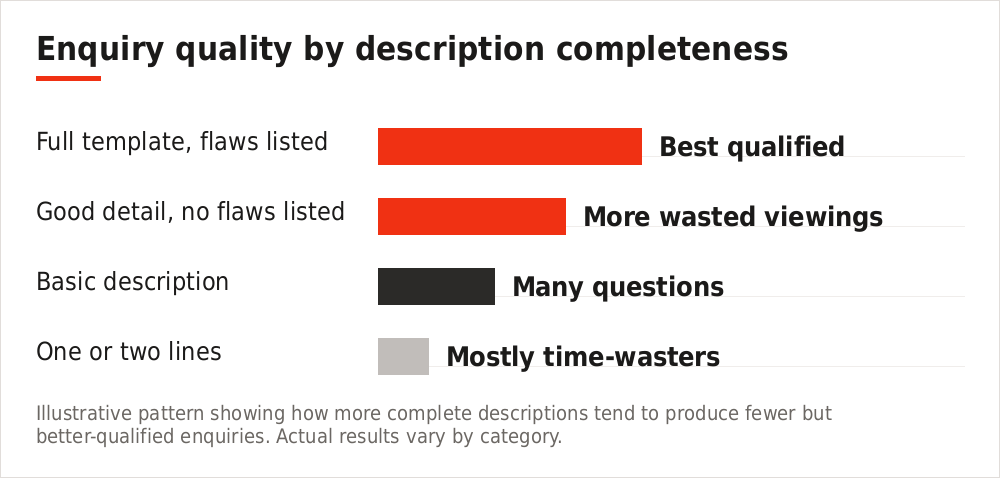
Illustrative pattern showing how more complete descriptions tend to produce fewer but better-qualified enquiries. Actual results vary by category.
| Do | Avoid |
|---|---|
| Short labelled sections | One long paragraph |
| Specific measurements | “Good size” |
| Named flaws with locations | “Some minor wear” |
| Plain, factual language | Sales language and superlatives |
| Normal sentence case | CAPITALS and exclamation marks |
| Stating what is not included | Letting them assume |
| 150–300 words for most items | Two lines, or a thousand words |
It never deters anyone and it makes genuine buyers hesitant to message. The same is true of “serious buyers only” and “do not insult me with offers”. A complete, confident description does the filtering far better.
Adapting a template without sounding like one
Templates give you structure, but a description that reads as filled-in boilerplate persuades nobody. The fix is straightforward: keep the skeleton, replace the generic phrasing with things only you could say about this specific item.
| Generic template phrasing | What actually works |
|---|---|
| In good condition | Small scratch on the lower left corner, pictured |
| Hardly used | Bought March last year, used perhaps six times |
| Selling due to upgrade | Replaced it with a larger model when we moved |
| Collection only | Collection from a first-floor flat, no lift, I can help carry |
| Any questions just ask | Happy to run it for you when you view |
Specificity is what separates a listing that gets enquiries from one that gets scrolled past. Every concrete detail is evidence you actually have the item and are describing it honestly.
How long should a description be?
Long enough to answer the obvious questions, short enough that someone reads it on a phone.
Lead with the essentials
What it is, condition, and why you are selling. The first two lines are what most people read.
Give the specification in a block
Measurements, model, age, what is included. Easy to scan rather than buried in prose.
State flaws plainly
One short paragraph, matched to the photographs.
Close with practicalities
Collection terms, availability, payment. This is where sales stall when it is missing.
Stop there
Warnings about time-wasters, capitals and long lists of conditions read as difficult rather than firm.
If two different people ask the same question, that answer belongs in the description. Over a few listings this process alone produces a better template than any example you could copy.
Common description mistakes
- Writing in capitals — reads as shouting and is harder to scan
- Long lists of rules — no timewasters, no offers, do not message unless serious
- Repeating the title rather than adding information
- Omitting measurements — the single most requested missing detail
- No collection information — buyers need to know before they commit
- Contradicting the photographs — describing as immaculate what is visibly worn
Frequently asked questions
How long should a description be?
150–300 words covers most items. Vehicles and property justify more. Length matters less than whether every obvious question is answered.
Should I really list the faults?
Yes. It is the single highest-return habit in selling. Buyers who accept the flaw in advance turn up ready to buy; buyers who discover it walk away.
Should I include my phone number in the text?
Use the platform’s phone field instead — it is only revealed to logged-in users, which reduces spam considerably.
Is it worth explaining why I am selling?
Very much so. One line answers the question every second-hand buyer silently asks, and costs you nothing.
Should I mention that the price is negotiable?
Only if it is. “Or nearest offer” invites negotiation; omitting it signals the price is firm. Either is fine, but be deliberate.
Can I reuse the same description?
For genuinely identical items, yes. Copying text between different listings reads as spam and can be rejected at moderation.
The short version
Pick the template for your category, fill in every field honestly, name the flaws and where they are, say why you are selling, and finish with collection and payment. It takes ten minutes and removes most of the back-and-forth that makes selling tedious.
Write it once, post it free
Free to list, free to sell, no commission at any value.
You can also search listings worldwide without creating an account.