


How to Sell Used Home Appliances Online
Appliances are among the most practical things to buy second-hand and among the most awkward to sell. Buyers worry about hidden faults, energy costs and whether it will fit through the door — and every one of those concerns can be answered in the listing.
What this covers
Key takeaways
- Dimensions and energy rating are the two things buyers filter on.
- Test everything and state that you have — buyers assume a fault otherwise.
- A clean appliance can be worth substantially more than an identical dirty one.
- Say clearly whether you will disconnect it, and whether the buyer must.
- Never sell an appliance with a known electrical fault without disclosing it explicitly.
What sells well second-hand
| Appliance | Demand | Notes |
|---|---|---|
| Washing machines | Strong | Consistent demand; landlords and movers buy steadily |
| Fridge freezers | Strong | Essential item; sells quickly if clean and working |
| Tumble dryers | Moderate | Seasonal — stronger in autumn and winter |
| Dishwashers | Moderate | Integrated models sell more slowly than freestanding |
| Ovens and hobs | Moderate | Buyers need exact cut-out dimensions |
| Microwaves | Weak | New ones are cheap; price low |
| Small kitchen appliances | Varies | Premium brands sell; generic ones rarely do |
| Air conditioners | Seasonal | Strong in summer, almost nil in winter |
A tumble dryer listed in October sells faster and for more than the same machine in May. An air conditioner in July outperforms one in November by a wide margin. If you can wait, wait for the season.
The specifications buyers need
- Brand and model number — on the rating plate, usually inside the door or on the back
- External dimensions — height, width, depth, including any protruding hoses
- Capacity — kilograms for washers and dryers, litres for fridges and freezers
- Energy rating — increasingly the deciding factor as running costs rise
- Freestanding or integrated — these are not interchangeable
- Fuel type for ovens and hobs — gas, electric, induction
- Age — approximate year of purchase
- Spin speed, programme count, or other headline features
An integrated appliance is built to sit behind a cabinet door and cannot be used freestanding without looking unfinished. Stating which you have avoids a wasted journey for someone who needed the other.
Testing before you list
Buyers assume an undescribed appliance has a problem. Testing takes an hour and lets you say so with confidence.
Run a full cycle
Washing machine, dishwasher or dryer — a complete cycle, not a quick programme. Check for leaks, noise and error codes.
Check temperatures
Fridge and freezer should hold temperature over several hours. Note the readings.
Test every function
All hob rings, oven elements, grill, fan, timer, lights, door seals.
Listen carefully
Bearing rumble in a washing machine and compressor noise in a fridge are expensive faults. Do not misrepresent them.
Note anything imperfect
A broken shelf, a missing drawer, a worn seal, a display segment that does not light.
Selling an appliance with a known electrical fault without disclosure is dangerous and may carry legal liability in many jurisdictions. If it has a fault, say so plainly and sell it as spares or repair.
Cleaning and presentation
No category rewards cleaning as much as this one. A limescaled, mouldy machine looks broken even when it works perfectly.
- Run a hot maintenance wash with cleaner in washers and dishwashers
- Clean the detergent drawer and door seal — the first places buyers look
- Clear and clean the filter, and show it
- Defrost and thoroughly clean fridges and freezers
- Degrease the oven, including the door glass
- Clean behind and underneath — visible when moved
- Wipe down the exterior, including the sides
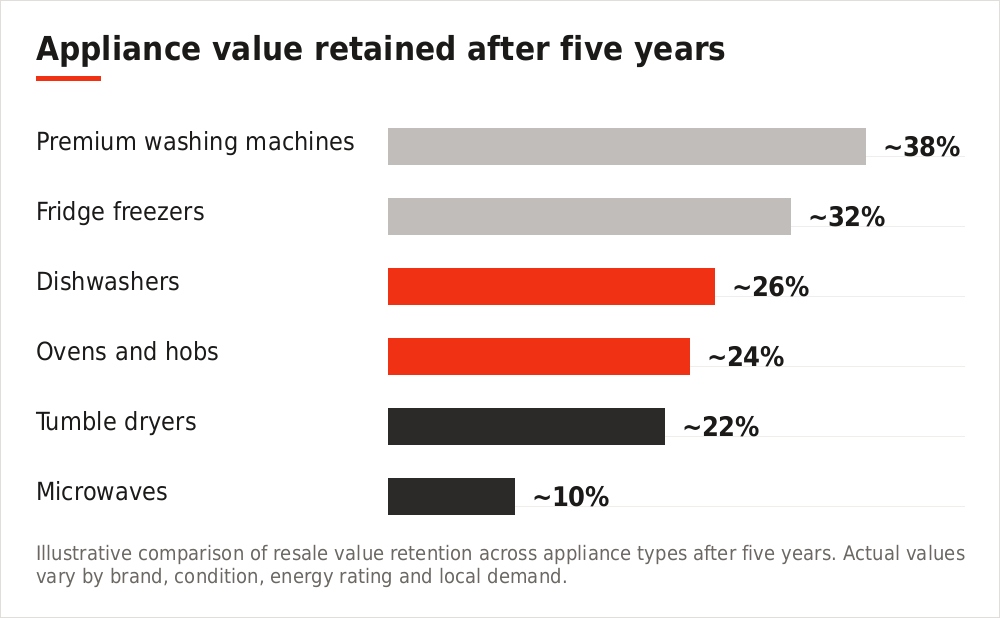
Illustrative comparison of resale value retention across appliance types after five years. Actual values vary by brand, condition, energy rating and local demand.
List your appliance free
No listing fee, no commission. Reach local buyers who can collect it.
Pricing appliances
Second-hand appliance values are driven by three things: brand reputation for reliability, age, and energy rating. A five-year-old premium machine often outsells a two-year-old budget one.
Check what the equivalent costs new. Because entry-level appliances are inexpensive, a used mid-range machine has to be priced well below new to make sense to a buyer.
Photographing appliances
- Front straight on, door closed, in good light
- Door open showing the clean interior
- Control panel close up, powered on if possible
- The rating plate showing model and specifications
- Rear, showing hoses, cable and connections
- Door seal and detergent drawer — proving they are clean
- Any dent, scratch or damaged trim
- The appliance running, mid-cycle, if you can
Writing the listing
Title: Brand + Model + Type + Capacity + Age.
Bosch Serie 6 washing machine, 9kg, 1400rpm, 2 years old
The description should state the full model number, all dimensions, capacity, energy rating, age, that you have tested it and what you tested, honest condition including every fault, whether it is freestanding or integrated, and exactly what collection involves.
Disconnection and collection
This is where appliance sales most often go wrong. Be explicit in the listing.
| State clearly | Why |
|---|---|
| Whether it is already disconnected | Buyers need to know whether to bring tools |
| Whether you will disconnect it | Water and gas connections are not everyone’s job |
| Which floor it is on | A washing machine down three flights needs two people |
| Whether transit bolts are included | Washing machines should be transported with them fitted |
| Parking and access | Whether a van can get close |
| Whether you can help lift | Appliances are heavy and awkward |
In most countries, disconnecting a gas cooker or hob legally requires a registered engineer. Do not attempt it yourself, and do not let a buyer do so. State in the listing that professional disconnection is required.
Safety and legal points
- Do not sell anything subject to a manufacturer safety recall — check the model before listing
- Disclose known faults in writing, in the listing itself
- Fit transit bolts to washing machines before they are moved, or damage is likely
- Fridges and freezers should stand upright for several hours before being switched on after transport — tell the buyer
- Where you are selling as a business, consumer protection obligations usually apply
- Old refrigeration units contain regulated refrigerants and must be disposed of properly if scrapped
Frequently asked questions
Should I sell an appliance that needs repair?
Yes, but describe the fault precisely and list it as spares or repair. Repairers and parts buyers actively look for these.
How long should a used appliance last?
Well-maintained major appliances often run ten years or more. Buyers know this, which is why brand reputation matters so much in this category.
Do I need to include the manual?
Helpful but not essential — most are available online. Mentioning the exact model number matters far more.
What about the warranty?
If any remains and it is transferable, that is a genuine selling point. Check the manufacturer’s terms and say so in the listing.
Is it worth selling a very old appliance?
Often yes for a low price — landlords, first-time renters and workshop users all buy older machines. Be honest about age and condition.
Who should disconnect the water supply?
Water connections are usually straightforward for a competent adult, but say who is doing it in the listing so there is no confusion on the day.
The short version
Find the model number and measure it. Run a full cycle and say you have. Clean the drawer, the seal and the filter. Photograph it open, running, and with the rating plate visible. Then be completely explicit about disconnection and collection.
Sell it, keep the full price
Free to list, free to sell, no commission at any value.
You can also browse listings across 238 countries before you settle on a price.