



How to Advertise a Rental Property Privately
Advertising a rental privately means keeping the letting fee and choosing your own tenant — but it also means handling the legal obligations yourself. This guide covers what your listing must include, how to photograph a property, screening applicants fairly, and the compliance points landlords most often miss.
What this covers
Key takeaways
- Safety certificates and deposit protection are legal requirements in most jurisdictions — check yours before advertising.
- Photographs and a clear rent figure determine whether anyone enquires at all.
- Screen every applicant by the same criteria — inconsistency is where discrimination claims arise.
- Never accept a deposit from someone who has not viewed the property.
- Always verify the right to rent where your country requires it.
Landlord obligations differ substantially between countries and often between regions within them. Deposit rules, notice periods, safety certification and licensing all vary. Check the requirements that apply where your property is before advertising.
Before you advertise: legal groundwork
Most jurisdictions require several things to be in place before a tenancy begins, and some before you can legally market the property at all.
- Gas and electrical safety certification where applicable
- Energy performance rating — many countries require this to be shown in the advertisement itself
- Smoke and carbon monoxide alarms fitted and tested
- Landlord licensing or registration where your local authority requires it
- Deposit protection arrangements understood before you take any money
- Mortgage and insurance permissions — consent to let, and landlord insurance rather than standard cover
- Freeholder or building permission if letting an apartment
In several countries, failing to protect a deposit or provide required certificates restricts your ability to end a tenancy later — sometimes for the entire duration. The paperwork is not bureaucracy for its own sake; it protects your position.
Setting the rent
Research comparable properties actually let recently, not asking rents on listings that have sat unlet for a month.
| Factor | Effect |
|---|---|
| Location and transport links | The dominant factor almost everywhere |
| Number of bedrooms | Major — and the main filter tenants use |
| Condition and finish | Significant; a recently updated kitchen or bathroom commands more |
| Furnished or unfurnished | Varies by market and tenant type |
| Outside space | Increasingly significant, particularly for families |
| Parking | Major in cities, minor in rural areas |
| Bills included | Widens the tenant pool but complicates your accounting |
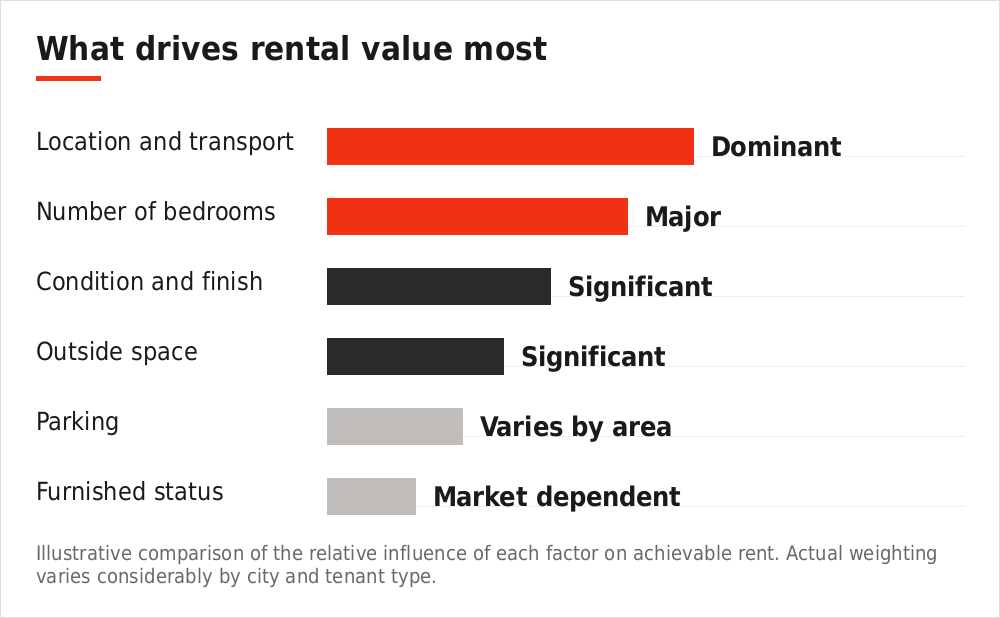
Illustrative comparison of the relative influence of each factor on achievable rent. Actual weighting varies considerably by city and tenant type.
A property let quickly at a modest discount usually earns more over a year than one held out for a higher figure that sits empty for six weeks. Void periods are the real cost in letting.
Photographing a property
Property listings live or die on photographs. Tenants scroll dozens of listings and open perhaps five.
Clean and declutter completely
Empty worktops, clear surfaces, no personal items. The tenant is imagining their life there, not observing yours.
Shoot in daylight with lights on
Open all curtains and switch on interior lights. It sounds contradictory but it evens out shadows and makes rooms look warmer.
Stand in the corner
Shooting from a room corner captures the most space and gives an honest sense of proportions.
Photograph every room
Including the bathroom, hallway and any storage. A missing room reads as a room being hidden.
Include outside space and the exterior
Garden, balcony, parking, and the building frontage.
Add a floor plan if you can
Even a rough one dramatically increases enquiry quality, because tenants self-select on layout.
Heavily distorted photographs that make rooms look larger than they are produce viewings that end in immediate disappointment. You waste your evening and the tenant’s. Honest photographs attract tenants who actually want the property.
Advertise your property free
No listing fee and no commission — keep what an agent would have taken.
Writing the listing
Title: Bedrooms + Type + Area + Feature + Availability.
2-bed flat, city centre, balcony, available October
Description should cover:
- Rent, and the period it covers — weekly or monthly, stated explicitly
- Deposit amount and how it will be protected
- What is included — bills, internet, parking, appliances
- Furnished, part-furnished or unfurnished
- Room count and approximate sizes
- Heating type and energy rating
- Available from date, and minimum term
- Pets, smoking, sharers — your policy, stated plainly
- Nearest transport, schools and amenities
- Who to contact and when viewings are possible
“No pets” or “professionals only” in the listing saves everyone time. Be careful, though: restrictions that appear to target protected characteristics can be unlawful. Restrict on the property, not on the person.
Handling enquiries
A well-priced property generates a lot of messages. Handle them systematically or you will lose track.
| Ask early | Why |
|---|---|
| When do you need to move in? | Filters out people six months out |
| How many people would live there? | Occupancy limits and licensing |
| Are you in employment or study? | Affordability, asked of everyone equally |
| Do you have pets? | Matches against your stated policy |
| Can you provide references? | Sets the expectation immediately |
A consistent set of questions asked of every applicant is both more efficient and your best protection against a discrimination complaint. Improvised questioning is where problems start.
Running viewings
- Group viewings into blocks rather than scattering them across a week
- Confirm the appointment the day before to reduce no-shows
- Do not attend alone if you are uncomfortable — bring someone
- Have the paperwork ready: certificates, energy rating, draft agreement
- Be honest about drawbacks — noise, parking, cold rooms in winter
- Allow time for questions; rushed viewings produce hesitant applicants
Screening tenants fairly
Screening protects you, but it has to be applied consistently and lawfully.
Verify identity and right to rent
Where your country requires immigration status checks, they are mandatory and must be done for every applicant without exception.
Confirm affordability
Payslips, employment contract, or accounts if self-employed. Apply the same threshold to everyone.
Take references
Previous landlord and employer. Contact them directly rather than relying on supplied letters.
Consider a credit check
Where lawful and with consent. Be clear about what you are checking and why.
Document your decision
Record the objective reason for accepting or declining each applicant. It is your defence if a decision is ever challenged.
In most countries you cannot refuse a tenant on grounds of race, religion, sex, disability, family status or other protected characteristics. Apply identical criteria to every applicant and keep records of why decisions were made.
Rental fraud to watch for
Property attracts fraud from both directions.
| Pattern | Target | Defence |
|---|---|---|
| Deposit requested before viewing | Tenant | Never pay before viewing and verifying ownership |
| Listing copied from another site | Tenant | Reverse image search the photographs |
| “Landlord abroad” who cannot show the property | Tenant | Walk away entirely |
| Overpayment of first rent, refund requested | Landlord | Never refund an overpayment; cancel instead |
| Forged references and payslips | Landlord | Contact referees directly using independently found details |
| Subletting without permission | Landlord | Address explicitly in the tenancy agreement |
Frequently asked questions
Do I need an agent to let a property?
No. Private letting is legal in most countries and saves the letting fee. You take on the compliance and screening work yourself.
How much deposit can I take?
Limits vary by jurisdiction and several countries cap it at a multiple of the rent. Check your local rules, and protect the deposit as required.
Can I refuse tenants with pets?
Usually yes, though some jurisdictions increasingly restrict blanket bans. Check current local law and state your policy clearly in the listing.
Should I let it furnished?
Depends on your market. Furnished suits students and short-term professionals; unfurnished suits families and longer tenancies.
What if a tenant stops paying?
Follow the legal process for your jurisdiction — never change locks or remove belongings, which is unlawful almost everywhere. Take advice early.
Do I need landlord insurance?
Standard home insurance usually does not cover letting. Landlord cover is strongly recommended and often required by mortgage lenders.
The short version
Get the certificates and permissions in place first. Price against properties actually let, not those still advertised. Photograph honestly in daylight. Ask every applicant the same questions, document your decisions, and never accept money from someone who has not seen the property.
List your rental with no fees
Free to advertise, free to let, no commission. Reach tenants searching your area directly.
Take a look at List It Global to see what similar items are fetching.