



How to Sell Furniture Online: A Practical Guide
Furniture is one of the most listed categories on classified sites and one of the most badly listed. Buyers need three things you can easily provide — accurate dimensions, honest condition, and a photograph that shows the piece in a real room. Get those right and most furniture sells within a week.
What this covers
Key takeaways
- Dimensions are non-negotiable. A listing without them loses most serious buyers immediately.
- Solid wood and quality brands hold value; flat-pack does not.
- Photograph furniture in a room, not against a blank wall — buyers need scale and context.
- State clearly whether it dismantles and whether you can help load.
- Bulky low-value items often move faster as “free to collect” than at a small price.
What actually sells, and what does not
Being realistic here saves disappointment. Furniture resale is strongly segmented.
| Type | Demand | Realistic expectation |
|---|---|---|
| Solid wood dining tables | Strong | Holds value well, sells reliably |
| Mid-century and vintage | Strong | Can appreciate; research before pricing |
| Quality branded sofas | Moderate | Sells if clean and smoke-free |
| Bed frames | Moderate | Sells well if it dismantles |
| Office desks and chairs | Moderate | Steady demand, especially ergonomic chairs |
| Flat-pack wardrobes | Weak | Often does not survive dismantling; price low |
| Mattresses | Weak | Hygiene concerns; many buyers avoid entirely |
| Large dark-wood units | Weak | Out of fashion; consider free to collect |
Chipboard furniture is usually damaged by dismantling, and buyers know it. If yours has never been taken apart, say so explicitly — it is a genuine selling point in that category.
Measuring properly
This is the most common reason furniture listings fail. Buyers are fitting the piece into a specific space, and without numbers they simply move on.
- Width, depth and height in centimetres or inches — state which
- Seat height for chairs and sofas
- Internal dimensions for wardrobes, drawers and shelving units
- Diagonal depth for sofas — this determines whether it fits through a doorway
- Weight, at least approximately, for anything substantial
- Whether it dismantles, and into how many pieces
Every sofa buyer has the same fear: will it get through the door? Give the diagonal depth and state whether the feet unscrew. Answering that one question upfront converts more viewings than anything else you can write.
Assessing condition honestly
Furniture flaws are visible in person and always discovered. Listing them costs you nothing and saves wasted collection trips.
| Check | What to look for |
|---|---|
| Structure | Wobble, loose joints, split wood, missing fixings |
| Surfaces | Scratches, water rings, heat marks, chipped veneer |
| Upholstery | Stains, tears, thinning fabric, sagging cushions |
| Mechanisms | Drawer runners, recliner action, sofa bed frame, hinges |
| Underneath | Woodworm, water damage, previous repairs |
| Smell | Smoke, pets, damp — disclose it, buyers will notice |
Both are extremely difficult to remove from upholstery and both are deal-breakers for many buyers. Saying “from a smoke-free, pet-free home” when true is a strong selling point — and concealing the opposite guarantees a wasted collection.
Pricing by material and brand
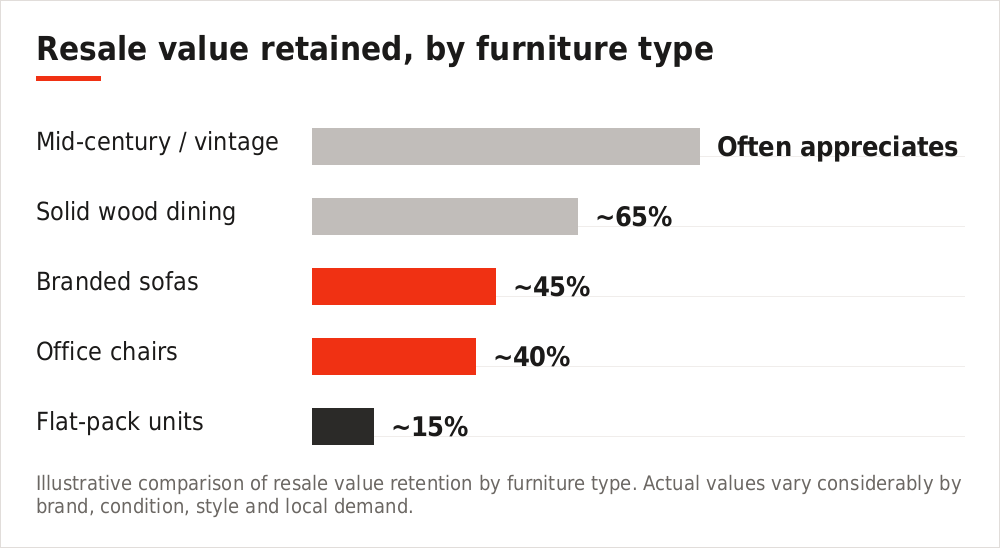
Illustrative comparison of resale value retention by furniture type. Actual values vary considerably by brand, condition, style and local demand.
Two rules cover most cases. Solid wood and recognised brands retain value; chipboard and unbranded pieces do not. And condition matters more than age for good furniture — a well-kept fifty-year-old oak table outsells a scuffed five-year-old veneer one.
List your furniture free
No listing fee, no commission. Reach local buyers who can collect this weekend.
Photographing furniture
Furniture is the one category where a plain background is not the goal. Buyers need to imagine the piece in their own home, and that requires context.
Tidy the room first
Clear the surrounding clutter. The room is part of the photograph whether you intend it or not.
Shoot the whole piece in situ
Straight on and from a three-quarter angle, in daylight, with the room visible for scale.
Capture every side
Front, back, both ends. Buyers want to know whether the back is finished if it will float in a room.
Show the details
Joints, legs, handles, upholstery texture, the underside. These signal quality.
Photograph every flaw
One clear close-up per mark, and reference them in the description.
Include a scale reference where helpful
A mug on a table, or a person standing beside a wardrobe, communicates size instantly.
Writing the listing
Title: Material + Type + Size + Colour + Age.
Solid oak dining table, seats 6, 180 × 90 cm, 3 years old
Description must include:
- Full dimensions, clearly labelled
- Material — solid wood, veneer, chipboard, fabric type, leather or faux
- Brand and range if known
- Age and how heavily used
- Condition, with every flaw listed
- Whether it dismantles, and into how many parts
- Whether it is from a smoke-free and pet-free home
- Collection details — floor level, lift access, parking
- Whether you can help load
Collection, delivery and access
Furniture sales fail at collection more than any other category, almost always for logistical reasons that could have been stated in advance.
| State clearly | Why it matters |
|---|---|
| Which floor it is on | A sofa on the third floor with no lift is a different job entirely |
| Lift or stairs | Determines how many people the buyer needs to bring |
| Parking access | Whether a van can get close, and any restrictions |
| Whether you can help lift | Many buyers arrive alone assuming you will |
| Whether it is already dismantled | Affects vehicle size needed |
| Available collection times | Avoids a week of back-and-forth messages |
If you have access to a van or can deliver locally for a small fee, say so. It widens your buyer pool considerably — a large share of furniture buyers have no way to transport a sofa.
Timing your listing
- Late summer and early autumn — student moves drive strong demand for beds, desks and basic furniture.
- January — people reorganising after the holidays, and post-Christmas replacement of older pieces.
- Spring — garden furniture, and general house-move season.
- Evenings and weekends — when people browse. A Sunday evening listing catches more eyes than a Tuesday afternoon one.
Frequently asked questions
Should I dismantle before listing?
Leave it assembled for photographs, but say whether it dismantles. Take it apart only once a buyer has committed — some items do not survive reassembly.
Can I sell a used mattress?
Rules vary by country, and many buyers avoid them regardless. Check local regulations, be scrupulously honest about condition, and expect limited interest.
What if nobody collects?
No-shows are common with free and low-value bulky items. Keep the listing live until it is genuinely gone, and do not stop replying to others because one person promised to come.
Is it worth listing damaged furniture?
Often yes — upcyclers and restorers actively look for pieces to repair. Describe the damage plainly and price it accordingly.
How do I price vintage furniture?
Research the specific maker and period rather than guessing from appearance. Some mid-century pieces are worth far more than owners assume.
Should I accept a deposit to hold it?
Generally no. First to arrive with payment is simpler, avoids disputes, and you can say so in the listing so nobody feels misled.
The short version
Measure it, photograph it in a tidy room, list every flaw, and state exactly what collecting it involves. Furniture buyers are solving a practical problem — the listing that answers their questions is the one they contact.
Clear the room, keep the money
Free to list, free to sell, no commission at any value.
You can also search listings worldwide without creating an account.