


How to Price Second-Hand Items So They Actually Sell
Price decides whether your item sells more than anything else you control. It is also where most sellers go wrong, for an entirely understandable reason: we price on what we paid, or what we feel the thing is worth, rather than what buyers are currently paying.
What this covers
Key takeaways
- Research sold prices. Asking prices tell you what sellers hope for, not what buyers pay.
- What you originally paid is irrelevant to what it is worth today.
- Different categories depreciate at very different rates — electronics fast, quality tools slowly.
- If two weeks pass with no genuine enquiries, the price is wrong.
- A slightly low price that sells beats a fair price that sits for three months.
Sold prices, not asking prices
This is the single most important distinction in pricing second-hand goods, and most sellers never make it.
When you browse a category and see five similar items at $400, you have learned what five optimistic people hope to get. You have learned nothing about what anyone actually paid. Those listings may have been sitting untouched for two months precisely because $400 is too high.
Wherever a platform lets you filter to completed or sold listings, do it. Where it does not, look for the signal instead: items that disappear quickly were priced right; items that reappear week after week were not.
How to research in ten minutes
Search the exact model
Not “laptop” but “Dell XPS 13 9310 16GB”. Precision matters — specification changes value substantially.
Find five comparable items
Same model, similar age, similar condition. Fewer than three and you are guessing.
Filter to sold where you can
If unavailable, note which listings vanish quickly versus which linger.
Adjust for condition and completeness
Original box, charger, receipts and low usage all add. Missing parts and cosmetic damage subtract more than sellers expect.
Set your number and write down your floor
Decide in advance the lowest you will accept. It stops you making a decision you regret mid-negotiation.
If the current model has dropped in price or been superseded, second-hand values fall with it. A phone that cost $900 two years ago competes with whatever $500 buys new today — not with its own original price.
How different categories lose value
Depreciation varies enormously by category. Applying a single mental rule across everything is why people misprice.
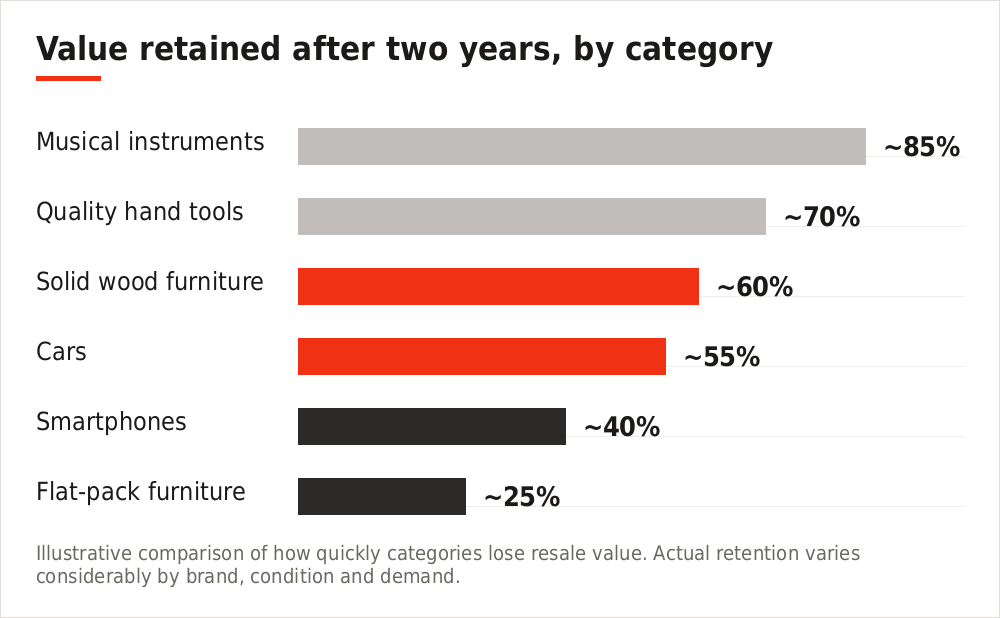
Illustrative comparison of how quickly different categories lose resale value. Actual retention varies by brand, condition and market demand.
| Category | Depreciation | What that means for you |
|---|---|---|
| Smartphones, laptops | Fast | Sell early. Every model release cuts value again. |
| Flat-pack furniture | Fast | Price low and prioritise a quick collection. |
| Cars | Steady | Mileage and service history matter more than age. |
| Quality hand tools | Slow | Good brands hold value for years. |
| Solid wood furniture | Slow | Condition matters far more than age. |
| Musical instruments | Very slow | Some appreciate. Research before discounting. |
| Baby equipment | Fast | Short usable window; sell as soon as outgrown. |
Priced it? List it free.
478 categories, 238 countries, and no commission on whatever you agree with your buyer.
Grading condition honestly
“Excellent condition” means something specific to a buyer inspecting your item in person. Overstating it does not win you a higher price; it wins you a wasted afternoon and a buyer who walks away.
| Grade | What it genuinely means | Typical of new price |
|---|---|---|
| As new | Unused or barely used, all packaging present | 80–90% |
| Excellent | Light use, no visible marks, fully working | 65–80% |
| Good | Normal wear, minor marks, fully working | 45–65% |
| Fair | Visible wear or a cosmetic fault, works fine | 25–45% |
| For parts | Not working or incomplete | 10–20% |
A buyer who arrives expecting “excellent” and finds “good” does not negotiate — they leave, and you start again. Listing the flaws in the ad filters out everyone who would have walked, and the people who come are ready to buy.
Four pricing strategies
| Strategy | How it works | Best for | Trade-off |
|---|---|---|---|
| Market price, firm | Price at the going rate, state “price firm” | Common items with clear comparables | Deters hagglers; may take slightly longer |
| Slight premium | Add 10–15% and expect to negotiate | Sellers comfortable haggling | Some buyers filter you out entirely |
| Priced to move | Set below market for speed | House moves, deadlines, bulky items | You leave money on the table |
| Free to collect | Give it away | Low-value bulky items | Expect several no-shows |
Pick one and commit. The worst outcome is drifting — starting high, dropping in $10 increments over two months, and eventually accepting less than a decisive price would have achieved in week one.
Price psychology that works
- Round numbers signal flexibility. $500 invites an offer; $485 reads as considered.
- Mind the filter boundaries. Buyers search “under $500”. At $520 you are invisible to them; at $495 you appear.
- “Or nearest offer” invites negotiation. Use it when you want a fast sale, omit it when you do not.
- Justify a premium explicitly. “Priced above others because it includes the original box, receipt and two years of warranty remaining” converts far better than an unexplained higher number.
- Bundle rather than discount. Adding the case and charger often closes a deal that a $20 reduction would not.
When and how to adjust
Most items that sell do so in the first week, while the listing is still near the top of category results. Silence after that is information.
| Signal | Likely cause | What to do |
|---|---|---|
| No views at all | Wrong category or weak title | Recheck category; rewrite title with specifics |
| Views but no messages | Price or photographs | Reshoot in daylight; drop 10–15% |
| Messages but no viewings | Description missing detail | Add dimensions, condition, what is included |
| Viewings but no sale | Condition overstated | Describe flaws accurately and reprice |
| Only lowball offers | Price above market | Recheck comparables; adjust or hold firm knowingly |
Change the price and the photographs together and you will never know which worked. Adjust one, wait a week, then adjust the other. You learn something you can use on the next item.
Seven pricing mistakes
- Pricing on what you paid. The market does not care what it cost you.
- Copying asking prices. You are copying other people’s mistakes.
- Ignoring the current new price. If new has dropped, used must follow.
- Adding sentimental value. It is worth more to you than to anyone else.
- Refusing to move on principle. A firm price that never sells earns nothing.
- Tiny increments. Dropping $5 at a time signals you will keep dropping.
- Forgetting the cost of storage. An item occupying your garage for six months has a cost too.
Frequently asked questions
Should I price high and negotiate down?
Only if you are comfortable haggling. Many buyers filter by price and never see an overpriced listing. A realistic price with “firm” stated often sells faster and nets more.
How much should I drop if it is not selling?
10–15% is meaningful enough to reach new buyers and re-enter price filters. Smaller cuts rarely change anything.
Is it worth listing something worth very little?
Yes — listing is free, so there is no downside. For genuinely low-value bulky items, “free to collect” often clears them faster than a small price.
Should I include delivery in the price?
State it separately. Buyers comparing listings look at the item price first, and a bundled delivery cost makes yours look more expensive than it is.
What if someone offers well below asking?
Counter once at a number you would genuinely accept, or reply politely that the price is firm. Do not argue — a lowball is an opening position, not an insult.
Does the currency I choose matter?
Choose the currency you want to be paid in. International buyers can see the price and convert it themselves.
The short version
Look up what comparable items actually sold for. Be honest about condition. Set a number you would accept today, decide your floor in advance, and give it a fortnight. If nothing happens, the market has told you something — and it is almost always about price or photographs.
Ready to list it?
Free to post, free to sell, no commission at any value. Buyers across 238 countries.
Or browse by category and location to check the local market first.