

Facebook Marketplace vs Classified Ads Websites
Facebook Marketplace has become the default for local second-hand selling in many countries, largely because everyone is already there. But “already there” is not the same as “best suited”, and the two models fail in quite different ways. Here is where each actually works.
What this covers
Key takeaways
- Marketplace has volume; classifieds have structure.
- Browsing by photograph favours Marketplace; searching by specification favours classifieds.
- Marketplace requires a personal account tied to your real identity.
- Listings in busy areas sink fast on Marketplace — classifieds run for a fixed term.
- Both are free. There is no reason to choose only one.
How the two models differ
Facebook Marketplace grew out of a social network. Its strength is that a vast number of people already have accounts and browse casually, and its architecture reflects that — a visual feed, loose categorisation, and messaging through an app everyone already uses.
A classified platform is built for search. Structured categories, defined attribute fields, filters on specification and distance, and listings that persist for a fixed period rather than sinking beneath newer posts.
Where Marketplace wins
- Sheer local volume — in most towns, more people are on it than anywhere else
- Speed for common items — sofas, prams and bicycles often sell within hours
- Zero friction to start — no new account, no new app
- Visual browsing — excellent when the item is recognisable from a photograph
- Some social context — you can see something of who you are dealing with
- Free at every stage
Marketplace is genuinely hard to beat. Local density is the deciding factor for bulky items that must be collected, and that is exactly what it has.
Where classifieds win
| Situation | Why structure matters |
|---|---|
| Buyers search by specification | Filters on make, model, capacity, year, size |
| Technical or specialist items | Attribute fields capture what matters |
| Vehicles | Mileage, engine, transmission, owners as searchable fields |
| Property and rentals | Bedrooms, rent, availability as structured data |
| Jobs and services | Marketplace is not built for these at all |
| Buyers outside your area | Marketplace is strongly local by design |
| Sellers wanting separation | No link to a personal social profile |
| Listings that persist | A fixed run rather than sinking in a feed |
The search problem
This is the sharpest practical difference, and it is worth understanding before you choose.
On a classified platform, someone looking for a specific laptop can filter to that processor, that amount of memory, within thirty kilometres, under a price ceiling. The results are exactly what they asked for.
On Marketplace, the same person searches text and scrolls. They will see broadly relevant items, many irrelevant ones, and may miss yours entirely because you phrased the title differently.
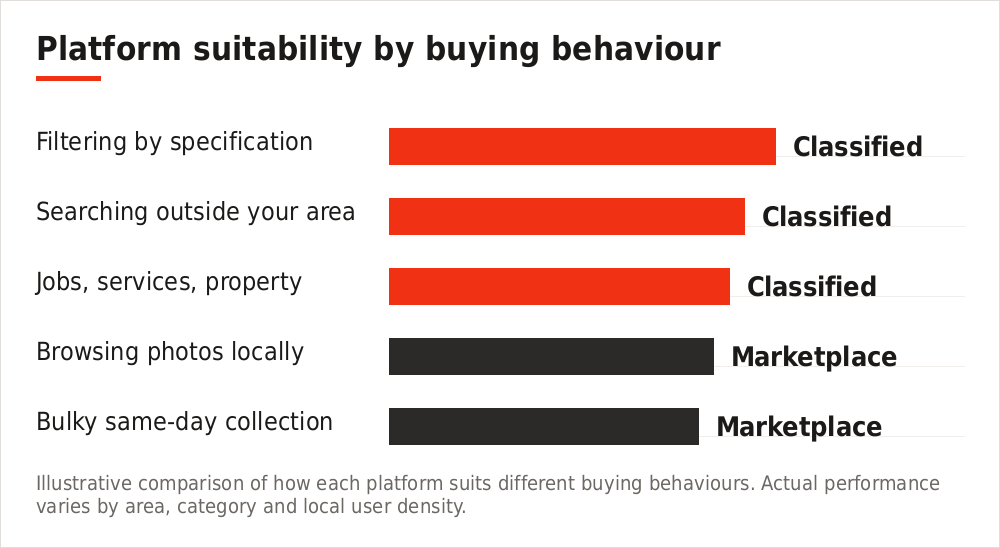
Illustrative comparison of how each platform suits different buying behaviours. Actual performance varies by area, category and local user density.
If they would recognise it instantly from a photograph, Marketplace works. If they would need to filter by specification — frame size, storage capacity, mileage, bedrooms — a structured platform will serve them far better.
List where buyers can filter
478 structured categories with specification and distance filters. Free to list, no commission.
Privacy and identity
Marketplace ties your listings to your personal profile. For many people that is a feature — buyers can see you are a real person with a history, which builds trust.
For others it is a genuine drawback:
- Buyers can see your name, photograph and often mutual connections
- Selling requires a personal social account you may not want
- Business sellers may not want trade listings on a personal profile
- Some people simply prefer transactions separate from their social life
A classified account carries only what you choose to display — typically a display name and, optionally, a phone number visible to logged-in users.
Time-wasters and enquiry quality
Both platforms attract non-serious enquiries. The pattern differs.
| Marketplace | Classified | |
|---|---|---|
| Enquiry volume | High | Lower |
| “Is this available?” then silence | Very common | Less common |
| Enquiry quality | Mixed — casual browsers | Better — active searchers |
| No-shows | Common | Common |
| Detailed questions | Less frequent | More frequent |
The underlying reason is intent. Someone scrolling a feed may message on impulse; someone who filtered to your exact specification has decided they want that thing.
“No time-wasters” does nothing on either platform. Full measurements, honest condition and clear collection details do the filtering properly, because people self-select out before messaging.
Best choice by category
| Selling | Try first | Reason |
|---|---|---|
| Sofa, wardrobe, white goods | Marketplace | Local volume; recognised from a photo |
| Laptop, phone, camera | Classified | Buyers filter by specification |
| Car or motorcycle | Classified | Structured fields for mileage, engine, year |
| Property to rent | Classified | Bedrooms, rent and availability as filters |
| Job vacancy | Classified | Marketplace is not designed for this |
| Trade services | Classified | Location-first search matches intent |
| Children’s clothing bundle | Either | Both work; Marketplace is faster locally |
| Specialist equipment | Classified | Buyer may be nowhere near you |
Using both together
They cost nothing, so the sensible approach for most sellers is simply to use both.
Write the listing once
Same photographs, same description, adapted slightly for each.
Post to Marketplace for local reach
Especially for bulky or common items.
Post to a classified platform for structured search
Where buyers filter by specification, or may be further away.
Keep the price identical
Buyers do cross-check, and inconsistency undermines trust.
Remove both when it sells
Immediately, so nobody wastes a journey.
Frequently asked questions
Which sells faster?
For common local items, usually Marketplace, because of sheer volume. For anything requiring specification search, classifieds reach better-qualified buyers.
Do I need a Facebook account to sell?
For Marketplace, yes. A classified platform requires only an email address or a Google sign-in.
Can I list the same item on both?
Yes, and it is usually sensible. Keep the price consistent and remove both listings once sold.
Is Marketplace safer?
Profiles offer some context, but neither platform processes payment, so the same safety rules apply: inspect before paying, meet in public, use traceable payment.
Why do my Marketplace listings disappear?
In busy areas newer listings push older ones down quickly. Classified listings run for a set period — 60 days here — regardless of what else is posted.
Which is better for business selling?
Classifieds, generally. Structured categories, no link to a personal profile, and buyers searching with purchase intent rather than browsing socially.
The short version
Marketplace for bulky, local, instantly recognisable things. Classifieds for anything a buyer would search by specification, anything requiring structured fields, and anything where the buyer might not be nearby. Both are free, so use both.
Add structured reach to your listing
Free to list, free to sell, no commission — across 238 countries.
You can also search listings worldwide without creating an account.