Subito Alternatives for Selling in Italy
Subito is the established general classified platform in Italy and works well for everyday local selling. But Italy has an unusually deep market in vintage furniture, design pieces and antiques, and those buyers are frequently in Germany, France, the United States or Japan rather than the next province.
What this covers
Key takeaways
- Subito remains strongest for local everyday items across Italy.
- Italian design and vintage pieces have a substantial international following.
- Cultural goods above certain ages face export licensing requirements.
- Distances within Italy are significant — regional listings limit reach considerably.
- Listing in Italian and English widens reach for anything collectable.
Why Italian sellers use more than one platform
| Reason | Detail |
|---|---|
| Paid placement | Competitive categories favour promoted listings |
| Regional fragmentation | A buyer in Milan will not collect from Puglia |
| International demand for design | Domestic listings miss the strongest buyers entirely |
| Thin markets for specialist goods | Niche items need a wider audience |
| High enquiry volume | Scale brings non-serious contacts |
| Wanting a second channel | No sense relying on one platform |
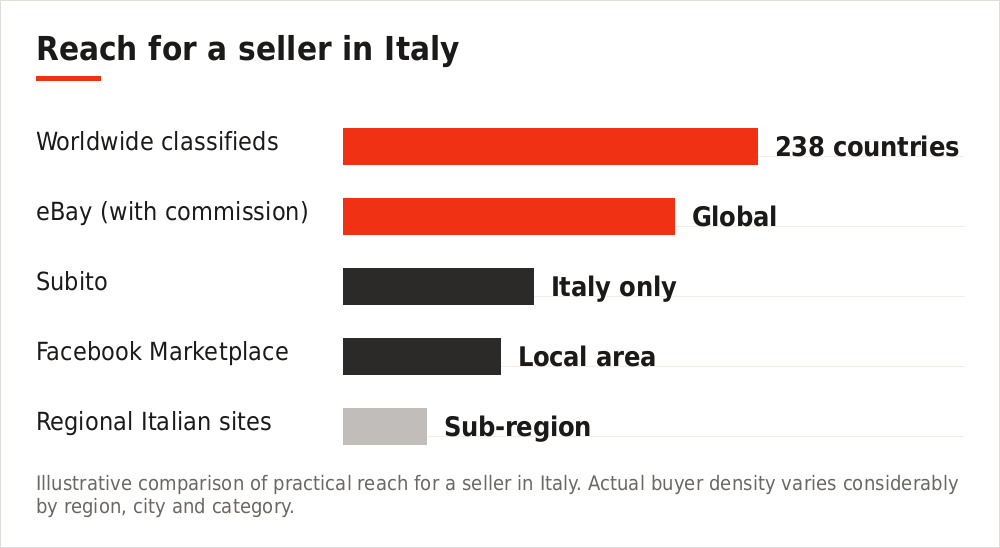
Illustrative comparison of practical reach for a seller in Italy. Actual buyer density varies considerably by region, city and category.
The alternatives compared
| Platform | Reach | Cost | Best for |
|---|---|---|---|
| Subito | Italy | Free with paid tiers | Local everyday items |
| Facebook Marketplace | Local, any city | Free | Bulky local pickup |
| List It Global | 238 countries | Free, no commission | Design, vintage and specialist goods |
| eBay | Global | Commission | Collectables and small shippable goods |
| Specialist design platforms | Global, one sector | Often commission | High-value design and antiques |
Reach buyers beyond Italy
238 countries, free to list, no commission and no paid ranking.
Best choice by category
| Selling | Try first |
|---|---|
| Furniture and appliances | Subito or Marketplace — collection required |
| Phone or laptop | Subito locally, worldwide if unsold |
| Vehicle or scooter | Subito plus specialist motoring portals |
| Mid-century design | Worldwide — buyers are international |
| Antiques and collectables | Worldwide, subject to export rules |
| Property | National portals plus classifieds |
| Services and trades | Structured classified platform |
Vintage, design and antiques
This is where Italian sellers most often undervalue what they have, and where an international listing makes the largest difference.
- Research the maker and designer before pricing — mid-century Italian design has a serious international market
- Photograph maker marks, labels and stamps clearly — this is what collectors search for
- Do not restore or refinish — original condition, even worn, is usually worth more
- Describe the period accurately rather than guessing at a style name
- Include the designer name in the title where you know it
- Expect buyers to arrange transport for anything genuinely valuable
A chair described as a mid-century armchair reaches nobody in particular. The same chair with the manufacturer and designer named reaches people who have been searching for that exact piece, sometimes for years, and who will arrange international shipping without hesitation.
Export rules on cultural goods
Items above certain ages and values may require authorisation before leaving the country, and the rules differ for movement within the EU versus outside it. This applies to artworks, antiques, archaeological items and some furniture. Penalties for unauthorised export are serious. Check with the relevant authority before agreeing an international sale of anything genuinely old.
- Establish the age and category of the item before listing internationally
- Check whether an export certificate is required
- Allow time — authorisation is not immediate
- Be transparent with buyers about the process and timescale
- Take professional advice for anything of significant value
Shipping design and antiques safely
Once you are selling internationally, packing becomes part of the transaction rather than an afterthought. Damage in transit is the most common way a good sale turns into a dispute.
Get a specialist quote before agreeing a price
Art and antique shippers handle furniture and fragile pieces properly. Their cost should be known and quoted separately, not absorbed.
Photograph the item and the packing process
Every stage, including the sealed crate. This is your evidence if a claim arises.
Insure for the full sale value
Standard carrier cover is usually far below what a design piece is worth.
Agree who bears transit risk
In writing, before payment. Ambiguity here is where disputes originate.
Consider buyer-arranged collection
For high-value pieces, specialist dealers often prefer to send their own shipper — which moves the risk to them.
For genuinely valuable items, a buyer who sends their own shipper is taking responsibility for transit. Provided payment has cleared first, that is usually the better arrangement for both parties.
Provenance and documentation
For design and antiques, what you can prove about an item affects its value as much as its condition.
| Documentation | Effect on value |
|---|---|
| Original purchase receipt | Establishes ownership history |
| Maker label or stamp intact | Often the difference between attributed and anonymous |
| Period photographs of the piece in use | Adds genuine provenance |
| Auction or dealer paperwork | Independent confirmation of attribution |
| Restoration records | Discloses work honestly; buyers value transparency |
| Nothing at all | Sold as unattributed — state this plainly |
Where you cannot verify attribution, say so. Describing a piece as being in the style of a designer, or as bearing a particular label you have not authenticated, is honest and protects you. Claiming attribution you cannot support invites a legitimate dispute.
North, south and the distance problem
Italy is long, and internal distances are greater than sellers often account for. A listing that would find a buyer in an hour in Milan may find nobody in a rural southern province.
| Situation | Approach |
|---|---|
| Bulky low-value items | Local only — transport dominates cost |
| Design and antiques | International — buyers arrange collection |
| Vehicles | National — buyers travel for the right one |
| Anything shippable | Worldwide — location becomes irrelevant |
| Rural sellers generally | Widen the listing radius substantially |
Italian selling obligations
- Occasional private sales of personal possessions are generally not taxable
- Regular trading requires registration as a business
- Business sellers must identify themselves; buyers gain consumer rights including distance-selling protections
- Platforms report seller income above thresholds under EU rules
- Vehicle sales require formal transfer of ownership, usually with authenticated signatures
- Property rentals require energy performance certification
Using several platforms
Write it once
Photographs and description transfer with minor edits.
Post locally for ordinary goods
Fastest route for collection-based items.
Add an international listing for design and specialist items
Where the strongest buyers are usually abroad.
Include key terms in English
Designer, maker, period and condition.
Remove everything on sale
Across all platforms, immediately.
Frequently asked questions
Is Subito still the best option?
For local everyday items in Italy, generally yes. For design, antiques and specialist goods, an international listing usually reaches better buyers.
Do I need an export licence?
Possibly, for items above certain ages and values. Check before agreeing an international sale — the rules are strict and enforced.
Should I list in English too?
For anything collectable, yes. Include the designer, maker and period in English as well as Italian.
Do I pay tax on sales?
Occasional sales of personal possessions are generally not taxable. Regular buying to resell is commercial activity. Check your position if you sell often.
Will buyers really collect from a remote area?
For genuinely valuable design and antiques, routinely. Specialist dealers and collectors arrange transport as a matter of course.
Should I restore a vintage piece first?
Almost never. Collectors strongly prefer original condition, and refinishing frequently reduces value substantially.
The short version
Subito for local everyday selling. For design, vintage and antiques, research the maker, name the designer in the title, do not restore anything, and list internationally — while checking export requirements before you agree a sale abroad.
List across Italy and beyond
Free to post, free to sell, no commission and no paid ranking.
Or browse what is listed on List It Global to see what is selling near you.