

Vinted and Depop vs Classified Ads
Vinted, Depop and similar apps have taken a large share of clothing resale, and for that specific job they work well. But sellers frequently discover the limits when they try to sell anything that is not clothing, or when they add up what the platform actually costs them.
What this covers
Key takeaways
- These apps are built for clothing and excellent at it.
- Costs fall on buyers or sellers depending on the platform — check which.
- Postage-based selling breaks down for anything bulky or heavy.
- Buyer protection means returns and disputes you cannot decline.
- Classifieds suit local, bulky, high-value and non-clothing items better.
How these platforms work
They are not classified sites. They are managed marketplaces, and the difference shapes everything.
- Payment is processed by the platform, not between you and the buyer
- Postage is integrated, with prepaid labels
- Buyer protection applies, funded by a fee
- Funds are held until the buyer confirms receipt
- Disputes are decided by the platform, not by you
- Everything is posted — collection is rarely part of the model
What they actually cost
The headline is often that selling is free. Whether that is true depends on where the fee has been moved to.
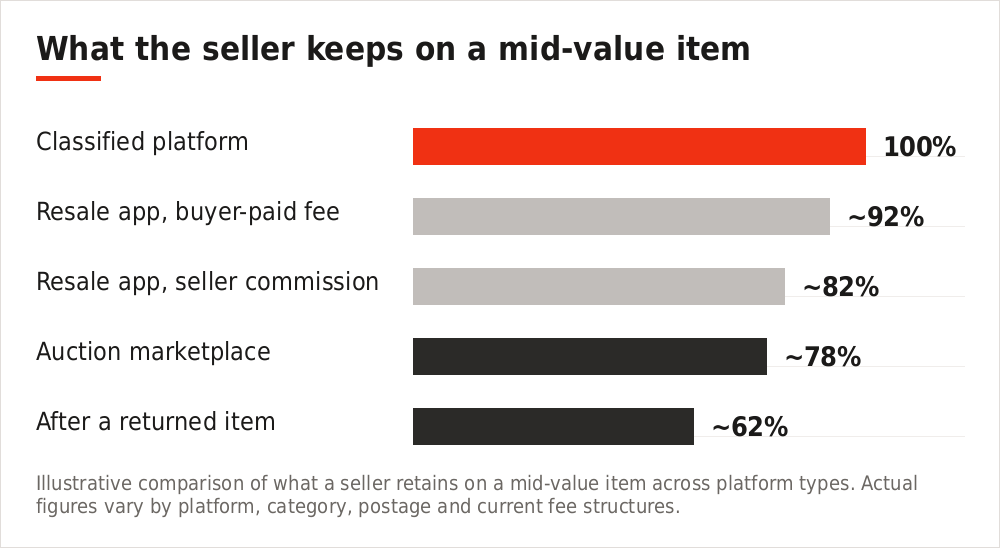
Illustrative comparison of what a seller retains on a mid-value item across platform types. Actual figures vary by platform, category, postage and current fee structures.
| Cost | Who pays | Effect |
|---|---|---|
| Buyer protection fee | Usually the buyer | Raises the effective price, so your item looks dearer |
| Commission on the sale | The seller, on some platforms | Direct deduction from what you receive |
| Postage | Usually the buyer | Adds to the total they compare against alternatives |
| Promoted listings | The seller, optionally | Recurring cost if you sell regularly |
| Returns | Frequently the seller | Postage both ways on a sale that did not happen |
A fee charged to the buyer is not free to you. It raises the total they pay, which means your item competes against alternatives at a higher effective price. The money comes out of the same transaction either way.
What they do well
- Clothing and accessories — enormous, engaged audience
- Small light items that post cheaply
- Brand-driven search — buyers browse by label and size
- Integrated postage removes the logistics problem
- Payment handled, so no cash meeting required
- Discovery through browsing rather than only search
Where they run out
| Situation | Problem |
|---|---|
| Furniture and appliances | Cannot be posted; the model does not support collection |
| Vehicles | Not the platform purpose at all |
| Tools and equipment | Weight makes postage uneconomic |
| High-value items | Fees and dispute exposure both scale up |
| Property and services | Outside the model entirely |
| Very low-value items | Postage exceeds the item value |
| Local selling | Posting something to someone two streets away |
Sell what does not fit in a parcel
Any category, any value, free to list with no commission.
Direct comparison
| Resale apps | Classified platform | |
|---|---|---|
| Best for | Clothing, small postable items | Anything, particularly bulky or local |
| Cost to sell | Fee somewhere in the transaction | None |
| Delivery | Integrated postage | Collection or your own arrangement |
| Payment | Handled by the platform | Direct between you and the buyer |
| Buyer protection | Yes | No — you handle the transaction |
| Returns | Buyer can open a dispute | Sale is final on handover |
| Value ceiling | Practical limits | None |
Neither model is better in the abstract. Buyer protection is genuinely valuable to buyers and genuinely costly to sellers, and which side of that trade suits you depends entirely on what you are selling.
Best choice by what you are selling
| Item | Use |
|---|---|
| A jacket or dress | Resale app — that is what it is for |
| A wardrobe | Classifieds — collection required |
| Designer handbag | Either, though fees rise with value |
| Power tools | Classifieds — weight defeats postage |
| Children’s clothes bundle | Resale app |
| Cot or pushchair | Classifieds — bulky, usually collected |
| Anything over a few kilograms | Classifieds |
Returns and disputes
This is the difference sellers feel most sharply, and it catches people who moved across from classified selling.
- Buyers can open disputes after receiving the item
- The platform decides, not you
- Funds can be held while a dispute runs
- Photograph everything before posting — your only real evidence
- Describe flaws exhaustively, since misdescription is the usual dispute ground
- On a classified sale, handover ends it — the buyer inspected and paid
Photographs taken before packing are frequently the only evidence you have if a buyer claims an item arrived damaged or misdescribed. Include the flaws you already declared, so there is a dated record matching your description.
Selling regularly on resale platforms
One consequence of platform-processed payments is that your sales are recorded and, above certain thresholds, reported to tax authorities. Many countries now require this.
| Situation | General position |
|---|---|
| Selling your own used possessions occasionally | Usually not taxable income |
| Buying specifically to resell | Generally treated as trading |
| Regular volume above reporting thresholds | Platform reports to tax authorities |
| Making items to sell | Trading activity |
| Selling a single high-value personal item | Usually not taxable, though rules vary |
Reporting is not the same as owing tax. Clearing your own wardrobe remains clearing your own wardrobe, whatever the volume of items. But if you are buying stock to resell, that is a business in most jurisdictions and should be treated as one. Rules differ considerably by country, so check your own position rather than assuming.
What you paid, what you sold it for, and when. It takes minutes and settles any question about whether you were trading or clearing possessions.
Photographing clothing well
Whichever platform you use, clothing sells on presentation more than any other category, and the same techniques work on both.
- Natural light against a plain wall beats any indoor lighting
- Hang or lay flat rather than photographing crumpled
- Photograph the label showing brand and size clearly
- Show the fabric composition tag — buyers genuinely check
- Give measurements, not just the size, because sizing varies enormously
- Photograph every flaw — marks, pilling, missing buttons, worn hems
- Include the item worn if you can, for drape and fit
The commonest reason clothing comes back is that it did not fit, and that is almost always because the listing gave a size label rather than actual measurements. Chest, length, waist and sleeve in centimetres removes the guesswork and the dispute.
Using both
Sort by weight and size first
Postable goes to the resale app; bulky goes to classifieds. That single split gets most of the decision right.
Clothing to the app
The audience is there and the postage is solved.
Everything else to classifieds
Tools, furniture, equipment, vehicles, electronics of any size.
High-value items to classifieds
Fees and dispute exposure both scale with price.
Bundle low-value clothing
Rather than posting single items worth less than the postage.
Frequently asked questions
Are these apps really free to sell on?
Depends on the platform. Some charge the buyer a protection fee rather than the seller, but that still raises the effective price of your item.
Can I sell furniture on them?
Not practically. The model is built around postage, and collection is rarely supported.
What if a buyer opens a dispute?
The platform decides. Your protection is a thorough description and photographs taken before dispatch.
Which is better for a high-value item?
Usually classifieds, because fees and dispute exposure both increase with the sale price.
Is buyer protection worth the cost?
To buyers, frequently yes. To sellers it is a cost and an exposure. It depends which side of the transaction you are on.
Should I use both?
Most people should. Split by weight and size, and each platform does the job it is good at.
The short version
Use a resale app for clothing and small postable items, where the audience and the integrated postage genuinely help. Use classifieds for anything bulky, heavy, high-value or local, where postage-based selling breaks down and fees eat the margin.
No fees, no commission, any category
Free to post, free to sell, and whatever you agree is what you keep.
You can also browse listings across 238 countries before you decide on a price.