eBay vs Classified Ads: Which Costs You Less to Sell?
eBay and classified platforms solve the same problem in fundamentally different ways — and the difference shows up in what you actually keep. This is a straight comparison of what each costs, what each is genuinely better at, and how to decide which suits the thing you are selling.
What this covers
Key takeaways
- eBay charges commission on the sale price; classifieds do not.
- That fee buys real things — payment handling, buyer protection, global reach.
- For local, bulky or high-value items, those services are largely wasted.
- For small, shippable, niche items, eBay’s buyer base often justifies the cost.
- Commission is charged on the sale price, not your profit.
The fundamental difference
eBay is a marketplace: it sits between you and the buyer, processes the payment, holds the funds, and steps in if there is a dispute. A classified platform is a noticeboard: it helps you find each other and then gets out of the way.
Neither model is superior in general. Each is better in specific circumstances, and knowing which circumstance you are in is the whole decision.
What each actually costs
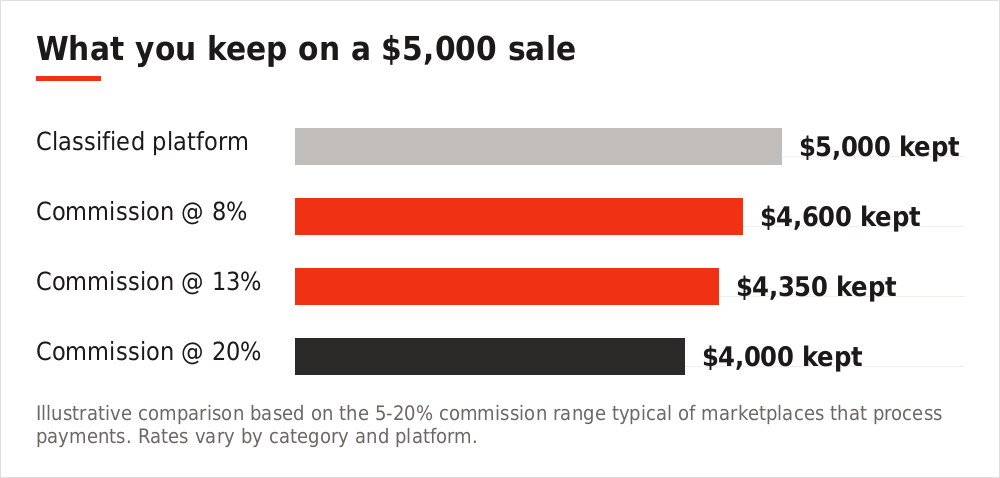
Illustrative comparison based on the 5–20% commission range typical of marketplaces that process payments. Rates vary by category and platform — check current fees before listing.
| Sale price | At 13% commission | You keep | On a classified platform |
|---|---|---|---|
| $100 | $13 | $87 | $100 |
| $500 | $65 | $435 | $500 |
| $1,500 | $195 | $1,305 | $1,500 |
| $5,000 | $650 | $4,350 | $5,000 |
And commission is often not the only deduction. Depending on the platform and category you may also meet payment processing charges, currency conversion spreads, promoted-listing fees, and shipping costs absorbed into “free delivery”.
This is the part sellers consistently underestimate. Buy a camera for $1,800, sell it two years later for $1,200, and a 13% commission takes $156 — from a transaction on which you already lost $600.
Where eBay is genuinely better
Worth saying plainly, because for these cases the fee is money well spent:
- Collectables and rare items — a global pool of specialist buyers competing drives prices up
- Discontinued parts — somebody, somewhere, needs exactly that component
- Small shippable goods — cheap postage means location is irrelevant
- Items with genuine bidding interest — auctions can exceed any fixed price you would have set
- Buyers who want recourse — protection makes cautious buyers willing to commit
- Established seller accounts — strong feedback history has real commercial value
If you genuinely believe two or more strangers would compete for your item, an auction format may earn you more than the commission costs. If you are confident there is exactly one likely buyer, you are paying for a mechanism you will not use.
Keep the whole sale price
No listing fee, no commission, no promoted-listing pressure. Free at any value.
Where classifieds win
| Situation | Why classifieds suit it |
|---|---|
| Bulky items | Shipping is impractical; buyer collects anyway |
| High-value items | Commission becomes a large absolute amount |
| Vehicles | Buyer must inspect and test in person |
| Property and rentals | Viewing is essential; no transaction to process |
| Services and trades | There is no product to ship at all |
| Job vacancies | Same — a marketplace model makes no sense |
| Free or very cheap items | Fees would exceed the value |
| Local same-day sales | Cash on collection, done in an hour |
Buyer protection: the real trade-off
This is the honest counterweight, and it deserves proper weight rather than a footnote.
On a commission marketplace, if the item never arrives or is not as described, the buyer has a route to a refund. That protection is funded by the fee, and it is genuinely valuable — particularly for a buyer sending money to a stranger in another country.
Because we do not process payments, we cannot reverse a transaction. That is precisely why the safety guidance matters: inspect before paying, use traceable payment methods, and meet in person wherever possible.
For an in-person sale where the buyer inspects the item and hands over cash, that protection is largely redundant — both parties can see exactly what they are getting. For a remote purchase of something small, it is the main reason to accept the fee.
Effort and logistics
| eBay | Classified | |
|---|---|---|
| Listing time | Similar | Similar |
| Packing and posting | Required | Usually not |
| Payment handling | Automatic | You arrange it |
| Dispute risk | Platform mediates | You resolve it |
| Time to sale | Days to weeks | Often same week locally |
| Meeting strangers | No | Usually yes |
Postage is the underrated cost. Packing materials, a trip to the post office, and the ongoing risk of damage in transit all consume time that a local handover does not.
How to decide
Can it be posted cheaply?
If no, use classifieds — the buyer is collecting regardless.
Is it worth more than a few hundred?
If yes, commission becomes significant and classifieds are worth trying first.
Is there a local buyer pool?
Common items sell locally quickly. Specialist items may need wider reach.
Would people bid against each other?
If genuinely yes, an auction may exceed the fee. If not, you are paying for nothing.
Does the buyer need protection to commit?
For remote sales of small goods, that may be decisive.
Using both
There is no rule against listing in both places. Many sellers list locally on a classified platform first, and only move to a commission marketplace if no local buyer appears within a fortnight — by which point the fee is worth paying to reach further.
Keep the pricing consistent, and remove every listing the moment it sells.
Frequently asked questions
How much does eBay actually charge?
It varies by category, format and seller status, and changes over time. Commission-based marketplaces generally sit in the 5–20% range. Always check current published fees before listing.
Is it cheaper to sell locally?
Almost always, because there is no commission, no postage and no packing materials. The trade-off is a smaller buyer pool.
What about very cheap items?
Fees and postage can exceed the value entirely. Bundle low-value items or list them locally as free to collect.
Do classified platforms have buyer protection?
No — we do not process payments, so we cannot refund. That is why inspecting before paying matters so much.
Which sells faster?
Locally, classifieds are usually faster for common items. For specialist goods, a global marketplace may find the one buyer who wants it.
Can I negotiate on a classified platform?
Yes, and it is expected. You deal with the buyer directly, so terms are entirely between you.
The short version
If it ships cheaply, is niche, and a buyer needs protection to commit, eBay’s fee buys something real. If it is bulky, local, valuable, or a service rather than a product, you are paying a percentage for infrastructure you will not use.
Sell without commission
Free to list, free to sell, at any value. Buyers across 238 countries.
Or start by browsing the marketplace to see comparable items.