Classified Sites That Do Not Take Commission
“Free to list” and “free to sell” are not the same thing, and the difference only becomes visible when the money arrives. This is a straightforward guide to which platforms actually take nothing from your sale, how to work out what any platform really costs, and when paying a fee is genuinely worth it.
What this covers
Key takeaways
- Commission marketplaces typically take 5–20% of the final sale price.
- Classified platforms take nothing because they do not process the payment.
- Headline commission is often not the whole cost — check processing and promotion fees.
- Commission is charged on the sale price, not your profit.
- The higher the item value, the more the model matters.
The four fee models
| Model | You pay | Cost on $1,000 | Typical of |
|---|---|---|---|
| Genuinely free | Nothing at any stage | $0 | Classified platforms |
| Free with paid boosts | Optional visibility fees | $0–$30 | Most large classified sites |
| Free listing, paid sale | Commission on the sale | $50–$200 | Payment-processing marketplaces |
| Subscription | Monthly regardless of sales | Varies | Trade and dealer platforms |
All four are legitimate, and each suits a different kind of seller. A high-volume dealer may find a subscription cheaper than per-sale commission. Someone clearing a garage almost never does.
Which platforms take no commission
As a rule, a platform takes commission when it handles the money and does not when it does not. That single distinction predicts the fee model almost perfectly.
| Platform type | Handles payment? | Commission? |
|---|---|---|
| Classified platforms | No | No |
| Local marketplace apps | Sometimes | Only when they do |
| Auction marketplaces | Yes | Yes |
| Fashion resale apps | Yes | Yes |
| Trade portals | Usually no | Subscription instead |
A platform that processes payments carries real cost and risk — fraud liability, chargebacks, dispute resolution, holding funds. The commission funds that. A platform that simply connects buyer and seller has none of those costs, which is why it can charge nothing.
The fees beneath the headline fee
Where commission exists, it is frequently not the only deduction. Depending on the platform you may also meet:
- Payment processing — often around 2.9% plus a fixed amount per transaction
- Currency conversion — a spread applied when the buyer pays in another currency
- Withdrawal fees — to move your own money to your own bank account
- Promoted listing fees — optional in theory, close to essential in crowded categories
- Shipping subsidies — “free delivery” funded from your margin
- Category surcharges — higher rates in some categories
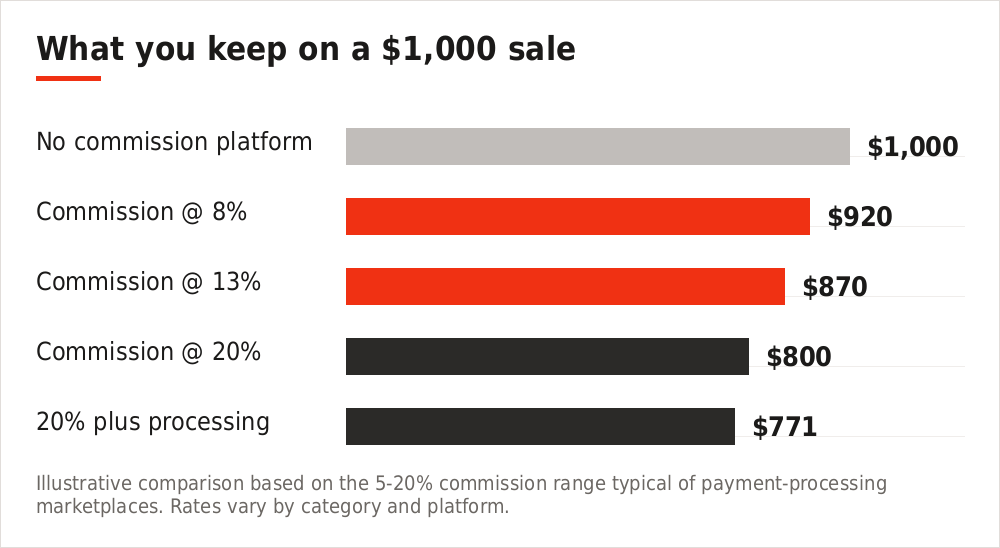
Illustrative comparison of what a seller keeps on a $1,000 sale under each model, based on the 5–20% commission range typical of payment-processing marketplaces.
Keep the full sale price
No listing fee, no commission, no promoted-listing pressure — at any value.
Working out the real cost
Before listing anywhere, run the arithmetic on the item you actually have.
Find the commission rate for your category
Rates vary by category and seller status, and they change. Check current published fees rather than assuming.
Add payment processing
Often charged separately and easy to overlook.
Add postage and packing
Materials, fuel or postage costs, and the time it takes.
Add promotion if the category needs it
Be honest about whether an unpromoted listing will actually be seen.
Compare against the free alternative
Including the value of your time for a local handover versus packing and posting.
Multiply your expected sale price by 0.15. If that number matters to you, the fee model matters. On a $40 item it is six dollars. On a $4,000 item it is six hundred.
When commission is worth paying
Sometimes it genuinely is, and it would be dishonest to pretend otherwise.
| Situation | Why the fee earns its place |
|---|---|
| Collectables and rare items | Global competing buyers can push the price well above the fee |
| Small shippable goods | Cheap postage means location stops mattering |
| Buyers who need protection | Some will not buy remotely without recourse |
| Genuine bidding interest | An auction can exceed any fixed price you would set |
| No local buyer exists | Reaching further is worth paying for |
The reverse is equally clear. For bulky items collected in person, vehicles inspected before purchase, property, services or job vacancies, you are paying a percentage for infrastructure you will never use.
Paid promotion and visibility
A related cost worth understanding: on several free platforms, visibility increasingly depends on paying.
Listings sink as newer ones appear, and promoted listings sit above organic ones. In competitive categories the practical effect is that “free” means “free but rarely seen”.
Search your own category as a buyer would and look at how many top results are marked as promoted. If most are, factor promotion into your cost calculation for that platform.
On List It Global there is no paid ranking of any kind. Results are driven by relevance and recency, and no listing can be bought above another.
If you sell regularly
For anyone selling more than occasionally, the arithmetic compounds quickly.
Someone moving $2,000 of goods a month pays roughly $3,120 a year at 13% commission. That is not a marginal cost — for many small traders it is the difference between the activity being worthwhile and not.
- Track your actual fees across a full quarter rather than estimating
- Compare against subscription models if you list in volume
- Use free platforms for high-value items where commission bites hardest
- Reserve commission platforms for goods that genuinely need their reach
- List in several places — there is no exclusivity requirement
Frequently asked questions
Are there really platforms with no commission at all?
Yes. Classified platforms that do not process payments have no transaction to charge against. List It Global takes nothing at any sale value.
How do free platforms cover their costs?
Operating a listings site costs far less than operating a payments business — no fraud liability, no chargebacks, no escrow to fund.
Is there a catch?
The genuine trade-off is that we cannot offer buyer protection or reverse a transaction, because we never hold the money. That is why the safety guidance matters.
Do I have to pay to appear higher?
Not here — there is no paid ranking. On some other platforms, competitive categories effectively require it.
What about very high-value items?
That is where the model matters most. On a $10,000 sale, 13% is $1,300 — enough to make a free platform clearly worth trying first.
Can I use both?
Yes. Many sellers list free locally first and only move to a commission platform if no buyer appears.
The short version
If a platform handles your money, it will take a percentage of it. If it does not, it usually charges nothing. Work out what 15% of your sale price actually is — and if that number matters, start with a platform that takes none of it.
Sell without commission
Free to list, free to sell, no paid ranking. Buyers across 238 countries.
You can also explore the full marketplace across every category.