Finding the Right Classified Site in Any Country
Every country has its own dominant classified platform, and if you are moving between markets the one you knew is rarely the one that works where you are now. The useful skill is not memorising platform names but knowing how to evaluate any local market quickly.
What this covers
Key takeaways
- Classified markets are national by default and rarely interoperate.
- Judge a platform by listing density in your category, not overall size.
- Newcomers have no local history, which affects buyer trust considerably.
- Listing in the local language reaches buyers that English alone misses.
- For specialist goods, international reach beats any local platform.
Why the landscape is fragmented
Classified platforms grew market by market, usually under separate ownership, and there was never much commercial reason to connect them. The result is that a seller in one country is invisible to buyers in the next, even where they are two hours apart.
- Language barriers reinforced national boundaries early
- Local payment habits differ significantly between markets
- Collection-based selling is inherently local
- Regulatory differences complicate cross-border operation
- Network effects are national — buyers go where listings are
How to evaluate a local platform
This works in any country, whatever the platform is called, and takes about ten minutes.
Search your category as a buyer would
Use the terms a local buyer would type. Count how many genuine listings appear.
Check the timestamps
If the first page is all from the last two hours, the category is crowded and your listing will sink fast. If the newest is three weeks old, the category is dead.
Count the promoted results
How much of page one is paid placement tells you what free visibility is actually worth.
Look at listing quality
Poor photographs and thin descriptions across the board mean a well-made listing will stand out easily.
Check price levels
Whether items in your category sell at reasonable prices, or whether the market is a race to the bottom.
Test the location filtering
Whether buyers can actually find things near them, which matters most outside major cities.
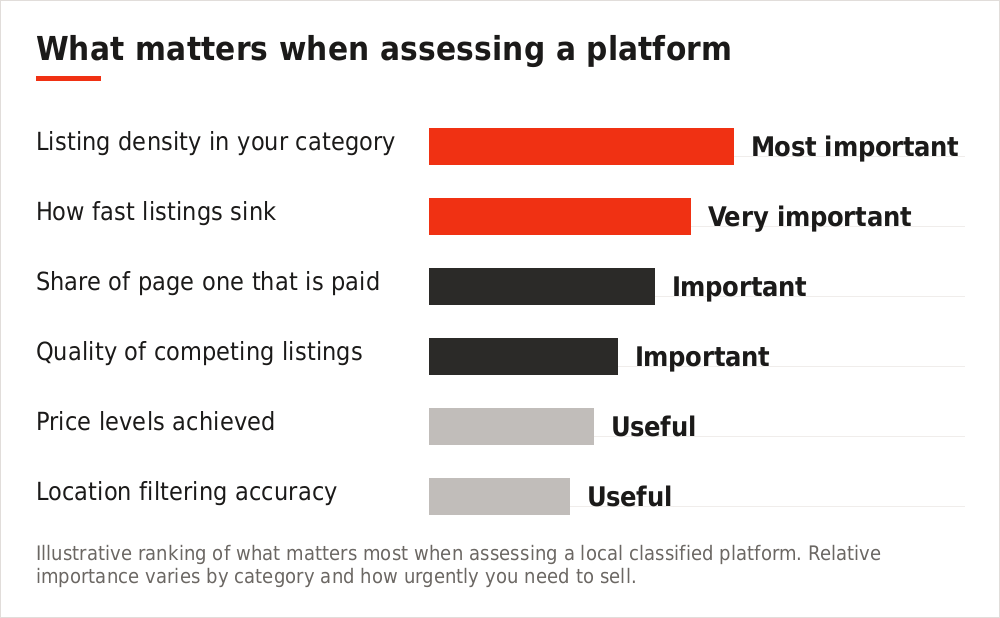
Illustrative ranking of what matters most when assessing a local classified platform. Relative importance varies by category and how urgently you need to sell.
What dominates where
Broadly, and subject to change, the pattern looks like this.
| Region | Typical pattern |
|---|---|
| Western Europe | Strong national incumbents, one per country |
| Eastern Europe | Regional platforms with high mobile usage |
| North America | A long-established general site plus social marketplace |
| Latin America | Regional marketplaces spanning several countries |
| South Asia | Very high volume, electronics-heavy |
| Middle East | Property and motors led, expatriate-driven |
| Africa | Mobile-first, growing rapidly, varied by country |
| Southeast Asia | App-based marketplaces dominate |
One listing, every market
238 countries and 3,047 regions. Free to list, no commission.
Selling as a newcomer to a country
If you have recently arrived somewhere, you face a specific problem: no local reputation, no history, and often no familiarity with how transactions normally work there.
- Observe how local listings are written before writing your own
- Note what payment methods appear in other listings
- Check whether collection or delivery is the local norm
- Learn the price expectations in your category before pricing
- Understand local negotiation habits — they vary enormously
- Find out what documentation is expected for vehicles and property
In some markets the listed price is essentially final and haggling is mildly rude. In others every price is an opening position and a seller who refuses to negotiate seems unreasonable. Getting this wrong makes ordinary transactions feel hostile in both directions.
The language question
| Approach | Reaches |
|---|---|
| Local language only | The domestic market, fully |
| English only | Expatriates and international buyers |
| Both in one listing | Widest reach, minimal extra effort |
| Key terms in both | Practical compromise for most sellers |
You do not need fluency. Brand, model, condition and location in the local language covers most of the benefit, because those are the words people actually search for.
Payment habits vary more than you expect
What counts as a normal way to pay for a used sofa differs enormously between countries, and assuming your home habits apply is a reliable way to make transactions awkward.
| Pattern | Where it is common |
|---|---|
| Cash on collection | Still standard in most markets for local sales |
| Instant bank transfer | Widespread where real-time payment systems exist |
| Mobile money | Dominant in several African markets |
| Payment apps by phone number | Very common across Northern Europe and parts of Asia |
| Cash on delivery by courier | Standard in parts of Eastern Europe and South Asia |
Look at how other listings in your category describe payment before deciding what to offer. Insisting on a method nobody locally uses will cost you buyers who were otherwise ready.
If a buyer proposes a payment method you have never used, research it before agreeing rather than during the transaction. The rule remains the same everywhere: funds cleared and irreversibly yours before the goods leave you.
Rules that differ by country
Several things that are trivially simple in one market require paperwork in another. Check these before listing rather than at the point of sale.
- Vehicle ownership transfer — some countries require authenticated signatures or attendance at a registry
- Property rental disclosure — energy certificates and safety documentation are mandatory in many places
- Business seller identification — required across the EU and elsewhere, with consumer rights attached
- Platform income reporting — now standard in many jurisdictions above thresholds
- Restricted goods — what may be sold privately varies considerably
- Animal advertising — licensing and minimum age rules differ substantially
Building trust without local history
Over-document the item
More photographs than local sellers use, and video where relevant. Detail substitutes for reputation.
Explain who you are briefly
Relocating, downsizing, clearing a flat. Context makes an unfamiliar seller legible.
Offer to meet publicly
Removes the concern for buyers who cannot place you.
Be precise about collection
Address area, times, access. Vagueness reads as evasiveness.
Respond quickly and completely
Responsiveness is the fastest trust signal available to a new seller.
When local is the wrong answer
Local platforms are right for local goods. For a substantial category of items they are simply the wrong tool.
- Specialist equipment with few buyers in any one country
- Collectables whose buyers are dispersed internationally
- Export goods — vehicles, machinery, plant
- Diaspora demand for goods from a particular market
- Anything in a thin local market, including rural areas
- High-value items where buyers will travel or ship
Frequently asked questions
How do I find the main platform in a new country?
Search for what you want to sell in the local language and see which sites dominate the results. That is usually your answer.
Should I use the local platform or an international one?
Both. Local for ordinary collection-based goods, international for specialist, exportable or high-value items.
Do I need to write in the local language?
For the domestic market, largely yes. Key terms in both languages is the practical compromise.
How do I know if a category is worth listing in?
Check timestamps on the first page. Very recent listings mean crowded; very old means dead.
Is it harder to sell as a newcomer?
Somewhat, because you have no local history. Thorough documentation and quick responses close most of that gap.
Can I use one platform everywhere?
For international and specialist items, yes. For ordinary local goods, the local platform usually has better density.
The short version
Every market has its own incumbent, and evaluating one takes ten minutes: search your category, check timestamps, count promoted results, judge listing quality. Use local platforms for local goods, list in the local language, and go international for anything specialist or exportable.
Wherever you are, wherever they are
238 countries, free to list, no commission and no paid ranking.
Have a look at what is currently listed to judge the going rate.