Renting Privately: How to Avoid Rental Fraud
Rental fraud works because people looking for somewhere to live are often under time pressure, competing with other applicants, and afraid of losing a good property. Fraudsters engineer exactly that urgency. The defence is simple and almost never fails: never pay anything for a property you have not seen.
What this covers
Key takeaways
- Never pay before viewing. This single rule defeats almost every rental fraud.
- Verify the landlord actually owns or manages the property.
- A rent far below the local market is bait, not luck.
- “I am abroad and cannot show it” is the defining excuse of this fraud.
- Deposits must be protected where the law requires it — ask which scheme.
How rental fraud works
The structure is consistent. An attractive property is advertised below market rent. The person advertising it does not own it — the photographs are copied from a genuine listing elsewhere. They cannot show you round because they are abroad, working away, or have just handed the keys to an agent.
They then need a deposit, a holding fee, or a first month’s rent to secure it, because demand is high. Once paid, they disappear.
The common patterns
| Pattern | How it works |
|---|---|
| The absent landlord | Owns it but is overseas; asks for a deposit to post the keys |
| The copied listing | Photographs and text lifted from a genuine advertisement |
| The holding fee | Payment demanded to take it off the market before viewing |
| The unauthorised sublet | A tenant rents out a property they do not own |
| The double let | The same property let to several people, each paying a deposit |
| The fake agency | A convincing but non-existent letting agent |
| The viewing fee | Payment requested simply to be shown round |
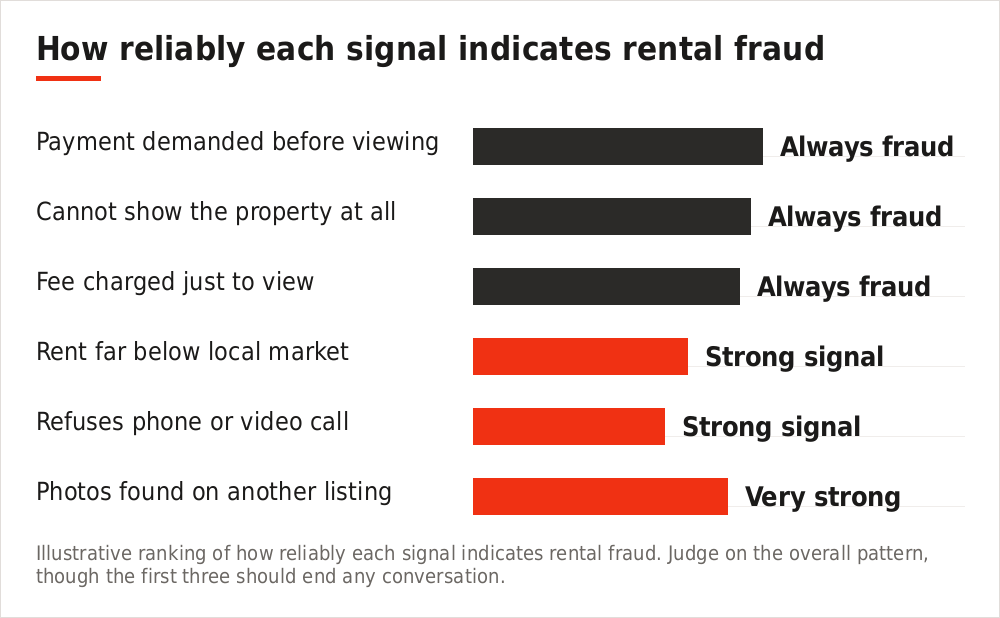
Illustrative ranking of how reliably each signal indicates rental fraud. Judge on the overall pattern, though the first three should end any conversation.
Red flags in a listing
- Rent well below comparable properties in the same area
- Photographs that look professional but the rest of the listing does not
- No exterior photograph or identifiable street view
- Vague location — a district rather than an address
- Text that reads as translated or copied
- Urgency built into the advertisement — “first to pay secures”
- No mention of deposit protection where the law requires it
- Contact details pushing you off-platform immediately
Save a listing photograph and search for it. Images copied from estate agent sites, holiday lets or listings in other cities appear immediately. This single check takes ten seconds and exposes a large share of fraudulent listings.
Red flags in the person
| Signal | What it means |
|---|---|
| Cannot show you the property | They do not have access to it |
| Working abroad, missionary, offshore | Standard cover story for never meeting |
| Wants payment before viewing | The fraud itself |
| Refuses a phone or video call | Avoiding anything verifiable |
| Pressure and deadlines | Designed to stop you checking |
| Asks for unusual payment methods | Untraceable transfers, cryptocurrency, gift cards |
| No tenancy agreement offered | There is no tenancy |
| Will not answer questions about the building | They have never been there |
Property listings, reviewed before publication
Every advertisement is moderated and reported listings are removed. Free to list.
How to verify a property
Insist on a viewing
In person, inside the property. Not outside it, not a video tour, not photographs. If that is impossible, walk away.
Check ownership
Many countries have a searchable land registry where you can confirm the registered owner for a small fee. Match it against who you are dealing with.
Verify any agency independently
Find their number yourself rather than using the one in the listing. Check they are registered with the relevant professional body.
Search the address
See whether it appears elsewhere, at a different rent, or as a property for sale.
Ask questions only someone with access could answer
Which way the windows face, what the boiler is, where the meters are.
Speak to a neighbour
If you can. They will know who owns it and whether it is genuinely available.
At the viewing
- Confirm they have keys and enter normally — not through a lockbox arranged remotely
- Ask for identification and proof of ownership or management authority
- Look for signs someone else lives there — belongings, post addressed to others
- Ask about deposit protection and which scheme will be used
- Request the safety certificates your jurisdiction requires
- Take someone with you and tell another person where you are going
- Photograph the property and the condition
Fraudsters have used key safes at genuinely empty properties to give the impression of legitimate access. A viewing should involve the landlord or agent being present, identifiable and answerable.
Paying safely
Sign a written tenancy agreement first
With the full names and address of the landlord, and the property address.
Confirm deposit protection arrangements
Where required by law, ask which scheme and get it in writing.
Pay by traceable method
Bank transfer to a named account matching the landlord’s name, never cash or untraceable transfers.
Get a receipt
For every payment, itemised.
Never pay a viewing fee
Charging to view is unlawful in many countries and is a fraud signal everywhere.
Be cautious of large advance payments
Six or twelve months upfront should prompt extra verification, not less.
Renting from abroad
This is where most rental fraud succeeds, because the usual defence — viewing in person — is genuinely difficult.
- Send someone you trust to view on your behalf
- Use a registered letting agent you have verified independently
- Insist on a live video walkthrough where they respond to your requests in real time, not a pre-recorded tour
- Verify ownership through the land registry
- Consider short-term accommodation first and view properly once you arrive
- Never send a deposit based on photographs and correspondence alone
Booking a few weeks of temporary accommodation costs less than losing a deposit and a month’s rent to a fraudulent listing — and it lets you view properties properly rather than choosing from photographs.
If it goes wrong
- Contact your bank immediately. Recall is sometimes possible within hours.
- Screenshot everything before the listing and account are deleted.
- Report the listing so it can be removed and others protected.
- Report to the police and your national fraud body.
- Ignore anyone offering to recover the money for a fee. That is a second fraud targeting victims of the first.
Frequently asked questions
Is a holding deposit ever legitimate?
Sometimes, after viewing and with a written agreement, and capped by law in many countries. Never before you have seen the property.
How do I check who owns a property?
Most countries have a land registry searchable for a small fee. It will confirm the registered owner.
What if the landlord genuinely lives abroad?
Legitimate overseas landlords use a managing agent who can show you round. Nobody genuine needs money before you see the property.
Can I be charged for a viewing?
Charging to view is unlawful in many jurisdictions and is a strong fraud signal in all of them.
Is a video tour good enough?
Only a live call where they respond to your requests, and even then verify ownership separately. Pre-recorded video proves nothing.
Can the platform recover my money?
No — we do not process payments, so we cannot reverse anything. We can remove the listing and act on the account, which is why reporting matters.
The short version
See the property in person before any money changes hands. Verify who owns it. Reverse image search the photographs. Refuse viewing fees and remote deposits entirely. And if you are renting from abroad, book somewhere temporary and view properly when you arrive.
Moderated listings, verified accounts
Every advertisement reviewed before publication. Free to list, no commission.
Take a look at List It Global to see what similar items are fetching.