


What to Do If You Get Scammed on a Classified Site
If you have just realised you have been defrauded, the next few hours matter more than anything else you will do. Some payments can be recalled if you act quickly. This is a practical sequence for what to do first, what evidence to preserve, and what recovery realistically looks like.
What this covers
Key takeaways
- Contact your bank immediately. Hours genuinely matter for recall.
- Screenshot everything before the listing or account disappears.
- Stop all contact — do not send anything further, however plausible the explanation.
- Report to the platform and to your national fraud body.
- Nobody legitimate will offer to recover your money for a fee.
Fraud is designed by people who do it repeatedly and refine what works. Being deceived is not a failure of intelligence. What matters now is acting quickly rather than spending time on the question of how you missed it.
The first hour
Stop sending anything
No further payments, no codes, no documents, no bank details. The follow-up explanation will be convincing. Ignore it.
Screenshot everything now
Messages, the listing, the profile, payment confirmations. Fraudulent listings and accounts are deleted quickly once the money moves.
Contact your bank
Before anything else administrative. Use the number on your card, not one from any message you received.
Change passwords if you shared anything
Starting with email, then banking, then anything reusing that password.
Write down the sequence
Dates, times, amounts, what was said. Memory degrades and you will be asked repeatedly.
Confronting them achieves nothing and tells them to move funds and delete accounts. Contact your bank first, then report. Save the confrontation for never.
Preserving evidence
- The full message thread, including timestamps
- The listing — screenshot the whole page, and note the URL
- The seller or buyer profile, including display name and join date
- Payment records — reference numbers, amounts, times, recipient details
- Any bank account or contact details they gave you
- Phone numbers and email addresses used
- Tracking numbers if goods were shipped
Contacting your bank
Speed determines what is possible here, which is why this comes before everything else.
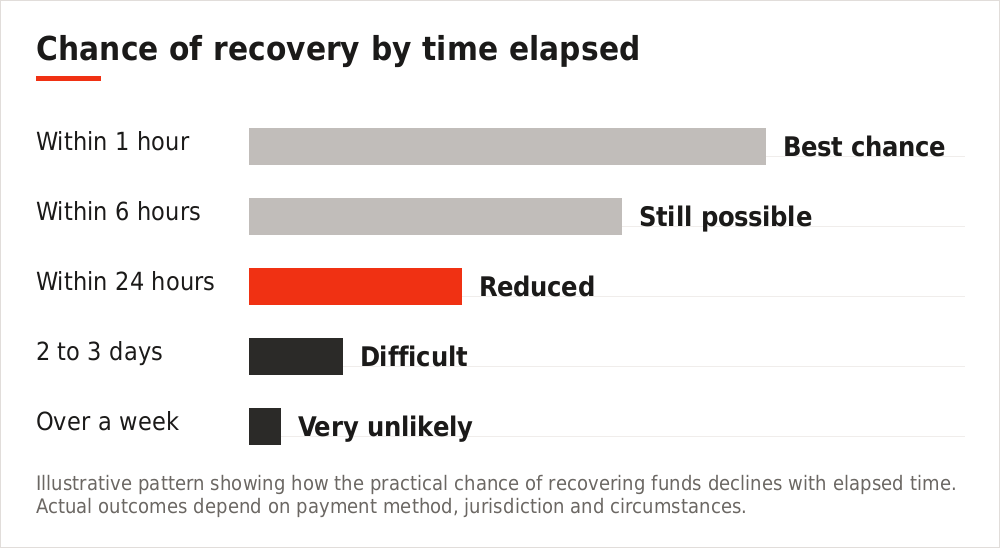
Illustrative pattern showing how the practical chance of recovering funds declines with elapsed time. Actual outcomes depend on payment method, jurisdiction and the individual circumstances.
| Payment method | Realistic prospect |
|---|---|
| Card payment | Reasonable — chargeback protections often apply |
| Bank transfer, reported fast | Possible if funds have not been moved on |
| Bank transfer, days later | Difficult — funds usually gone |
| Payment app | Depends heavily on the service and setting used |
| Cash | No recovery route |
| Gift cards | Effectively none — report immediately regardless |
| Cryptocurrency | Effectively none |
Tell the bank plainly that you have been defrauded, when it happened, and the recipient details. Ask specifically whether the payment can be recalled and whether any reimbursement scheme applies where you are.
Buy and sell on a moderated platform
Every ad reviewed before publication, accounts verified, and reported listings acted on.
What recovery realistically looks like
Being honest about this matters, because false expectations lead people into recovery scams.
Card payments have the strongest protections. Bank transfers reported within hours can sometimes be stopped. Bank transfers reported days later, cash, gift cards and cryptocurrency are, in the overwhelming majority of cases, not recoverable.
Reporting it
Report the listing or user to the platform
Use the report button. It lets moderators remove the listing and act on the account, which protects the next person.
Report to your national fraud body
Most countries have one. Individual cases are often not investigated alone, but patterns across many reports are what lead to enforcement.
Report to the police where required
Some jurisdictions require a police report before a bank will consider reimbursement.
Report to the payment provider
If a specific app or service was used, they have their own fraud process.
Keep every reference number
You will need them if the matter continues.
If your account was compromised
Where you shared a verification code or clicked a fraudulent link, the problem may extend beyond the money.
- Change your email password first — it controls resets for everything else
- Enable two-factor authentication everywhere it is offered
- Check for forwarding rules added to your email account
- Review recent account activity and sign out all other sessions
- Change any reused passwords on other services
- Check your credit file if personal documents were shared
- Watch for follow-up attempts using the information they now hold
Beware recovery scams
Victims are frequently approached by someone offering to recover the funds for an upfront fee. These approaches are themselves fraudulent, and the lists of who to target are traded between fraudsters. No legitimate organisation asks for payment upfront to recover money.
- Ignore anyone contacting you unprompted about recovering funds
- Ignore “recovery agents” and “fund retrieval” services entirely
- Your bank will never ask you to move money to a “safe account”
- Verify anyone claiming to be from your bank by calling the number on your card
- Be sceptical of anyone who already knows details of what happened to you
Afterwards
Losing money to fraud is genuinely unpleasant, and people commonly feel embarrassed enough not to tell anyone. That silence is precisely what allows it to keep working.
Tell someone. Report it. And if it has knocked your confidence about buying and selling online, the practical answer is not to stop — it is to use the same handful of rules every time: see it before you pay, meet in public, use traceable payment, and never act because someone is hurrying you.
Frequently asked questions
Can the platform get my money back?
No. Because we do not process payments, we cannot reverse a transaction. We can remove the listing and act on the account, which is why reporting still matters.
How quickly must I contact my bank?
Immediately. Recall is sometimes possible within hours and rarely possible after that.
Will the police investigate?
Individual low-value cases often are not pursued alone, but reports build the pattern that leads to action against organised operations.
Should I confront them?
No. It achieves nothing and prompts them to move funds and delete evidence.
Can I get money back from a bank transfer?
Sometimes, if reported very quickly. Some countries operate reimbursement schemes for authorised push payment fraud — ask your bank directly.
What if they contact me again?
Do not engage. Screenshot it, report it, and block them.
The short version
Stop sending anything. Screenshot everything. Ring your bank within the hour using the number on your card. Report to the platform and your national fraud body. And ignore absolutely anyone who offers to get your money back for a fee.
Buy and sell somewhere ads are checked
Moderated listings, verified accounts, free to post and no commission.
Or browse by category and location to check the local market first.