Is Buying Second-Hand Actually Cheaper?
Buying used is usually cheaper, but not always, and not by the same margin in every category. In some cases it gets you a better item for less money; in others it buys you somebody else’s problem. Knowing which is which is worth more than any individual bargain.
What this covers
Key takeaways
- Savings vary enormously by category — from marginal to substantial.
- Used often buys better quality at the same price, not just the same thing cheaper.
- Factor in collection, repairs and consumables before calling it a saving.
- You give up warranty, returns and consumer protections in a private sale.
- For anything cheap and new, the saving rarely justifies the effort.
Why it depends on the category
The size of the discount is set by how quickly a category depreciates, which varies more than most buyers expect.
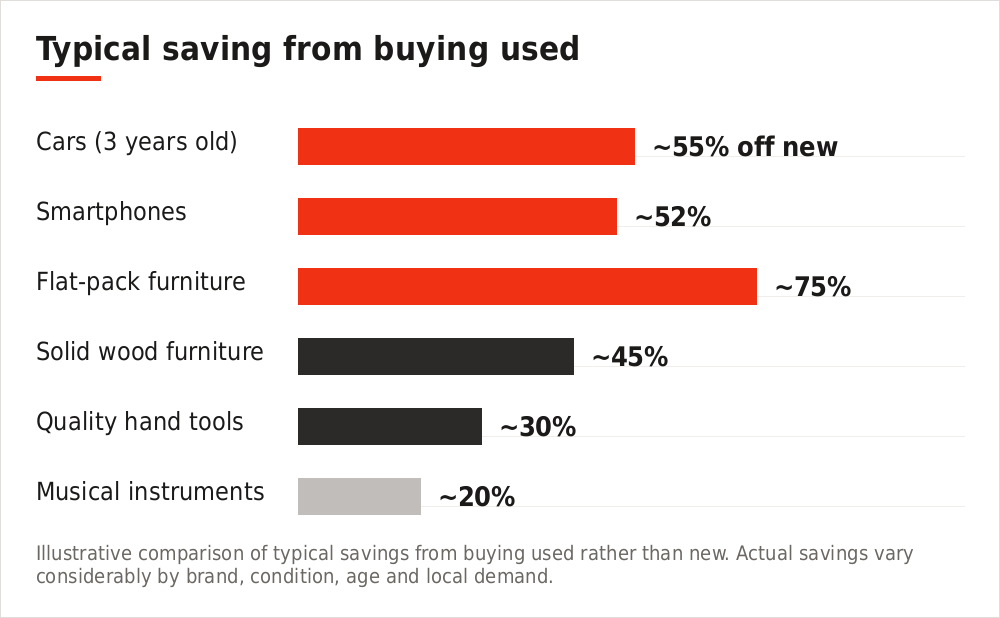
Illustrative comparison of typical savings from buying used rather than new. Actual savings vary considerably by brand, condition, age and local demand.
Fast-depreciating categories offer the biggest discounts precisely because the item loses value quickly — which is also a reason to think about what it will be worth when you come to sell it on.
Where used wins clearly
| Category | Why used is better value |
|---|---|
| Solid wood furniture | Older pieces are often better made than new equivalents at the price |
| Cars | The steepest depreciation happens in the first years |
| Hand tools | Quality tools last decades and barely depreciate in usefulness |
| Musical instruments | Do not deteriorate with age; some improve |
| Children’s equipment | Outgrown long before it wears out |
| Sports equipment | Frequently bought enthusiastically and barely used |
| Free weights | Essentially indestructible |
| Books and media | Content is identical |
Where new is usually better
| Category | Why |
|---|---|
| Mattresses | Hygiene, and support degrades with use |
| Car seats | Unknown collision history; damage is often invisible |
| Safety equipment | Helmets, harnesses and anything load-bearing |
| Cheap electronics | New price is low; used saving is marginal |
| Flat-pack furniture | Rarely survives dismantling and moving |
| Anything with a short warranty left | The remaining cover is worth little |
| Items needing specialist fitting | Installation may cost more than the saving |
Browse listings near you
Deal directly with sellers, with no commission inflating the price.
The hidden costs of buying used
The listed price is rarely the total. Several costs are easy to overlook until you are committed.
- Collection — fuel, time, and possibly van hire
- Immediate consumables — tyres, filters, strings, pads, batteries
- Servicing — a machine that has not been maintained needs work
- Missing parts — chargers, manuals, fixings, cases
- Cleaning and repair — time as well as money
- Wasted journeys — not every viewing ends in a purchase
- Risk of failure — no warranty if it stops working
An item saving you fifty, two hours away, is not saving you fifty. Fuel, four hours of your day and the possibility of arriving to find it misdescribed all count. Distance is a real cost and buyers routinely ignore it.
Working out the real cost
Start with the asking price
And what comparable items actually sold for, so you know whether it is fair.
Add collection
Fuel, hire, and an honest value on your time.
Add what it needs immediately
Consumables, servicing, missing parts.
Compare against the current new price
Not the original launch price — what it costs new today.
Consider resale value
A used item bought well often sells on for close to what you paid.
The quality argument
The most compelling case for buying used is not saving money on the same item — it is getting a better item for the same money.
A budget for a new entry-level product frequently buys a used mid-range or professional one. In categories where build quality varies enormously and durability is high — tools, furniture, instruments, bicycles, cameras — that trade is usually worth making.
Rather than a new budget model, look at what your budget buys second-hand one or two tiers above it. In durable categories the used professional item will usually outlast the new budget one by years.
What you give up
Being honest about the trade-off matters.
| Buying new | Buying used privately |
|---|---|
| Full manufacturer warranty | Usually none |
| Right to return in many countries | No cooling-off period |
| Consumer protection law applies | Limited in private sales |
| Known condition | You must inspect properly |
| Delivery arranged | You collect |
| Credit and finance available | Payment in full |
Buying from a business seller rather than a private one restores some of those protections, which is part of why trade listings can command higher prices for the same item.
The environmental case, honestly
Buying second-hand is generally better environmentally, because the largest impact of most products is in manufacturing them rather than using them. But the picture is not uniform, and it is worth being accurate rather than assuming.
| Clearly better used | Genuinely arguable |
|---|---|
| Furniture and homeware | Very old, inefficient appliances |
| Clothing and textiles | Older vehicles with high emissions |
| Tools and equipment | Heating equipment past its efficient life |
| Toys and children’s items | Devices with degraded batteries |
| Books and media | — |
The exception is narrow but real: a refrigerator or boiler from twenty years ago may consume enough extra energy over its remaining life to outweigh the impact of manufacturing a modern replacement. For everything that does not consume energy continuously, used is almost always the lower-impact choice.
Every item bought second-hand is one not manufactured and one not sent to waste. For durable goods that is straightforwardly the better outcome, and it happens to save money at the same time.
Thinking about what you will get back
Most buyers consider only the purchase price. The more useful figure is the difference between what you pay and what you eventually sell it for.
Buy things that hold value
Quality tools, solid furniture and instruments can be sold years later for close to what you paid, making the true cost of ownership very low.
Buy at the flat part of the curve
A three-year-old car has already taken the steepest depreciation. Buying after that drop and selling a few years later costs far less per year than buying new.
Avoid categories that go to zero
Budget electronics and flat-pack furniture are worth almost nothing after a few years regardless of care.
Keep the box and paperwork
They add value when you come to sell, and cost nothing to store.
Look after it
Condition is the main thing separating a good resale price from a poor one.
A simple decision test
- Does it wear out or become obsolete? If not, buy used.
- Is it safety-critical? If yes, buy new.
- Is new genuinely cheap? If yes, the saving may not justify the effort.
- Can you inspect it properly? If not, weigh the risk carefully.
- Would used buy a better tier? If yes, that is usually the stronger option.
- Is collection practical? Factor it in honestly.
Frequently asked questions
How much do I typically save?
Anywhere from very little to more than half, depending entirely on the category and how quickly it depreciates.
Is buying used risky?
Less than people assume, if you inspect properly and pay on collection. The main risk is buying without seeing it.
Do I get any protection?
Private sales offer little. Buying from a business seller gives you consumer rights in most countries.
Is used always more environmentally sound?
Usually, though not for very inefficient old appliances where running costs may exceed the benefit of not manufacturing a new one.
What if it breaks straight away?
In a private sale you generally have no recourse, which is exactly why thorough inspection before payment matters.
Should I buy used for a gift?
For durable items in excellent condition, often fine. For anything where packaging and warranty matter, less so.
The short version
Used wins clearly for durable things that do not become obsolete — furniture, tools, instruments, children’s equipment. New wins for anything safety-critical or already cheap. And the best argument for buying used is not the same item cheaper, but a better item for the same money.
Buy and sell directly
No commission inflating prices. Free to list, free to sell.
You can also search listings worldwide without creating an account.