
Buying a Used Car Privately: Checks Before You Pay
Buying privately usually saves several hundred to several thousand against a dealer price, and the trade-off is that you carry the checking yourself. There is no warranty and limited legal recourse — so the hour you spend on paperwork and inspection before handing over money is the most valuable hour in the whole process.
What this covers
Key takeaways
- Run a history check before viewing. It costs little and catches outstanding finance, write-offs and theft.
- The seller’s name must match the registration document and their address.
- View in daylight, in dry weather, at the seller’s home — never a car park.
- Outstanding finance means the car can be repossessed from you.
- A seller refusing an independent inspection is telling you something.
Checks before you travel
- Ask for the registration number and full vehicle details
- Confirm the seller’s name matches the registration document
- Ask how long they have owned it and why they are selling
- Ask about service history and whether it is documented
- Ask whether there is outstanding finance — and verify independently
- Ask about accident damage and previous repairs
- Confirm you can view at their home address
A genuine private seller has the car at their home, and that address appears on the registration document. Someone proposing to meet elsewhere may be trading illegally, selling a car they do not own, or hiding something. Insist on the address.
The history check
This is the highest-value few minutes in the entire process, and many buyers skip it.
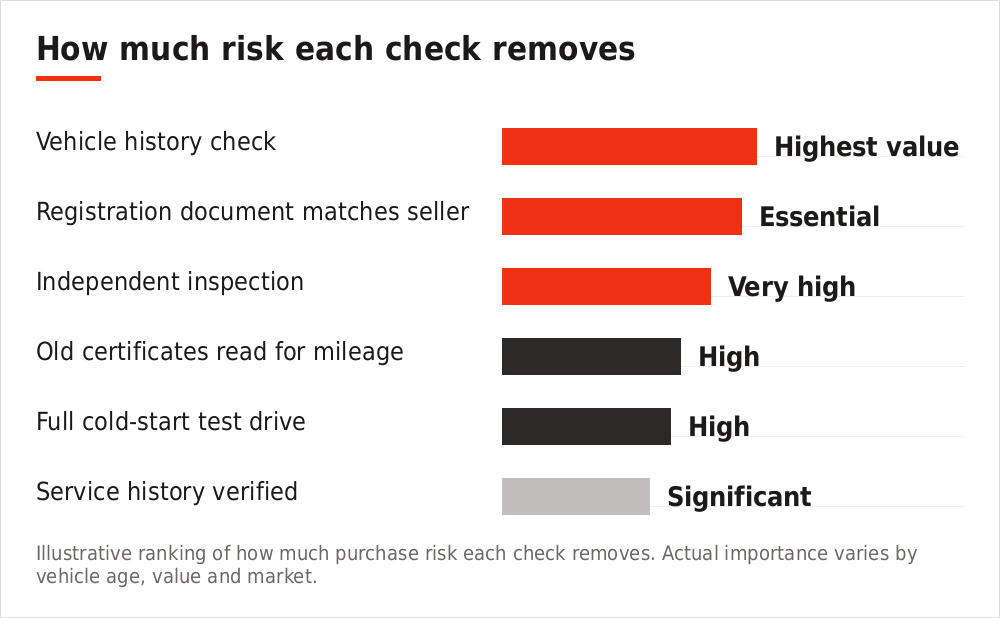
Illustrative ranking of how much purchase risk each check removes. Actual importance varies by vehicle age, value and market.
| A history check reveals | Why it matters |
|---|---|
| Outstanding finance | The finance company can repossess the car from you |
| Insurance write-off | Substantially affects value and sometimes safety |
| Stolen status | You would lose both the car and the money |
| Mileage discrepancies | Recorded readings that do not progress logically |
| Number of previous keepers | Should match what the seller told you |
| Registration and colour changes | Can indicate a disguised history |
If a car is sold with finance still owing, the finance company retains an interest in it and can recover it — from you, after you have paid the seller in full. You would then be pursuing the seller for your money, which is rarely successful.
Paperwork to see
- Registration document — check the seller’s name and address match where you are standing
- Vehicle identification number — verify it matches the document, on the car itself
- Service history — stamped book or invoices, with dates and mileages that progress logically
- Roadworthiness certificates — current and previous, to read the advisory history
- Receipts for major work — cambelt, clutch, tyres
- Both keys — a missing second key is a real cost
- Handbook and locking wheel nut key
Previous roadworthiness certificates show recorded mileage at each test and any advisory items. Together they tell you whether the mileage progression is plausible and what has been going wrong over the years — far more informative than the current pass alone.
Browse vehicles with full specifications
Filter by make, model, year and mileage. Free to use, no commission.
Inspecting the car
View in daylight and in dry weather. Rain hides paint defects and darkness hides almost everything.
Check the engine is cold
Arrive slightly early. A pre-warmed engine can conceal starting problems and smoke.
Walk round for panel gaps and paint mismatch
Uneven gaps and differing shades suggest accident repair. Look along the panels at an angle.
Check tyres including the spare
Tread depth, uneven wear indicating alignment problems, and matching brands across axles.
Look underneath
Corrosion, fluid leaks, damaged sills and recent undersealing that might hide something.
Check under the bonnet
Oil condition, coolant level and colour, corrosion, obvious leaks, mismatched or very new components.
Test every electrical item
Windows, lights, wipers, air conditioning, heated seats, infotainment, central locking with both keys.
Check the interior against the mileage
A heavily worn steering wheel and pedals on a low-mileage car is a warning sign.
The test drive
- Confirm you are insured to drive it before setting off
- Start it from cold and watch the exhaust in the mirror
- Drive at least fifteen minutes, including a faster road
- Test the brakes firmly where safe — pulling or vibration matters
- Listen with the radio off for knocks, whines and rumbles
- Check the steering tracks straight and does not vibrate
- Try every gear, including reverse
- Watch the dashboard for warning lights after the initial check
When to pay for an inspection
An independent inspection costs a modest sum and is worth it whenever the value justifies it or you are unsure what you are looking at.
A seller who refuses one has told you something important. Genuine sellers of sound cars have no reason to object, and many welcome it because it removes the buyer’s doubt entirely.
Negotiating properly
Inspect fully before discussing price
You cannot negotiate on what you have not found.
Base your offer on real costs
Tyres needing replacement, an upcoming service, advisory items. Concrete numbers persuade; general grumbling does not.
Make one clear offer
A specific figure you would genuinely pay.
Be prepared to pay the asking price
If the car is as described and priced fairly, that is the correct outcome.
Do not renegotiate after agreeing
Unless you discover something genuinely undisclosed.
Paying and completing
- Pay by bank transfer where possible — traceable and safer than carrying cash
- Pay the registered keeper, into an account in their name
- Complete the change of ownership with the licensing authority on the day
- Write two receipts showing date, price, vehicle details and both parties
- Take both keys, the handbook, service history and locking wheel nut key
- Arrange insurance before driving it away
- Keep the advertisement as a record of what was described
When to walk away
- The seller’s name does not match the registration document
- The history check shows finance, a write-off or a mileage discrepancy the seller did not mention
- They will not let you view at their home address
- The engine was warm when you arrived after they said it had not been driven
- They refuse an independent inspection
- They are pressuring you to decide immediately
- The price is far below market with a vague explanation
Frequently asked questions
What if the car turns out to be faulty?
In a private sale you generally have very limited recourse — the car must simply be as described. This is precisely why inspection before payment matters so much.
Is a history check really necessary?
Yes. It costs little and catches outstanding finance, write-off status and theft — any of which could cost you the entire purchase price.
Can I take the car for an inspection?
Ask. Many sellers will accompany you to a garage. Refusal without good reason is informative.
Should I pay a deposit to hold it?
Only after viewing, and only with a written receipt stating the terms. Never remotely.
How much can I expect to save privately?
Usually a meaningful margin against a dealer price, reflecting the fact that you take on the checking and get no warranty.
What if there is outstanding finance?
Do not proceed until it is settled and you have written confirmation. Otherwise the car can be recovered from you.
The short version
Run a history check before you travel. View at the seller’s home, in daylight, with the engine cold. Check the registration document matches the person and the address. Read the old certificates for mileage progression. And never complete while there is finance outstanding.
Find your next car
Full specifications, distance filtering, and no commission built into prices.
Or browse by category and location to check the local market first.