



Building a Seller Reputation That Wins Repeat Buyers
On a classified platform there is no seller rating badge doing the persuading for you. Trust has to be built inside the listing itself and in how you handle the first two messages — and for anyone selling repeatedly, that reputation compounds into repeat buyers and referrals in a way one-off sellers never see.
What this covers
Key takeaways
- Honesty about flaws builds more trust than any claim of excellence.
- Response speed is read as reliability before anything else.
- Doing what you said you would do is the entire mechanism.
- A problem handled well produces more loyalty than a sale with no problem.
- For repeat sellers, reputation is the difference between constant new leads and returning ones.
Why reputation works differently here
On a commission marketplace, a rating score and hundreds of reviews do the reassuring. On a classified platform the buyer is meeting a stranger in a car park, and the only evidence they have is your listing and your messages.
That is a disadvantage for a new seller and an advantage for a careful one, because you are not competing against someone else’s five-year rating history. You are competing against other listings written that week.
Building trust in the listing
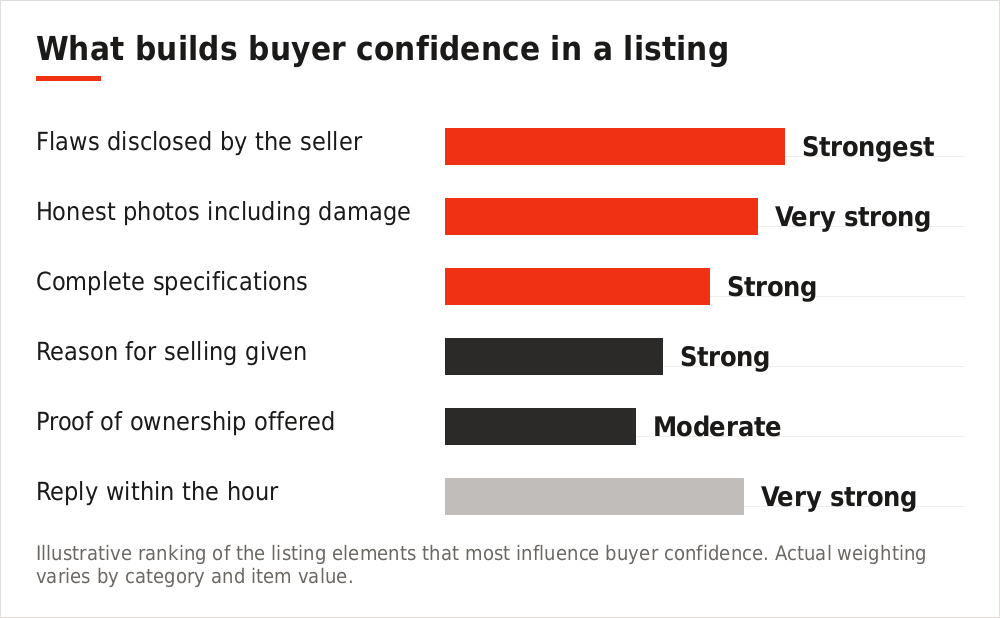
Illustrative ranking of the listing elements that most influence buyer confidence. Actual weighting varies by category and item value.
- List the flaws yourself. Counterintuitive and the strongest signal available — a seller who volunteers the scratch is trusted on everything else.
- Photograph honestly, including the damage, in daylight.
- Explain why you are selling. One line removes the buyer’s main suspicion.
- Give complete specifications rather than making people ask.
- Offer proof — receipts, service history, serial numbers, battery reports.
- Invite testing — “happy to demonstrate it working” costs nothing and reassures enormously.
- State collection and payment terms upfront so nothing is negotiated awkwardly on the day.
A buyer reading a listing assumes there is something the seller has not mentioned. When you mention it first, that assumption collapses and everything else you have written becomes credible. It is the cheapest trust you will ever buy.
The first two messages
Most buyers decide whether you are reliable within two exchanges, long before meeting you.
| Signals reliability | Signals risk |
|---|---|
| Reply within the hour | Reply two days later |
| Answers the actual question | Generic or evasive reply |
| Offers a specific viewing time | Vague about availability |
| Volunteers extra detail | Answers only what is forced |
| Happy to speak by phone | Avoids calls entirely |
| Confirms arrangements in writing | Leaves details unsettled |
Build a selling history
Unlimited free listings, no commission, and a verified account buyers can see.
Handover as a reputation moment
Be there when you said
Punctuality does more for your reputation than anything you write.
Have it ready and clean
Accessible, presentable, with everything you promised included.
Let them inspect without pressure
Rushing a buyer is read as concealment, even when it is just impatience.
Point out the flaws again in person
Show them the mark you described. It confirms you were straight with them.
Give a receipt
Two copies for anything of value. It marks you out as someone who does things properly.
Explain anything useful
How to reassemble it, where the manual is, what needs doing next. Costs two minutes.
Reviews and how to earn them
Where a platform supports seller reviews, they accumulate into genuine commercial value — particularly for anyone selling regularly.
- Ask, once, at the right moment — immediately after a smooth handover
- Make it easy — tell them where, briefly
- Never offer anything in exchange — incentivised reviews are dishonest and usually against platform rules
- Do not chase — a single polite mention is enough
- Respond to reviews you receive, including critical ones
Handling problems well
Something will eventually go wrong — an item develops a fault, a buyer feels misled, a collection falls through. How you respond matters more than whether it happened.
A buyer whose problem you resolved fairly usually trusts you more than one whose transaction was uneventful. Handling a complaint properly is a reputation opportunity, not just damage control.
Reply quickly and calmly
Silence turns a complaint into a public one.
Listen before defending
Establish what they actually experienced.
Acknowledge anything you got wrong
If you missed a fault, say so plainly.
Offer something reasonable
A partial refund, a return, or help resolving it. Weigh it against the cost of the dispute.
Know where the line is
You are not obliged to remedy something you disclosed accurately and they inspected. Be fair, not infinitely accommodating.
Turning buyers into repeat buyers
For traders, this is where the real return sits. A buyer who had a good experience will come back rather than start a search from scratch.
- Mention what else you sell — briefly, at handover, not in the listing
- Keep listings consistent so your style becomes recognisable
- Use the same display name across everything you list
- Be findable — complete profile, verified account
- Honour informal commitments — if you said you would hold it until Saturday, do
- Treat small sales as seriously as large ones — the $20 buyer may return for the $2,000 item
What damages a seller reputation
- Undisclosed faults. Discovered at the viewing, remembered permanently.
- Not turning up. Or arriving substantially late without warning.
- Selling to someone else after agreeing to hold it.
- Raising the price on arrival.
- Stock photographs instead of the actual item.
- Ignoring messages after the sale.
- Aggressive replies to low offers.
- Leaving sold listings live.
Frequently asked questions
Does a new account put buyers off?
Less than sellers assume. A complete, honest listing with good photographs matters far more than account age.
Should I ask buyers for reviews?
Once, politely, after a smooth handover. Never offer anything in return.
What if I get an unfair review?
Respond factually and without heat. A measured reply to an unreasonable review often reflects better on you than the review does.
Should I refund a buyer who changes their mind?
Private sales generally carry no obligation, but for a regular seller goodwill often outweighs the amount involved. Business sellers have legal obligations that differ.
How do I show I am trustworthy without a rating?
Disclose flaws, photograph honestly, reply quickly, offer proof of ownership, and invite testing. Those do the work a rating would.
Is it worth using my real name?
A consistent display name helps repeat buyers find you. Full personal details are not necessary.
The short version
List the flaws before anyone asks. Reply within the hour. Turn up when you said, with the item ready. Give a receipt. And when something goes wrong, deal with it quickly and fairly — that is the moment reputations are actually made.
Start building your selling history
Unlimited free listings, verified accounts, no commission at any value.
Have a look at what is currently listed to judge the going rate.