



Posting Job Ads Free: A Guide for Small Employers
Job boards charge per posting and the fees add up quickly for a small employer filling one or two roles a year. Classified platforms reach a different pool — local candidates who are looking casually rather than running an active job search — and cost nothing. For hourly, trade and local roles in particular, that audience is often better than a national board.
What this covers
Key takeaways
- State the salary. Adverts without pay get dramatically fewer applications.
- Classified platforms reach passive local candidates, not just active jobseekers.
- Separate genuinely essential requirements from nice-to-have ones.
- Describe the actual day-to-day work, not corporate language.
- Discrimination law applies to job advertisements in most countries.
Which roles suit classified advertising
| Works well | Less suitable |
|---|---|
| Trades and skilled manual roles | Senior executive positions |
| Hospitality and retail | Highly specialised professional roles |
| Drivers and logistics | Roles requiring national search |
| Care and support work | Positions needing extensive screening |
| Warehouse and production | Remote roles with no local element |
| Cleaning and facilities | Academic and research posts |
| Administrative and reception | — |
| Seasonal and temporary work | — |
The common thread is local and practical. Someone browsing classifieds in their own town is well placed to consider a role fifteen minutes from home, and that is exactly the candidate a small employer usually wants.
Why you must state the salary
This is the single most consequential decision in the whole advertisement.
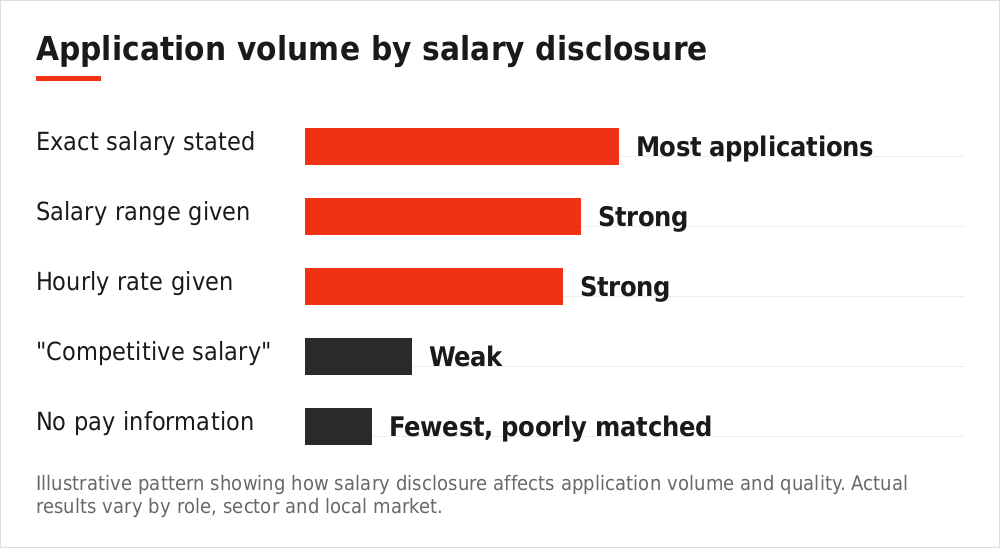
Illustrative pattern showing how salary disclosure affects application volume and quality. Actual results vary by role, sector and local market.
Candidates skip adverts without pay information, because experience has taught them it usually means the figure is disappointing. Worse, the applications you do receive are unfiltered — you spend time on people whose expectations were never going to match.
If you cannot commit to a figure, give a range or an hourly rate. “Competitive salary” communicates nothing and is widely read as a warning sign. Several countries now require pay transparency in job adverts as a matter of law.
Writing the advertisement
Title: Role + Location + Type.
Warehouse supervisor, Birmingham, full-time, immediate start
Open with the practical facts
Pay, hours, location and start date. This is what candidates check first, so lead with it rather than burying it under company background.
Describe the actual work
What the person will do on a normal Tuesday. Concrete tasks, not “driving operational excellence”.
Separate essential from desirable
Two clearly labelled lists. Long undifferentiated requirement lists deter good candidates who meet most of them.
Say what you offer
Holiday, pension, training, progression, equipment, uniform. Small employers often forget to mention genuine benefits.
Explain how to apply
Exactly what to send, to whom, and by when. Ambiguity here loses applications.
Post your vacancy free
No posting fees, no subscription, no per-application charges.
Essential versus desirable
Overlong requirement lists are the most common reason good candidates do not apply. Research consistently suggests many people will not apply unless they meet almost every listed criterion — so every unnecessary requirement narrows your field.
| Genuinely essential | Usually not |
|---|---|
| Legally required licences or certifications | “Degree educated” for practical roles |
| Ability to do the physical work | Arbitrary years of experience |
| Availability for the shift pattern | Specific software they could learn in a week |
| Right to work in the country | Industry background where skills transfer |
| Driving licence where driving is the job | “Own transport” where public transport works |
Handling applications
- Acknowledge every application — even a one-line reply protects your reputation locally
- Screen against your stated criteria, consistently for every applicant
- Reply within a few days — good candidates accept other offers quickly
- Keep notes on your decisions and why they were made
- Tell unsuccessful applicants rather than leaving them waiting
- Handle personal data properly under your local privacy rules
In a small town, how you treat applicants circulates. Employers who never reply acquire a reputation that makes the next vacancy harder to fill.
Reaching passive candidates
The strongest argument for advertising outside the main job boards is that the best candidate for a local role is often not looking for a job at all. They are employed, reasonably content, and would move for the right opportunity fifteen minutes closer to home — but they are not refreshing a jobs app every morning.
Those people browse classifieds for other reasons entirely, and see your vacancy incidentally. It is a smaller audience than a national board, but a differently composed one.
A passive candidate needs a reason to change. Lead with what is genuinely better — the pay, the hours, the commute, the stability — rather than assuming they are already motivated to move.
When to post
| Period | Hiring conditions |
|---|---|
| January | Strongest month — people act on new year intentions |
| September | Second peak as routines resettle after summer |
| Spring | Steady, good for seasonal and outdoor roles |
| Mid-summer | Slow — holidays reduce both applications and response speed |
| December | Very slow until after the holiday period |
Within the week, evenings and Sunday attract the most browsing — the same pattern as everything else on classified platforms.
A simple screening process
Write your criteria before the first application arrives
Deciding what matters after you have seen candidates invites inconsistency, and inconsistency is where discrimination claims begin.
Score against those criteria only
Same questions, same standards, every applicant.
Phone screen before interviewing
Ten minutes confirms availability, salary expectations and genuine interest. It saves both parties a wasted meeting.
Interview with prepared questions
The same core set for everyone, with follow-ups as needed.
Record the reason for each decision
Brief and factual. It is your defence if a decision is ever challenged.
Legal obligations when advertising
In most countries you cannot specify or imply preferences based on age, sex, race, religion, disability, marital status or other protected characteristics. This includes indirect wording such as “young and energetic team” or “recent graduate”.
- Avoid discriminatory wording, direct or implied
- State genuine occupational requirements only where legally justified
- Comply with pay transparency rules where they apply
- Do not ask for information you cannot lawfully consider
- Verify right to work at the appropriate stage, for every candidate equally
- Handle applicant data lawfully and delete it when no longer needed
- Never charge candidates for training, equipment or the application itself
Mistakes that lose good candidates
- No salary. The single biggest deterrent.
- Vague location. “Midlands area” tells nobody whether they can commute.
- Corporate language. Describe the job, not the mission statement.
- Twenty requirements. Most people will not apply.
- No hours stated. Shift patterns decide whether someone can take the role.
- Unclear application process. Ambiguity loses applications.
- Never replying. Damages your ability to hire next time.
- Stale adverts for roles already filled.
Frequently asked questions
Is it free to post a job advertisement?
Yes. No posting fee, no subscription and no charge per application.
How long does a vacancy stay live?
Sixty days, with free renewal and an email reminder before it expires.
Should I include the company name?
Usually yes — candidates research employers and anonymous adverts attract fewer serious applications.
Can I ask for a CV by email?
Yes. State exactly what to send and where. Handle the data properly and delete it when finished.
What if I get too many applications?
Tighten the essential requirements or narrow the location. Do not add arbitrary criteria that exclude capable people.
Can I advertise for a specific age group?
Almost never lawfully. Age is a protected characteristic in most countries, including implied wording.
The short version
State the pay, the hours and the exact location. Describe what the person will actually do. Keep essential requirements genuinely essential. Reply to everyone who applies. And check your wording against discrimination law before publishing.
Advertise your vacancy free
No posting fees, no subscription, no charge per application.
Take a look at List It Global to see what similar items are fetching.