



How Tradespeople Can Get Leads From Classified Ads
Most tradespeople get work through word of mouth, and there is nothing wrong with that — until a quiet month arrives. Classified listings fill that gap: they cost nothing, they reach people who need a job doing right now, and unlike paid advertising nobody can outbid you for the top position.
What this covers
Key takeaways
- Create a separate listing per service, not one covering everything.
- Name the towns you cover. This single change matters more than anything else.
- Qualifications and insurance are the strongest trust signals available to you.
- Replying within the hour wins a disproportionate share of jobs.
- Vague listings attract vague enquiries and waste your evenings.
Why this channel suits trades
Someone searching for an electrician has a problem now. They are not browsing, comparing brands or building awareness — they want somebody who can come out. That intent is what makes classified listings work for trades in a way they do not for many other businesses.
- Immediate need — most trade searches are urgent
- Local by definition — buyers filter by distance
- No bidding — a sole trader appears alongside a large firm
- No monthly cost — nothing to justify in a quiet month
- Multiple listings — each service can be found separately
- Direct contact — no lead-generation company taking a cut
How to structure your listings
The instinct is to write one listing covering everything you do. It is the wrong approach, because buyers search for specific jobs.
| Instead of one listing for | Create separate listings for |
|---|---|
| “Electrical services” | Rewiring · Consumer unit upgrades · EV charger installation · Fault finding · Electrical certificates |
| “Plumbing” | Boiler servicing · Bathroom installation · Leak repair · Radiator fitting · Emergency callout |
| “Building work” | Extensions · Loft conversion · Repointing · Groundwork · Garden walls |
| “Gardening” | Regular maintenance · Tree work · Fencing · Turfing · Clearance |
Someone searching “EV charger installation” will find the specific listing and skip the general one. It is more work upfront and it is where most of the gain sits.
Writing a listing that gets called
Title: Trade + Speciality + Area.
Qualified electrician — EV charger installation, Manchester and Stockport
Open with what you do
No preamble about your commitment to quality. State the service.
List the specific jobs
Bullet points. Buyers scan for their exact problem.
Name every town you cover
Not the region — the actual places. This is how people search.
State qualifications and insurance
Registrations, certifications, public liability cover, years in the trade.
Give a pricing indication
Hourly rate, call-out charge, or free quotation. Something.
Set expectations on availability
Typical lead time and working hours.
Say how to reach you
And answer when they do.
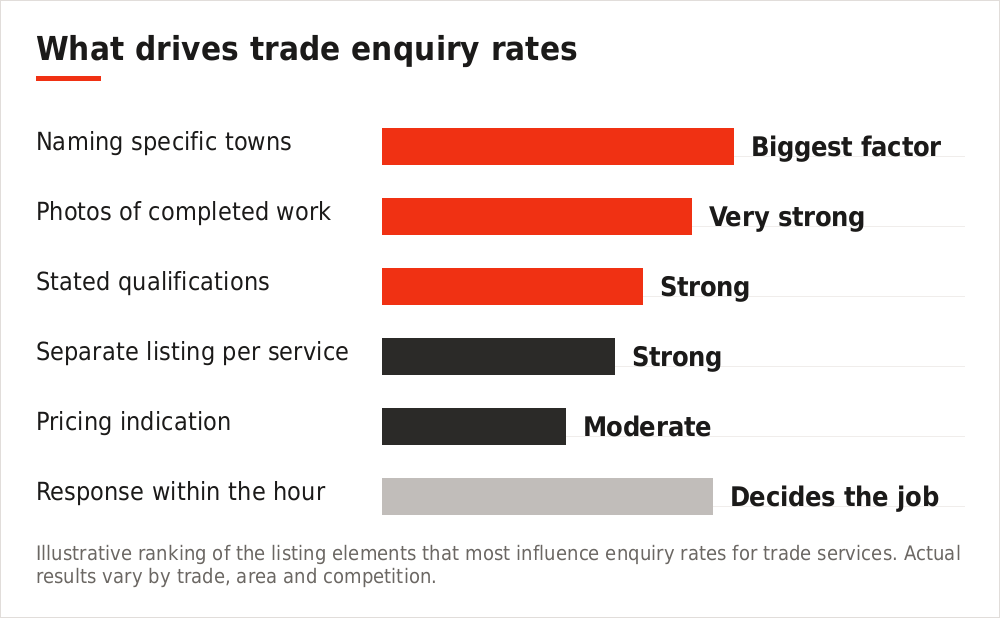
Illustrative ranking of the listing elements that most influence enquiry rates for trade services. Actual results vary by trade, area and competition.
Advertise your trade free
Unlimited listings, no fees, no commission, no monthly cost.
Building trust in a listing
A customer letting a stranger into their home is making a trust decision on very little information. Give them more than your competitors do.
- Full trading name and how long you have been established
- Qualifications — named certifications rather than “fully qualified”
- Trade body registrations with membership numbers where you have them
- Public liability insurance and the level of cover
- Photographs of completed work — far more persuasive than any description
- Guarantees on workmanship, stated plainly
- A real photograph of you or your van, not a stock image
Six before-and-after images from recent jobs will convert better than any amount of description. They prove you exist, that you finish work, and roughly what standard to expect.
Whether to publish prices
| Publishing prices | Not publishing |
|---|---|
| Fewer enquiries, better qualified | More enquiries, more time-wasters |
| Filters out mismatched budgets | Every quote requires a conversation |
| Builds trust through transparency | Flexibility to price per job |
| Works for standardised jobs | Better for complex or variable work |
A middle path works for most trades: publish a call-out charge or hourly rate, and offer free quotations for larger work. That filters out the mismatches without committing you on a job you have not seen.
Converting enquiries into work
Most customers contact three or four tradespeople. The first one who replies usefully very often gets the work — frequently before the others have even seen the message.
Reply within the hour where you can
Even a brief acknowledgement with a callback time beats silence.
Ask the right questions immediately
What the job involves, where, when, and whether they have a budget in mind.
Give a range early
“Jobs like this are usually between X and Y, subject to seeing it” saves both parties time.
Book the visit while you have their attention
A specific day and time, confirmed in writing.
Follow up once if they go quiet
People get busy. One polite follow-up recovers a surprising number of jobs.
Quoting properly
- Put it in writing, every time
- Itemise labour and materials separately
- State clearly what is not included
- Give a validity period — material prices move
- Specify payment terms and any deposit
- Set out timescales realistically
- Note your guarantee on the work
A clear written quotation is also your protection. Most trade disputes come down to what was and was not agreed, and a document settles it.
Obligations as a trader
In most countries you must identify yourself as a business, must not misrepresent qualifications or registrations, and customers gain rights they would not have in a private sale — often including cancellation periods for work agreed at their home.
- Identify yourself as a business in every listing
- Only claim registrations you actually hold — these are checkable and misuse is an offence
- Hold the insurance you advertise
- Follow gas, electrical and building regulations for certified work
- Give required cancellation notices where contracts are agreed in the customer’s home
- Provide certificates where the work requires them
Frequently asked questions
How many listings should I have?
One per distinct service. A general builder might reasonably have five or six. Do not duplicate the same listing across categories.
Should I list my mobile number?
Use the platform’s phone field — it is revealed only to logged-in users, which reduces spam considerably while remaining easy for genuine customers.
Is this better than a lead-generation service?
Different. Those sell the same enquiry to several trades and charge per lead. A classified listing sends the enquiry to you alone, at no cost.
How often should I refresh listings?
Listings run 60 days with free renewal. Refresh with new photographs of recent work rather than reposting the identical text.
What if I cover a large area?
Create separate listings for distinct areas rather than one vague listing claiming to cover everywhere.
Do I need to say I am a business?
Yes — legally required in most countries, and it builds credibility rather than undermining it.
The short version
One listing per service, not one for everything. Name the towns you actually cover. State your qualifications, insurance and a pricing indication. Add photographs of finished work. Then answer enquiries within the hour, because that is what wins the job.
Get local work, free
Unlimited listings, no fees, no commission, and enquiries come straight to you.
Or start by browsing the marketplace to see comparable items.