



Payment Scams That Target Sellers
Most fraud advice is written for buyers, but sellers are targeted just as often and in more inventive ways. The pattern is almost always the same: create the appearance that payment has been made, so that you release the goods before discovering it has not.
What this covers
Key takeaways
- Never release goods until funds are cleared in your own account.
- A confirmation email, screenshot or text message is not payment.
- Any request to refund an overpayment is fraud, without exception.
- Some payment methods can be reversed weeks after they appear to settle.
- Unusual urgency is the most consistent warning sign.
The one principle behind all of it
Every seller-side payment fraud depends on separating two things that should never be separated: the moment you hand over the goods, and the moment money is genuinely and irreversibly yours.
The common patterns
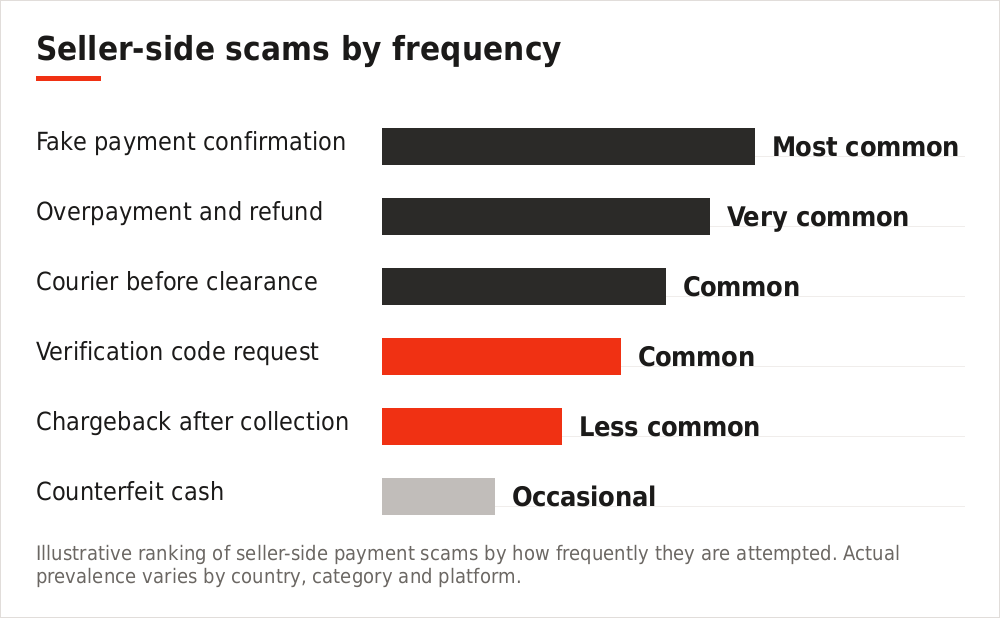
Illustrative ranking of seller-side payment scams by how frequently they are attempted. Actual prevalence varies by country, category and platform.
| Pattern | How it works |
|---|---|
| Fake payment confirmation | A convincing email or screenshot claiming funds are sent |
| Overpayment and refund | Sends too much, asks for the difference back |
| Courier collection | Insists on their own courier before payment clears |
| Pending transfer | Claims funds are held until you confirm dispatch |
| Chargeback after collection | Pays by reversible method, then reverses it |
| Counterfeit cash | Notes that pass a glance but not a check |
| Verification code request | Account takeover disguised as buyer caution |
The overpayment scam
A buyer sends more than the agreed price, explains it as an error or as covering shipping, and asks you to return the difference. The original payment is fraudulent and will be reversed. The refund you send is real money and is gone. If anyone overpays you, refund nothing and cancel the sale.
The variations are endless: a mistyped amount, a shipping agent who needs paying, an assistant who processed it wrongly. The structure never changes, and you send real money against a payment that will not stand.
The courier collection scam
Particularly common for higher-value items. The buyer cannot collect personally but will send a courier, often today, often before payment has cleared.
- The courier is usually real, which makes it convincing
- The payment is not, or is reversed afterwards
- Once collected, the item is untraceable
- Pressure to release before clearance is the giveaway
- Legitimate buyers accept waiting for funds to clear
It is entirely normal for machinery, vehicles and large equipment, particularly in international sales. The rule is simply that collection happens after cleared funds, never before. A genuine buyer will not argue with that.
Sell safely, keep everything
Moderated listings, on-platform messaging and no commission at any value.
Fake payment confirmations
Screenshots are trivial to fabricate, and emails claiming to come from a payment service are easy to imitate convincingly.
| Not payment | Payment |
|---|---|
| A screenshot of a transfer | Cleared funds in your own account |
| An email saying funds are sent | Balance you can withdraw |
| A text message confirmation | Cash counted and checked in person |
| A pending or processing status | — |
| Funds held until dispatch is confirmed | — |
Check your account yourself, through your own banking app, not through any link someone sends you. No payment service holds money pending proof of postage, and that message is always fraudulent.
Chargebacks and reversals
This one catches sellers who did everything else right, because the money genuinely arrives and then leaves again later.
- Card payments can be charged back weeks or months afterwards
- Some payment services allow disputes that favour the buyer by default
- Goods and services mode exposes you to reversal, and the buyer chooses which to use
- Bank transfers are generally final once genuinely cleared
- Cash cannot be reversed, which is why it remains common for local sales
- Keep evidence — receipts, messages, photographs at handover
Spotting a fraudulent buyer early
Most of these attempts announce themselves in the first two or three messages, before any money is discussed. The language patterns are remarkably consistent.
| Early signal | What it usually means |
|---|---|
| Offers full asking price immediately, without questions | Not interested in the item, only the transaction |
| Never asks about condition or specification | Has not read the listing and does not care |
| Wants to move to a private messaging app at once | Removing the reportable record |
| Cannot view or collect personally | Setting up the courier or shipping scenario |
| Introduces a shipping agent or assistant | Adding a third party to justify overpayment |
| Message reads as generic or copied | Sent to many sellers at once |
| Urgency without explanation | Pressure to prevent you checking |
Genuine buyers ask about condition, dimensions, age, why you are selling. Someone who agrees to the full price in their first message without wanting to know anything about the item is interested in something other than the item.
Extra care on high-value sales
Vehicles, machinery and equipment attract more determined attempts, because the return justifies more effort on the fraudster’s part.
Complete the transaction at a bank
For large cash sums, deposit while the buyer is present. The notes are checked professionally and the money is unambiguously yours.
Do not release registration documents early
For vehicles, paperwork and keys transfer at the same moment as cleared payment, never in advance as a gesture of good faith.
Verify the payer matches the buyer
Payment arriving from a third party is a warning sign, and can implicate you in money laundering entirely unknowingly.
Keep the listing live until settled
Until money has genuinely cleared, the item is still for sale.
Have someone with you
For any high-value handover, particularly one involving cash.
If someone other than the buyer sends the money, decline it. Beyond the fraud risk, accepting funds from an unconnected third party can involve you in laundering the proceeds of crime without any knowledge on your part.
Taking payment safely
For local sales, take cash at handover
Count it, check the notes, and hand the item over at the same moment.
Or take a transfer while they are present
Confirm it has actually arrived in your account before they leave with the item.
For distance sales, wait for genuine clearance
Days, not minutes. A pending credit is not settlement.
Write a receipt
Two copies, showing item, price, date and both parties.
Photograph the item and the handover
Serial numbers included, before it leaves you.
Refuse anything unusual
Cryptocurrency, gift cards, third-party payers or anything you do not understand.
For higher-value cash sales, check the security features on the notes, or complete the transaction inside a bank branch where the cash can be deposited immediately. Counting quickly in a driveway is where counterfeit notes succeed.
If it goes wrong
- Contact your bank immediately — recall is sometimes possible within hours
- Screenshot everything before the account and listing disappear
- Report the account so moderators can act and others are protected
- Report to police and your national fraud body
- Ignore anyone offering recovery for a fee — that is a second fraud targeting victims of the first
Frequently asked questions
Is cash still the safest option?
For local sales, yes, because it cannot be reversed. Check the notes on higher-value transactions, or complete inside a bank.
What if a buyer overpays by accident?
Treat it as fraud. Refund nothing and cancel the sale. Genuine accidental overpayment is vanishingly rare.
Can I trust a payment confirmation email?
No. Check your own account through your own banking app, never through a link in a message.
Is courier collection always a scam?
No, it is normal for large items. The rule is cleared funds first, collection second.
Can a payment be reversed after I hand over the item?
Card payments and some payment services allow disputes weeks later. Bank transfers and cash generally cannot be reversed.
Does the platform hold payments?
No, we do not process payments at all. You deal directly with the buyer, which is why these precautions matter.
The short version
Money and goods change hands at the same moment, or the money clears first. A screenshot is not payment. Any overpayment is fraud. Courier collection happens after clearance, never before. And nobody legitimate needs a verification code from your phone.
Report anything suspicious
Every listing moderated, every report acted on. Free to list, no commission.
Or browse what is listed on List It Global to see what is selling near you.