Negotiating Price on Second-Hand Purchases
Negotiating on a second-hand purchase is expected, but most buyers do it badly — either opening so low they are ignored, or accepting the asking price when a small amount of preparation would have saved them a meaningful sum. The good news is that the technique is simple and almost entirely about doing your homework first.
What this covers
Key takeaways
- Research sold prices before you message. Everything else follows from that.
- An offer roughly 10–15% below asking is taken seriously; half price is usually ignored.
- Give a reason for your offer — unexplained numbers feel arbitrary.
- Cash today and easy collection are worth real money to a seller.
- Never renegotiate on arrival unless you have found something genuinely undisclosed.
Preparation beats technique
Almost all negotiating advantage comes from knowing what the item is actually worth before you make contact. Without that, you are guessing, and sellers can tell.
Find what comparable items actually sold for
Not asking prices — those are aspirations. Sold prices tell you what buyers genuinely paid.
Check what new costs today
If the current model has dropped in price, used values follow it down and the seller may not have noticed.
Identify the specific weaknesses
Missing accessories, worn consumables, an old battery, no service history. These are your legitimate talking points.
Work out your ceiling
The most you would genuinely pay. Decide before you feel any pressure to commit.
Check how long it has been listed
An item sitting for weeks means a seller more willing to move.
When to negotiate and when not to
| Negotiate when | Do not when |
|---|---|
| The listing has been up for weeks | It was posted an hour ago at a fair price |
| Price is above comparable sold items | It is already priced below market |
| Consumables need replacing soon | The seller has stated “price firm” |
| Accessories or parts are missing | It is a genuinely rare item with competition |
| You can collect immediately | You are asking for delivery as well |
| You are buying more than one item | The item is already very cheap |
If something is clearly below market, negotiating wastes the only advantage you have — speed. Confirm you will take it at the asking price and arrange collection. Someone else is reading the same listing.
Making the opening offer
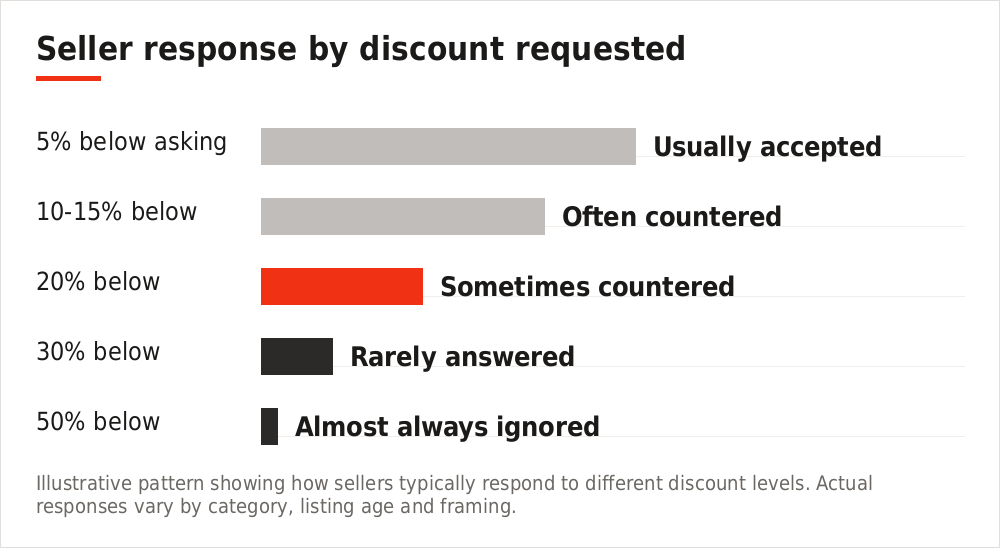
Illustrative pattern showing how sellers typically respond to different discount levels. Actual responses vary by category, listing age and how the offer is framed.
The framing matters as much as the number. Compare these:
| Weak | Effective |
|---|---|
| “What’s your lowest?” | “Would you take $340? I can collect this evening.” |
| “Will you take $150?” (on a $400 item) | “Similar ones have sold around $340 — would that work?” |
| “It’s not worth that” | “The tyres will need replacing soon — could you do $340?” |
| “Best price?” | “I’ll take it at $340 cash today if that suits.” |
Three rules cover most situations. Name a specific figure rather than asking the seller to bid against themselves. Give a reason. And offer something in return — speed, certainty, easy collection.
Browse listings with no fees added
Buyers deal directly with sellers — no commission built into the price.
Where your leverage actually comes from
- Speed — collecting today is worth more to most sellers than an extra 5%
- Certainty — sellers have usually dealt with several no-shows already
- Convenience — you come to them, at their time
- Buying multiple items — clearing several things at once has real value
- Listing age — the longer it has sat, the more flexible they become
- Genuine defects — things that will cost you money to put right
- Being easy to deal with — underrated, and often decisive
Sellers frequently accept slightly less from someone straightforward and pleasant over slightly more from someone difficult. Being the easy buyer is worth real money.
Negotiating in person
Inspect thoroughly first
Take your time. Test everything. Do not discuss price until you have looked properly.
Raise anything genuinely undisclosed
If you find damage that was not in the listing, say so calmly and factually.
Make one clear offer
A single reasonable figure. Do not haggle incrementally — it frustrates people.
Be prepared to pay the asking price
If the item is as described and fairly priced, that is the right outcome.
Have the money ready
Counting out cash at the agreed figure is a quietly persuasive way to close.
Agreeing a price by message and then trying to reduce it on the doorstep is the tactic sellers dislike most. It frequently ends with them refusing to sell at all, and it is a reasonable response.
Mistakes that cost buyers money
- Opening at half price. You get ignored rather than countered.
- “What’s your lowest?” Asking the seller to negotiate against themselves rarely works.
- Negotiating before seeing it. You have no information yet.
- Criticising the item. Sellers dig in when they feel insulted.
- Not researching. You cannot recognise a good price without a reference point.
- Haggling over trivial amounts. Risking a good purchase over $10.
- Missing an underpriced item because you paused to negotiate.
- Ignoring collection cost. A bargain two hours away may not be one.
Knowing when to walk
Walking away is a legitimate outcome, not a failure. Do it when the item is materially different from the description, when something feels wrong about the seller or situation, when the price exceeds your researched ceiling, or when you discover a fault that changes the value.
You owe nobody a purchase. “Thanks, but it is not quite what I was after” is a complete and courteous ending.
What it looks like from the other side
Understanding the seller’s position makes you better at this. Most private sellers are not traders. They want the item gone, with minimal hassle, to someone who turns up when they said they would.
They have usually already dealt with several people who promised to come and did not. Against that background, a polite buyer naming a specific fair price and confirming a collection time is genuinely welcome — and that is precisely why the approach works.
Frequently asked questions
How much below asking should I offer?
Around 10–15% is taken seriously. Beyond 25% you are usually ignored unless the item has clearly been sitting unsold.
Should I negotiate by message or in person?
Agree the price by message before travelling. Renegotiating on arrival is the fastest way to lose the sale.
What if the seller says the price is firm?
Respect it. Either pay the asking price or decline politely. Pushing after a firm answer rarely works and often ends the conversation.
Is it rude to negotiate?
Not at all, when done reasonably. Naming a specific figure with a reason is normal. Demanding half price is not.
Can I ask for extras instead of a discount?
Often more effective. A case, a charger or a spare part costs the seller nothing and may be worth more to you than the cash.
What if several people want it?
Do not negotiate. Confirm you will pay the asking price and arrange the earliest collection.
The short version
Research sold prices first. Offer a specific figure 10–15% below asking, give a reason, and offer speed in return. Inspect before discussing price, never renegotiate on the doorstep, and pay the asking price without argument when the item is genuinely worth it.
Buying and selling, commission-free
Deal directly with the other party. No fees, no percentage, no middleman.
Or browse what is listed on List It Global to see what is selling near you.