
How to Find Bargains on Classified Ads Sites
Genuine bargains on classified sites are not luck. They come from badly written listings, sellers with deadlines, and items posted in the wrong season or category — all of which are findable if you know what to look for and are prepared to search in ways most buyers do not.
What this covers
Key takeaways
- Misspelled listings have almost no competition — the most reliable technique there is.
- Buy out of season. Garden furniture in November costs a fraction of April.
- House moves, bereavements and relocations create genuine deadline pricing.
- On a real bargain, move immediately rather than negotiating.
- A price far below market with a vague explanation is a warning, not a win.
Where bargains actually come from
Underpriced items exist for identifiable reasons, and understanding them tells you where to look.
| Reason | What it looks like |
|---|---|
| Seller does not know the value | Inherited items, house clearances, unfamiliar categories |
| Badly written listing | Misspellings, vague title, one dark photograph |
| Deadline pressure | Moving, emigrating, clearing a property |
| Wrong season | Skis in July, garden furniture in November |
| Wrong category | Item filed where its buyers never look |
| Bulky and awkward | Priced low because collection is difficult |
| Needs minor repair | Discounted far beyond the actual fix cost |
Searching for mistakes
This is the single most effective technique available to a patient buyer, and almost nobody uses it.
Search is text-based. A listing spelled incorrectly does not appear in the search that everybody else runs — so it sits there, unseen, often for weeks.
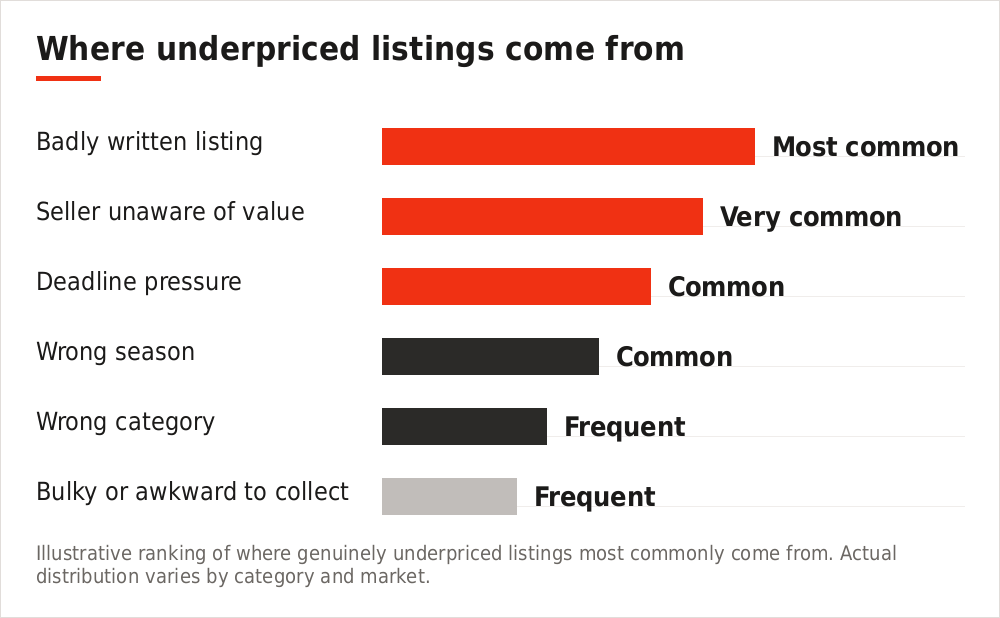
Illustrative ranking of where genuinely underpriced listings most commonly come from. Actual distribution varies by category and market.
- Try common misspellings of the brand you want
- Try missing spaces and joined words
- Try the model number alone, without the brand
- Try generic descriptions — “mountain bike” rather than the brand name
- Search the parent category and browse rather than filtering
- Search in the local language as well as English
Filtering to exactly what you want shows you the same results everybody else sees. Browsing a whole category, sorted by newest, surfaces the badly titled listings that filters miss entirely.
Timing your search
Seasonality works in reverse for buyers. Everything that is a disadvantage when selling is an advantage when buying.
| Buy this | In | Because |
|---|---|---|
| Garden furniture, barbecues | October-January | Nobody is looking; sellers want the space |
| Bicycles | November-January | Demand collapses in cold weather |
| Winter sports equipment | April-August | Season over, storage needed |
| Air conditioning units | November-February | Out of season entirely |
| Fitness equipment | March-May | New year resolutions have faded |
| Student furniture | June-July | End of tenancy clear-outs |
| Anything bulky | End of month | House moves complete then |
Browse listings across 238 countries
No fees built into prices — you deal directly with the seller.
Looking in the wrong category
Sellers frequently file items where they think they belong rather than where buyers look. Those listings sit unseen by the people who would pay most.
- Professional equipment listed under general household goods
- Vintage items listed as ordinary second-hand
- Vehicle parts listed under the wrong make
- Musical instruments filed under general electronics
- Specialist tools in generic DIY categories
- Collectables in whatever category the object physically is
The technique is simple: search the broadest plausible category and browse it, rather than filtering to the narrow one where everybody else is competing.
Signals of a motivated seller
Some phrases in a listing indicate genuine flexibility. They are worth watching for.
| Phrase | What it usually means |
|---|---|
| “Moving abroad” | Fixed deadline, will accept less as it approaches |
| “House clearance” | Volume to shift, limited attachment to price |
| “Must go by Friday” | Genuine urgency |
| “No longer needed” | Space is worth more than the money |
| “Open to offers” | Explicit invitation |
| Listed for several weeks | Frustration builds; flexibility grows |
| Reduced more than once | Actively wants it gone |
Why speed beats negotiation
The most common way buyers lose a genuine bargain is by treating it like an ordinary purchase.
If something is clearly below market, other people are reading the same listing right now. Confirm you will take it at the asking price and arrange the earliest possible collection. Haggling over 10% loses the item entirely far more often than it saves the money.
Message immediately, and specifically
“I will take it at your asking price — can I collect this evening?” beats “is this still available?” by a wide margin.
Offer the easiest possible collection
Your convenience matters less than closing it.
Confirm in writing
Time, place, price, so nothing drifts.
Turn up when you said
Sellers frequently have several people promising to come.
Bring the exact money
Nothing derails a good purchase like fumbling at the handover.
Recognising real value
You cannot recognise a bargain without knowing what the thing is worth. That knowledge is the actual skill.
- Pick a category and learn it — depth beats breadth for finding value
- Track sold prices over weeks until the range becomes instinctive
- Learn which brands hold value and which do not
- Know the repair costs for common faults in your category
- Understand model cycles — when successors launch, prices step down
- Recognise the details that separate a good example from an ordinary one
Bargains that are not
Some apparent bargains cost more than paying full price would have.
- Far below market with a vague story. Frequently stolen or non-functional.
- Cheap but two hours away. Fuel and a day of your time are real costs.
- Needs repair you cannot do. Price the fix before committing.
- Missing a part that is unavailable. Check availability first.
- Free but enormous. Transport can cost more than buying something smaller.
- Bulk lots you cannot store. Storage is a recurring cost.
- Deposit requested before viewing. Not a bargain, a scam.
Frequently asked questions
How do I know whether something is genuinely underpriced?
Compare against what similar items actually sold for, not what others are asking. Without that reference you are guessing.
Should I set up alerts?
Yes — saved searches notify you when matching items appear, which matters because good listings sell within hours.
Is it worth travelling for a bargain?
Calculate fuel, time and the risk of a wasted journey. A saving of thirty on a two-hour round trip is usually not a saving.
Should I offer below asking on a cheap item?
Rarely worth it. On genuinely underpriced items, speed is your only advantage and negotiating throws it away.
Why do people underprice things?
Usually they do not know the value, need the space, or have a deadline. All three are common and none of them are suspicious.
How often should I check?
Good listings go within hours. Daily browsing plus saved-search alerts covers most of it.
The short version
Search for misspellings and browse whole categories rather than filtering. Buy out of season. Watch for deadline language. Learn one category properly so you recognise value instantly. And when you find something genuinely underpriced, buy it at the asking price immediately.
Buying and selling, commission-free
No fees inflating prices. You deal directly with the other party.
You can also search listings worldwide without creating an account.