



Buying Used Appliances: What to Check
A used washing machine or fridge can save a great deal against new, but appliances are the category where buyers most often inherit somebody else’s problem. They are heavy, awkward to return, and the faults that matter are rarely visible in a photograph. Half an hour of checking prevents nearly all of it.
What this covers
Key takeaways
- Never buy an appliance you have not seen running. This is the whole guide in one line.
- A cheap inefficient appliance can cost more over a few years than a better one.
- Measure the doorway and the space before you agree anything.
- Fridges and freezers must stand upright for hours before being switched on.
- Budget for connection — hoses, cables and fittings are rarely included.
Which appliances are worth buying used
| Good used buys | Approach with caution |
|---|---|
| Quality washing machines from known makers | Very old fridges and freezers |
| Fridges and freezers under about eight years | Anything with a known common fault |
| Dishwashers in good condition | Cheap tumble dryers |
| Range cookers and quality ovens | Built-in appliances of unknown dimensions |
| Microwaves | Anything gas, without professional fitting |
| Chest freezers | Appliances stored outdoors or in damp garages |
Running costs matter more than price
Appliances are one of the few categories where the purchase price is genuinely the smaller number. An inefficient fridge runs continuously for years, and the electricity it consumes can exceed what you saved buying it.
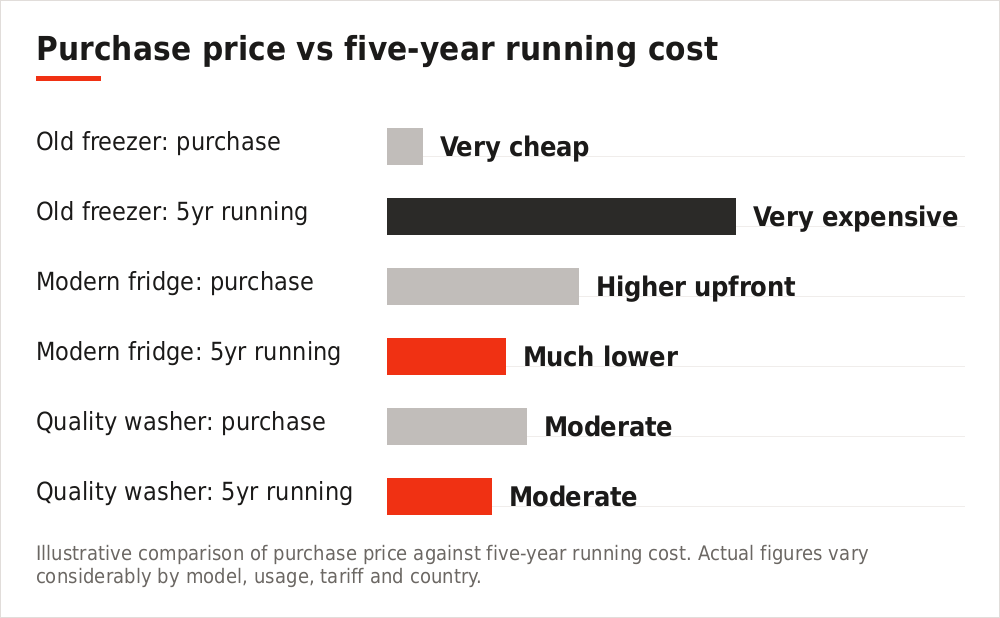
Illustrative comparison of purchase price against five-year running cost. Actual figures vary considerably by model, usage, tariff and country.
- Check the energy rating on the label or by model number
- Very old cold appliances run constantly and are the worst offenders
- Look up the annual consumption figure for the specific model
- Compare over five years, not on purchase price alone
- A free old freezer is rarely free once you account for what it costs to run
Questions before you travel
- Exact make and model number — so you can research known faults
- Age, and whether they bought it new
- Why they are selling — upgrading and moving are good answers
- Is it currently plumbed in and working
- Any faults, noises or intermittent problems
- Full dimensions including depth with the door open
- Whether hoses, cables and fittings are included
This phrase should always prompt caution. An appliance already disconnected and standing in a garage cannot be demonstrated, and you are being asked to take the fault history entirely on trust. Ask them to reconnect it, or accept that you are gambling.
Insist on seeing it working
This is the one non-negotiable point. A machine that has been disconnected proves nothing.
Arrange to view while it is still installed
Before they disconnect it for you, not after.
Run an actual cycle
Not just switching it on. A short wash cycle reveals filling, heating, draining and spinning.
Listen throughout
Bearing noise on a spin, grinding, or an unusual pump sound.
Check it reaches temperature
Warm door glass, or a cold interior in a fridge that has been running.
Look for leaks
Underneath and around the door seal during the cycle.
Browse appliances near you
Filter by distance and category. Free to use, no commission inflating prices.
Checks by appliance type
| Appliance | Check specifically |
|---|---|
| Washing machine | Drum bearings by rocking the drum, door seal condition, spin noise, filter, no rust around the detergent drawer |
| Fridge or freezer | Door seals grip paper, no ice build-up, compressor cycles rather than runs constantly, no smell |
| Dishwasher | Spray arms turn freely, filter clean, no standing water, door hinges firm |
| Oven | Elements glow evenly, thermostat reaches temperature, door seal and hinges, all shelves present |
| Tumble dryer | Drum turns smoothly, heats properly, vent or condenser clear, filter intact |
| Microwave | Door seal undamaged, turntable rotates, heats a cup of water in the expected time |
Close a fridge or freezer door on a sheet of paper. If it pulls out easily, the seal has lost its grip and the appliance will work harder and cost more to run. Seals can be replaced, but factor the cost in.
Measuring and access
- Measure the space including height, width and depth
- Measure every doorway on the route in, and any tight turns
- Check the appliance depth with the door open for fridges and dishwashers
- Confirm built-in dimensions exactly, as integrated appliances vary by a few centimetres and it matters
- Check where the services are — water, waste and power in the right place
- Allow clearance for ventilation behind cold appliances
Transport and installation
- Fit transit bolts in a washing machine if available, or move it very carefully
- Keep cold appliances upright in transit wherever possible
- Stand a fridge or freezer for several hours before switching it on, longer if it was laid down
- Budget for new hoses — old ones perish and leaks are expensive
- Gas appliances need professional fitting, always, without exception
- Test on a full cycle once installed, while you are at home to watch it
Compressor oil migrates into the cooling circuit when an appliance is tilted or laid down. Running it before that oil drains back can wreck the compressor permanently. Stand it upright for several hours at minimum, and considerably longer if it travelled on its side.
When to walk away
- They cannot or will not demonstrate it working
- It has been standing disconnected for an unknown period
- There is rust, water damage or a persistent smell
- The drum has noticeable play when rocked
- They will not give the model number
- It was stored outdoors or in a damp garage
- Research shows a known expensive fault for that model
Frequently asked questions
How old is too old?
Depends on quality more than years. A well-built machine at ten years can outlast a budget one at three, though very old cold appliances are expensive to run regardless.
What if it breaks after I buy it?
In a private sale you generally have no recourse, which is exactly why seeing it run a full cycle before paying matters so much.
Can I move a fridge on its side?
Avoid it if you can. If unavoidable, stand it upright for considerably longer before switching on, ideally overnight.
Are old hoses safe to reuse?
Replace them. They are inexpensive, they perish with age, and a burst hose causes far more damage than the saving.
Is a free appliance worth taking?
Only if it is efficient and working. A very old freezer given away free can cost more in electricity than a replacement.
Should I buy built-in appliances used?
Only with exact dimensions confirmed against your space. Integrated units vary between manufacturers and a small difference makes them unusable.
The short version
See it running a full cycle before you pay. Get the model number and research known faults. Check the energy rating, because running costs outweigh purchase price. Measure every doorway. And stand a fridge upright for hours before switching it on.
Find appliances locally
Free to use, no commission, and you deal directly with the seller.
Take a look at List It Global to see what similar items are fetching.