


Setting Up Alerts So You Never Miss a Listing
Good listings sell within hours, not days. If you are checking a category every few evenings you are seeing what is left rather than what arrived — and by the time you message, the seller has already agreed a collection with someone who saw it first.
What this covers
Key takeaways
- Well-priced items are often gone within hours of listing.
- Saved searches notify you automatically rather than relying on you checking.
- Set searches broader than you think — narrow filters miss badly titled listings.
- Run several searches with different phrasings for the same item.
- When an alert arrives for something genuinely good, message immediately.
Why manual checking loses
The mathematics are unforgiving. If a desirable item sells in four hours and you check once a day, you will miss most of them — and the ones still there when you look are usually still there for a reason.
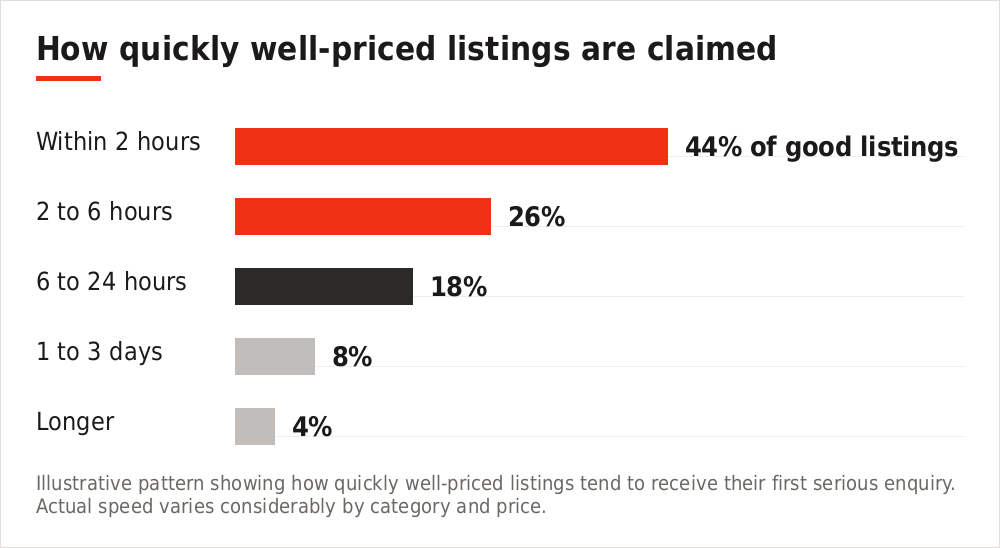
Illustrative pattern showing how quickly well-priced listings tend to receive their first serious enquiry. Actual speed varies considerably by category and price.
Setting up a saved search
Run the search you actually want
Category, location, distance and price range. Get the results looking roughly right first.
Save it from your account panel
Saved searches live under your account, where you can edit or delete them at any time.
Give it a clear name
If you run several, “road bike 54cm under 600” is more useful than “search 3”.
Choose your alert frequency
Immediate for competitive categories, daily digest for casual interest.
Check the emails arrive
Look in your spam folder for the first one and mark it as safe.
Tuning what you get told about
The instinct is to filter tightly. It is usually wrong, because tight filters exclude exactly the badly titled listings that represent the best value.
| Too narrow | Better | Why |
|---|---|---|
| Exact model name only | Brand, or category plus price | Catches misspellings and vague titles |
| Very tight price band | Wider range | Sellers misjudge prices in both directions |
| Ten kilometre radius | Whatever you would genuinely travel | A real bargain justifies a longer drive |
| One deep subcategory | The parent category | Items are often filed in the wrong branch |
| Condition filters applied | No condition filter | Sellers grade inconsistently |
A search that occasionally shows you irrelevant items is working correctly. A search that never shows you anything unexpected is filtering out the listings worth finding.
Save searches, get alerts
Create a free account to save searches and be told when matching items appear.
Running several searches
For anything you genuinely want, one search is rarely enough. Sellers describe the same object in very different ways.
- The exact model — catches well-written listings
- The brand alone — catches listings that omit the model
- A generic description — catches sellers who do not know the brand
- The category, browsed broadly — catches everything else
- Common misspellings — catches what nobody else sees
Someone hunting a specific camera lens might reasonably run four searches. Each costs nothing and each catches a different kind of seller.
Responding to an alert
The alert only helps if you act on it properly. Most of the advantage is lost in the first message.
| Weak | Effective |
|---|---|
| “Is this still available?” | “I will take it at your asking price — can I collect this evening?” |
| “What is your best price?” | “Happy with the price. When suits you?” |
| Several questions at once | One specific question, plus a collection offer |
| Messaging then going quiet | Confirming a time immediately |
Sellers receive it constantly from people who never follow up, so it carries almost no weight. A message that commits to the price and proposes a specific collection time marks you out as the buyer worth replying to first.
Where alerts matter most
| Category | Why alerts help |
|---|---|
| Specialist equipment | Appears rarely; you cannot browse daily for months |
| Vehicle parts | Specific components for specific models |
| Collectables | Competition is fierce and immediate |
| Popular electronics | Well-priced examples go within hours |
| Property rentals | Good ones are taken the day they appear |
| Specific furniture | Right size, right style, right price is a rare combination |
A search strategy for something specific
Hunting one particular item over weeks or months needs a different approach from casual browsing. Someone looking for a specific camera lens, a rare vehicle part or a piece of furniture in an exact size is playing a long game.
Learn the market first
Watch what comparable examples sell for over several weeks before you are ready to buy. Without that reference you cannot tell a bargain from an ordinary price when one appears.
Decide your ceiling in advance
Write down the most you will pay. When an alert arrives you have minutes, not hours, and a number decided calmly beforehand prevents a decision made in a hurry.
Widen the geography as time passes
Start local, then extend the radius each month you go without finding it. A specialist item may only appear a few times a year within any given distance.
Keep a record of what you see
Prices, condition, how quickly each sold. After a dozen listings you will recognise value instantly.
Be ready to move the same day
Have the money available and know when you could collect. Hesitation is what loses items to other buyers.
These sound contradictory but they are the same discipline. You wait patiently for weeks precisely so that you can move within minutes when the right listing finally appears.
Alerts are useful for sellers too
The feature is framed around buying, but sellers benefit from the same mechanism.
- Watch your own category to see what competing listings look like and what they ask
- Track how quickly similar items disappear — the clearest signal of whether your price is right
- Spot seasonal shifts as listing volumes rise and fall through the year
- Find stock to resell if you trade — underpriced listings are your supply
- Check the going rate before pricing something new
Common mistakes
- Filtering too narrowly. You exclude the listings worth having.
- Only one search. Sellers phrase things differently.
- Ignoring the alerts. They only work if you open them.
- Not checking spam for the first notification.
- Setting an unrealistic price ceiling. You never see anything.
- Leaving stale searches running for things you no longer want.
- Hesitating when one arrives. Speed is the whole point.
Frequently asked questions
Do I need an account for saved searches?
Yes, so we know where to send the alerts. Creating one is free and takes under a minute.
How many searches can I save?
Run as many as are useful. Several searches for the same item, phrased differently, is a sensible approach.
How quickly do alerts arrive?
Depending on your chosen frequency, either as matching listings are approved or as a periodic digest.
Can I search internationally?
Yes. Set the location to a country or leave it broad to catch listings anywhere.
Why am I not receiving alerts?
Check your spam folder first, then confirm the search is not filtered so tightly that nothing matches.
Can I turn them off?
Yes, edit or delete any saved search from your account panel at any time.
The short version
Set searches broader than feels comfortable, run several with different phrasings, and accept some irrelevant results as the price of catching the badly titled listings. Then when an alert arrives for something genuinely good, message immediately and commit to the price.
Never miss the right listing
Free account, unlimited saved searches, and no commission on anything you buy or sell.
You can also explore the full marketplace across every category.